
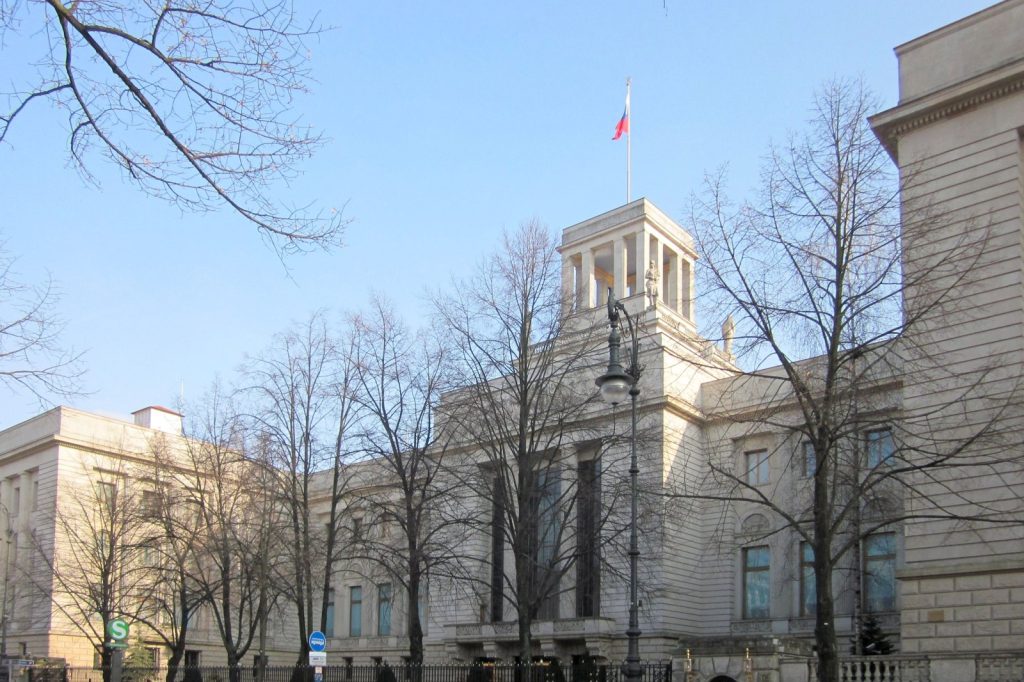
Annalena Baerbock did not hedge. On Monday, 4 April 2022, Germany’s foreign minister said the government had declared a “substantial number” of people tied to the Russian embassy persona non grata. They had been working in Germany every day “against our freedom, against the cohesion of our society,” she said. Forty embassy employees had to go.
Berlin was one capital among many. The Guardian counted 206 Russian diplomats and embassy staff told to leave in the first days of that week by governments including Italy, France and Germany. Add the 100-plus already expelled since Russia invaded Ukraine on 24 February, and the total passed 325. By late April, Business Insider put the number at more than 400 Russian diplomatic staff removed from embassies and missions across Europe since the start of March.
The Bucha trigger
The week’s expulsions were an immediate answer to the killings of civilians in Bucha, north of Kyiv. Ukrainian officials said the bodies of 410 civilians were recovered from towns in the Kyiv area once Russian troops pulled back. The German government called what happened in Bucha war crimes.
Country by country, the numbers varied. Italy said it was expelling 30 diplomats; its foreign minister, Luigi Di Maio, cited “national security reasons.” France sent home 35 and described the move as part of a joint European action. Slovenia named 33, Spain 25, Denmark 15 intelligence officers accused of spying, Estonia 14 consular staff, Portugal 10 and Sweden three. Lithuania expelled the Russian ambassador. Poland had already ordered out 45 on 23 March.
German intelligence sources told the media that those leaving included people judged to pose “a concrete threat” to Ukrainian activists in Germany and to the roughly 307,000 Ukrainian refugees who had arrived since the war began. The same sources said they believed as many as 2,000 suspected Russian spies were operating in the country.
Biggest wave on record, possibly
Business Insider’s analysis called the wave the largest since the Soviet Union collapsed, and perhaps the largest ever. For comparison, European countries expelled nearly 200 Russians after the 2018 attempt on the life of the defector Sergei Skripal in Britain.
What set 2022 apart was the breadth. Twenty-three EU countries took part, along with three European states outside the bloc and the EU itself. Several of them, including Austria, Bulgaria and Germany, had kept decent relations with Moscow. Hungary, which also has them, expelled no one.
Chris Miller, a professor at Tufts University’s Fletcher School, called the expulsions “a long overdue response to Russia’s security services’ activity in Europe.” Governments had left those services a free hand for too long, he said, even as Russian agents were tied to assassinations and attacks “from Berlin to London.” Austria and Hungary, in his words, were “notorious for their open-door attitude.” Belgium and Austria are often seen as hubs for Russian spying, partly because the international organizations in Brussels and Vienna let Moscow accredit more operatives as diplomats.
Moscow did not accept the logic. Deputy foreign minister Alexander Grushko called the expulsions a “pre-coordinated campaign” and promised “retaliatory measures.” Dmitry Medvedev wrote on Telegram that the countries had punished mainly themselves. Russia began sending home diplomats from some Baltic states and from the EU, and later in April its deputy foreign minister said Moscow was still assessing the situation while favoring open diplomatic channels.
Sources
- European Countries Expel Russian Spies Amid Fighting in Ukraine – Business Insider
- EU allies expel 200 Russian diplomats in two days after Bucha killings | Russia | The Guardian




