
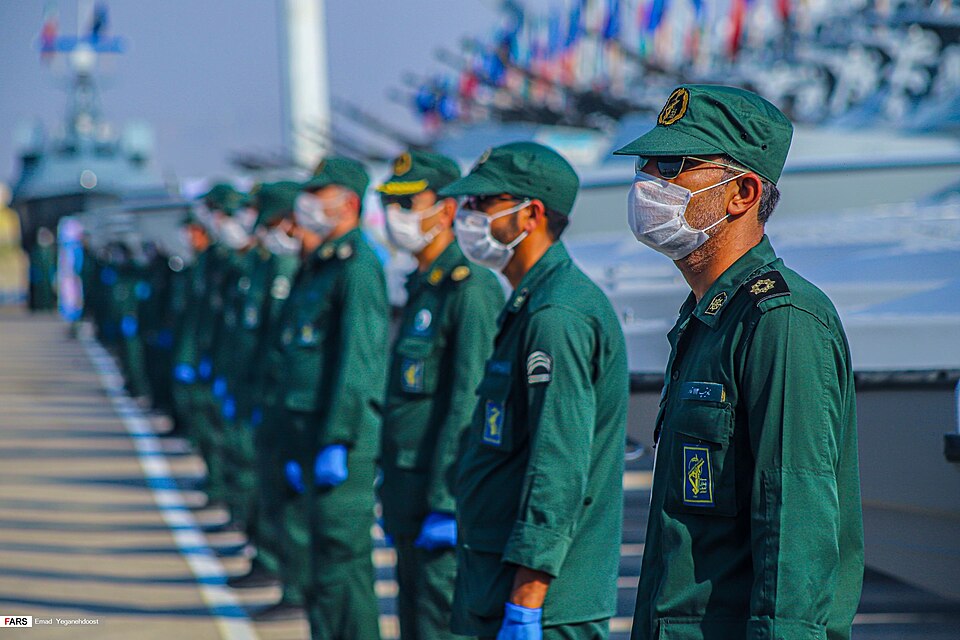
“There is to be no hesitation.” With those words in late April 2026, President Donald Trump told the U.S. Navy to shoot and kill any boat laying mines in the Strait of Hormuz, whether a small fast-attack craft or something larger. The order shows who the Navy expects to meet there: not warships, but the Revolutionary Guards’ swarm of small boats.
A navy built around speed
The Islamic Revolutionary Guard Corps runs its own naval arm, and it has long relied on small, quick craft. Iranian state broadcaster Press TV traces the doctrine to the Tanker War of the mid-1980s. In the first year, the outlet said, Iran answered only one in six attacks on its vessels. By 1987 it had added fast boats and was answering more evenly, and commanders drew the lesson that quick boats cost far less than large, slow warships.
Press TV says the fleet now includes the Ashura class, which can reach 90 knots, the Seraj at up to 65 knots, and the Tondar, armed with C-802 anti-ship missiles with a range of 120 kilometers. In February 2025 the Guards showed off the Heydar-110 at Bandar Abbas, a carbon-fiber catamaran of about 14 meters with two anti-ship cruise missiles and a top speed of 110 knots. Press TV claims it is the fastest combat boat in service. The broadcaster also points to unmanned craft, led by the Ya Mahdi drone boat. Analysts it cited estimate the Guards may hold anywhere from hundreds to thousands of small boats, nicknamed the “mosquito fleet.”
That is Tehran’s account, and it is partisan. Business Insider reported something different about the outcome of the fighting that began on February 28, 2026: Iran’s conventional navy had been sunk, and U.S. forces had destroyed more than 95% of Iran’s naval mines during the Operation Epic Fury bombing campaign. A defense official told the magazine that Tehran probably still placed some mines in or near the strait. American forces were working to clear them with crewed and uncrewed systems, and Iranian gunboats were seen firing at merchant ships in recent days. A ceasefire took hold on April 8, according to Press TV.
The coalitions in the water
The Americans are not alone in the area, and the groupings that patrol it predate the current war. After Iran seized the British-flagged tanker Stena Impero on July 19, 2019, in Omani waters, the United States set up the International Maritime Security Construct, also called Operation Sentinel, in November 2019. War on the Rocks listed its members in 2021 as the United States, the United Kingdom, Albania, Bahrain, Estonia, Lithuania, Saudi Arabia and the United Arab Emirates. Europeans, wary of the Trump administration’s “maximum pressure” policy, launched a separate mission, Operation Agenor, in January 2020 with eight countries: Belgium, Denmark, France, Germany, Greece, Italy, the Netherlands and Portugal. France hosts its headquarters at a naval base in Abu Dhabi.
Both are coalitions of the willing, outside the UN, NATO and the European Union. The authors noted that members would expose an attack on a ship, yet none is obliged to come to the stricken vessel’s aid without approval from home. U.S. surveillance assets supply over 2,000 hours of coverage a month.
Sources
- Trump tells US Navy warships to 'shoot' any Iranian boats laying mines as the mission to clear the Strait of Hormuz ramps up (Business Insider, Jake Epstein)
- Building Maritime Security Coalitions: Lessons Learned from the Strait of Hormuz (Edgar Tam and Pierre Morcos, War on the Rocks)
- Explainer: How Iran's tiny speedboats turned Strait of Hormuz into US Navy no-go zone (Press TV, Yousef Ramazani)




