
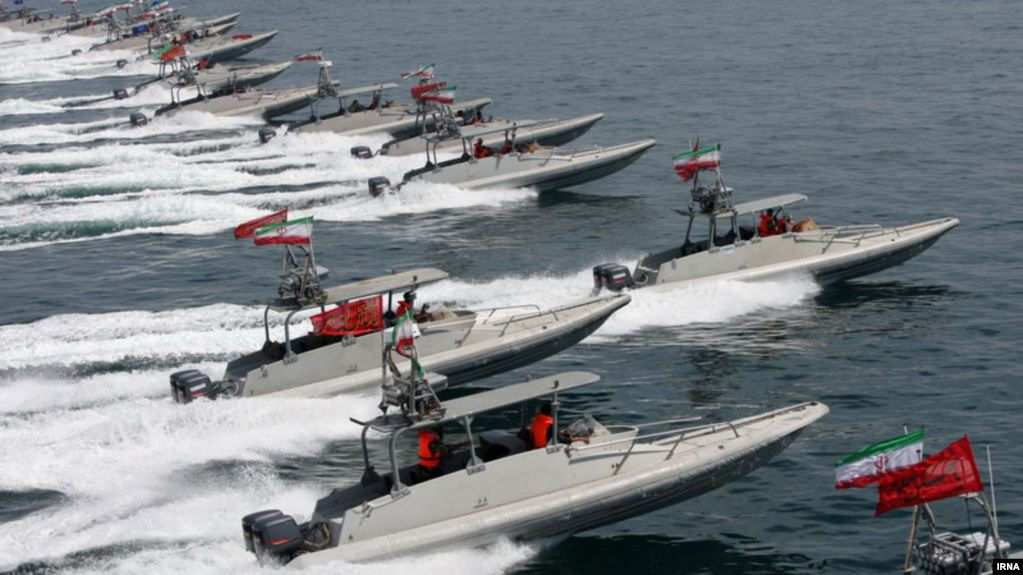
Iran keeps two navies, and only one of them matters in the Strait of Hormuz. The regular Islamic Republic of Iran Navy has frigates, destroyers and submarines for blue-water work in the Gulf of Oman and beyond. The IRGC Navy handles the Persian Gulf, the strait and coastal defense, and according to thehormuzstrait.com it reports to the Supreme Leader rather than the Defense Ministry.
Swarms of small boats
The site estimates the IRGC Navy fields more than 1,500 fast attack craft, armed with rocket launchers, machine guns, torpedoes and anti-ship missiles. They work in swarms of 20 to 50. The theory is arithmetic. A single U.S. destroyer, the site says, can track and engage perhaps 10 to 15 incoming threats at once, so 40 to 60 boats arriving from different directions saturate it. Even if 80% are destroyed, the rest might still cripple a warship. Merchant ships carry no weapons, and for them a swarm of three or four boats is enough.
Press TV pointed to newer hardware as well. On February 27, 2025, the Navy unveiled the Heydar-110 in Bandar Abbas, a carbon-fiber catamaran about 14 meters long that Press TV said tops out at 110 knots and carries two anti-ship cruise missiles. The Ashura class, in service since the 1980s, is credited with 90 knots. The Tondar class carries C-802 missiles with a range of 120 kilometers. The Ya Mahdi drone boat, under 12 meters long, is guided remotely from shore or from other vessels.
Mines and mountain batteries
Iran holds an estimated 2,000 to 5,000 mines, according to thehormuzstrait.com: contact mines, influence mines triggered by a ship’s acoustic or magnetic signature, and bottom mines that are invisible to surface radar. The strait is only 60 to 100 meters deep, which suits mine warfare. The site says Iran laid mines mainly by submarine during the 2026 blockade.
Along the southern coast, the Zagros Mountains give missile crews high firing positions and cover. The Noor anti-ship cruise missile has a 170-kilometer range. The Ghader reaches 300 kilometers, far enough to strike ships in the Gulf of Oman. The Qader is launched from aircraft. The site says these batteries kept meaningful capability even after U.S. and Israeli strikes in early 2026.
Seizures and the cost argument
The Navy has seized dozens of commercial vessels since 2019. The usual method pairs helicopters and boats: armed personnel fast-rope onto the deck while boats close in from both sides, and the crew is ordered at gunpoint toward an Iranian port. The 2026 seizures of the Epaminondas and the MSC Francesca followed that pattern, and more than 800 seafarers were held at the peak of the crisis.
The U.S. Fifth Fleet, based in Manama, Bahrain, has its own counter-measures: rules of engagement that allow it to fire on boats showing hostile intent, mine-countermeasure vessels, convoy escorts for tankers and electronic warfare against IRGC coordination.
The site argues Iran does not need to win a naval fight. Shipping companies suspended operations within days of the first mine detections in 2026, it says, and one detonated mine can push insurance so high that owners will not send ships through. Mines cost hundreds of dollars each, while supertankers cost $100 million or more.
Press TV described the ceasefire that began on April 8, 2026, as fragile, with the boats waiting in sea caves along the Gulf coast.
Sources
- IRGC Navy Tactics Strait of Hormuz: Swarm Warfare, Mines & Missiles
- Explainer: How Iran’s tiny speedboats turned Strait of Hormuz into US Navy no-go zone




