
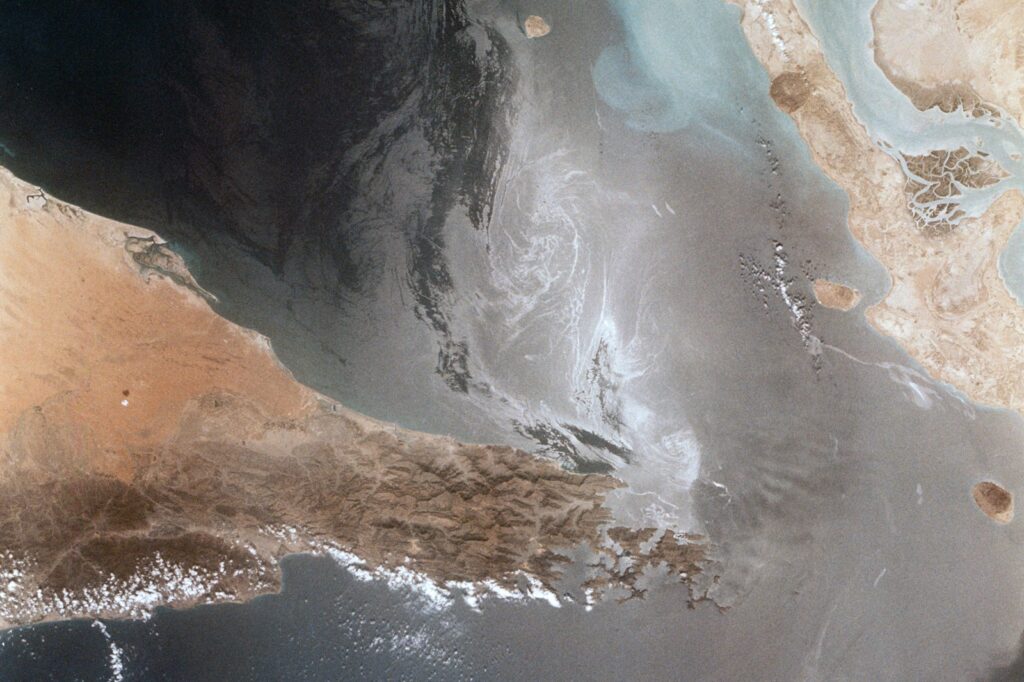
IRGC Escalates Strait of Hormuz Threats Amid U.S. Election Tensions
Iran’s Islamic Revolutionary Guard Corps warned it would sink U.S. warships approaching the Strait of Hormuz as attacks on commercial vessels surged, aiming to influence U.S. midterm elections and disrupt global oil flows.
IRGC Structure and Command
The Islamic Revolutionary Guard Corps consists of five service branches: Ground Forces, Aerospace Force, Navy, Quds Force, and Basij. It is led by a commander-in-chief appointed by and reporting to Iran’s supreme leader. The IRGC has approximately 125,000 personnel as of 2024. The IRGC Navy is Iran’s primary force exercising operational control over the Persian Gulf.
Quds Force and Regional Influence
The Quds Force is responsible for arming, training, advising, and commanding pro-Iranian non-state actors abroad such as Hezbollah and the Houthis. This unit specializes in unconventional warfare, military intelligence and clandestine operations. Through the Quds Force, Iran extends its influence across the Middle East by supporting allied armed groups.
Domestic Political and Economic Power
The IRGC has expanded into economics, politics, and society, described as a ‘business empire’ and ‘industrial empire with political clout’. Originating as a radical ideological militia, the IRGC has taken on a growing role in nearly every aspect of Iranian politics, economics and society. It is designated as a terrorist organization by the United States and over 20 other countries.
Election-Timing Strategy and Risks
On September 29, 2026, the IRGC published an open letter to Americans seeking to influence U.S. political attitudes ahead of the midterm elections. Twelve vessels were attacked between October 5 and 11, 2026, including six on October 8, per UKMTO. Rear Admiral Ali Azmaei of the IRGC Navy warned that Iranian forces would sink U.S. warships approaching the Strait of Hormuz. Oil flows through the Strait of Hormuz fell to 2.9 million barrels per day on October 11, 2026, the lowest monthly level. Iranian officials told Reuters that Tehran changed the pace and type of attacks to influence U.S. midterm elections. The strategy risks provoking a direct military response if Tehran moves beyond commercial shipping to strike American naval assets.
IRGC Navy’s Operational Role in the Persian Gulf
The IRGC Navy serves as Iran’s primary force exercising operational control over the Persian Gulf, functioning as a de facto coast guard in the region. It is responsible for maritime security, patrol operations, and asserting Iran’s presence in strategic waterways including the Strait of Hormuz. This operational mandate allows the IRGC Navy to monitor and respond to vessel movements, particularly those of foreign warships, within Iran’s claimed sphere of influence.
Unlike the conventional Iranian Navy (Artesh), which focuses on traditional naval defense, the IRGC Navy is structured for asymmetric and irregular warfare, emphasizing speedboats, small craft, and coastal missile systems suited to littoral operations. This configuration enables rapid deployment and hit-and-run tactics in confined maritime environments like the Strait of Hormuz, where larger warships face maneuverability constraints.
The IRGC Navy’s posture in the Gulf is closely tied to the broader IRGC mandate of preventing foreign interference and safeguarding the Islamic Republic’s ideological integrity. Its actions, including warnings to sink U.S. warships, are framed as defensive measures to counter perceived threats to national sovereignty and to uphold the IRGC’s constitutional role in deterring external aggression. This dual role as both a maritime security force and an instrument of strategic signaling underscores its significance in Iran’s naval doctrine.
Impact on Global Oil Markets and Energy Security
The surge in attacks on commercial vessels in the Strait of Hormuz has directly disrupted global oil flows, with shipments falling to 2.9 million barrels per day on October 11, 2026—the lowest daily volume recorded that month according to Kpler data. This sharp decline reversed a recent recovery in Persian Gulf oil exports, which had averaged approximately 15.5 million barrels per day in September 2026, their highest level since the war began. The disruption has contributed to volatility in Brent crude prices, which settled at $105.69 per barrel on October 14, 2026, as traders weighed ongoing supply risks against broader market dynamics.
Energy security analysts note that while the United States is less directly dependent on Persian Gulf oil than many Asian economies, disruptions in the Strait still influence global energy prices and affect American consumers through increased gasoline costs. Maritime experts have observed that the current oil flow levels resemble pre-war volumes but are being transported by far fewer ships, increasing the vulnerability of each vessel to attack. This dynamic has heightened concerns about the sustainability of energy supplies amid escalating tensions in the region.
IRGC’s Constitutional Mandate and Strategic Doctrine
The Islamic Revolutionary Guard Corps’ constitutional mandate is to ensure the integrity of the Islamic Republic by preventing foreign interference, thwarting coups by the traditional military, and suppressing ideological deviations. This mandate distinguishes the IRGC from the Artesh, which focuses on defending national sovereignty through conventional means. The IRGC’s role is thus framed as both a military and ideological safeguard of the revolution.
This doctrinal foundation underpins the IRGC’s asymmetric naval posture in the Persian Gulf, where its Navy operates as a de facto coast guard while preparing for hit-and-run tactics using speedboats and coastal missile systems. The IRGC justifies actions such as warnings to sink U.S. warships as defensive measures aligned with its constitutional duty to deter external aggression and protect the Islamic Republic’s ideological legacy.
Quds Force and Proxies in Regional Influence
The Quds Force extends Iran’s regional influence by arming, training, advising, and commanding pro-Iranian non-state actors abroad, including Hezbollah in Lebanon and the Houthis in Yemen. This unit specializes in unconventional warfare, military intelligence, and clandestine operations to project power without direct Iranian military engagement. Through these proxies, Iran has established a network of allied groups that carry out attacks and political influence campaigns across the Middle East.
These proxy forces enable Iran to exert pressure on adversaries while maintaining plausible deniability, particularly in conflicts involving Israel, Saudi Arabia, and U.S. interests. The Quds Force provides strategic guidance and weapons systems that allow groups like the Houthis to target maritime traffic in the Red Sea and Gulf of Aden, indirectly affecting global trade routes. This asymmetric approach complements the IRGC’s naval activities in the Strait of Hormuz by creating multiple fronts of pressure.
By leveraging the Quds Force’s capabilities, Iran can respond to regional developments and international pressure through indirect means, such as enabling drone and missile strikes by allied groups. This method of influence has been used to retaliate against perceived threats and to advance Iran’s strategic objectives in Iraq, Syria, and beyond. The Quds Force remains central to Iran’s doctrine of exporting the Islamic Revolution and countering regional rivals through allied non-state actors.
Sources
- Islamic Revolutionary Guard Corps
- Letter to Americans from Iran's IRGC Explained
- Tehran signals escalation in conflict IRGC likens to a ‘world war’
Photo: NASA (Public domain)




