
At 7:30 p.m. local time on July 19, 2019, “small crafts and a helicopter” closed on the British tanker Stena Impero near Larak Island. Within hours Iran’s Revolutionary Guard Corps announced it had seized the ship for “failing to respect international maritime rules.” The owner, Stena Bulk, could not reach the vessel. Twenty-three crew members were aboard.
The seizure showed what the Guard’s naval wing is built to do.
A force born of revolution
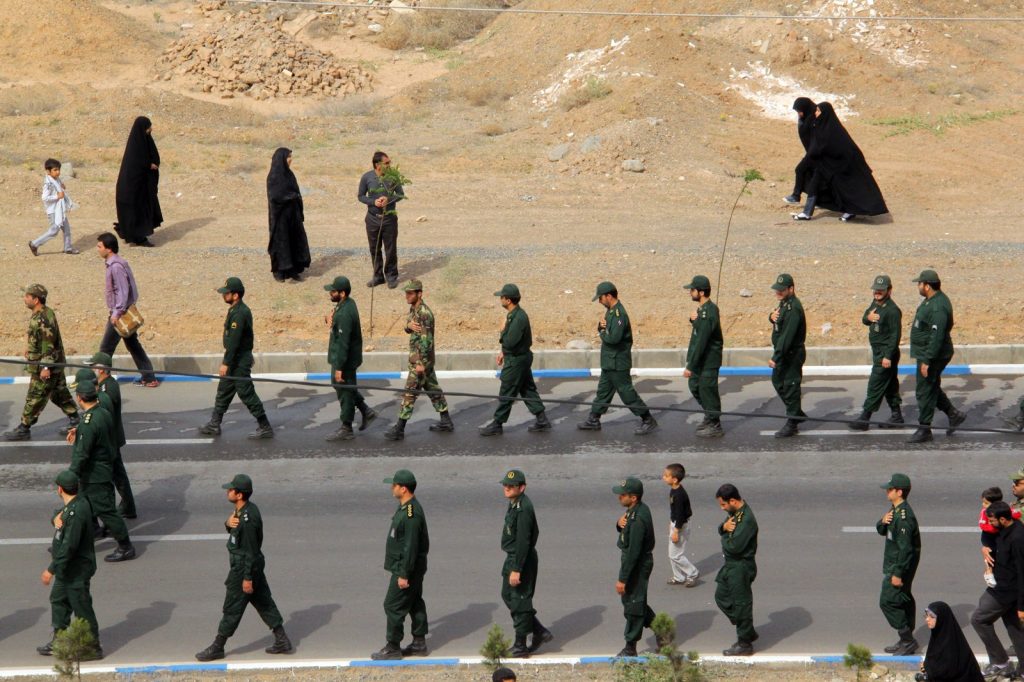
The Islamic Revolutionary Guard Corps is a paramilitary organization formed after Iran’s 1979 Islamic Revolution to defend the clerically overseen government. It answers only to the supreme leader and operates independently of the regular military. PBS NewsHour also noted its vast economic interests across the country.
Washington took notice. On April 8, 2019, President Donald Trump announced the designation of the Guard as a “foreign terrorist organization,” the first time the United States had applied that label to part of another government. The designation froze any Guard assets in U.S. jurisdictions and banned Americans from doing business with it. Trump said the step recognized that the IRGC “actively participates in, finances, and promotes terrorism as a tool of statecraft.”
The fleet that watches the strait
The Guard’s navy, the IRGCN, is not a blue-water fleet. Baird Maritime, citing U.S. Navy analysts in May 2019, described “hundreds of heavily armed small fast attack craft,” including Iranian variants of North Korean Pekyaap-class torpedo boats and Seraj-1 vessels able to exceed 60 knots. Their weapons run from cannons, machine guns and unguided rockets to torpedoes and anti-shipping cruise missiles.
The IRGCN is responsible for controlling the Strait of Hormuz and for defending Iran against seaborne invasion. Its doctrine is the swarm: “using huge numbers of small armed craft, intended to overwhelm the defences of even the most sophisticated of enemy warships.” The approach accepts heavy losses of men and boats.
Tit for tat in the Gulf
The Stena Impero seizure followed Britain’s capture of an Iranian supertanker off Gibraltar on suspicion of violating Syria sanctions. A second ship, the Liberian-flagged Mesdar, was briefly detained that night and then released after being told to comply with environmental rules.
British Foreign Secretary Jeremy Hunt called the seizures “unacceptable.” Security analyst Richard Weitz saw a “reciprocal action,” the “latest in a series of these subconventional forms of provocative moves.”
Sources
- US Navy Braces for Possible Attacks by Iranian Small Craft (Baird Maritime)
- Iran seizes British oil tanker in Strait of Hormuz (Al Jazeera)
- U.S. Declares Iran's Guard Force a 'Terrorist Organization' (PBS NewsHour)




