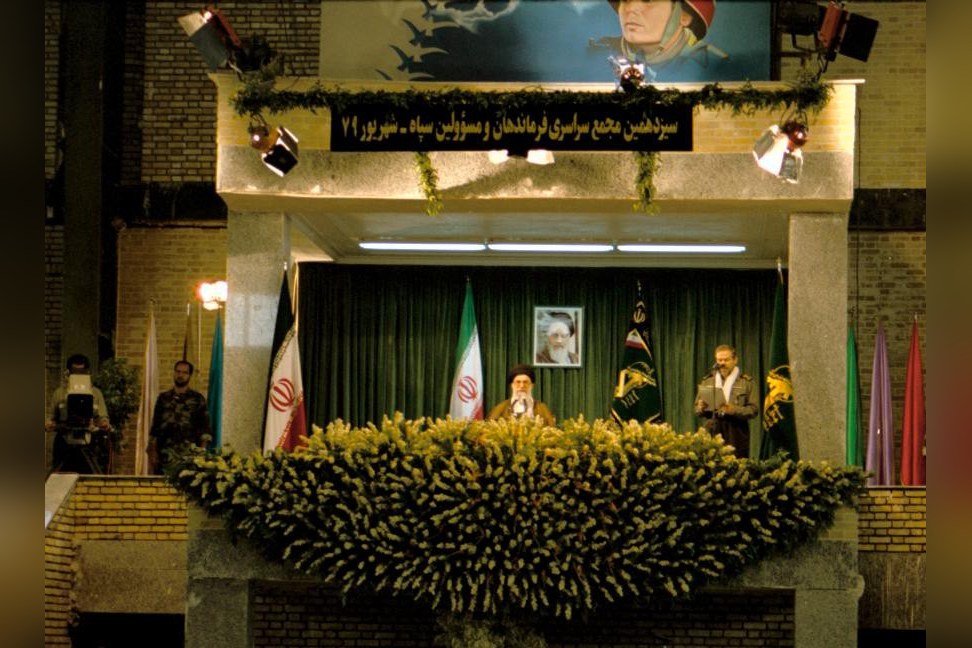
On the day the new Tehran airport was due to open in 2004, guardsmen drove vehicles onto the runways and shut it down. The contract had gone to a Turkish-Austrian consortium. The Revolutionary Guards said foreign involvement was a security risk; the Guardian’s reading was that the consortium’s real mistake was trying to do business without them. The Guards ended up running the airport.
That story explains the Islamic Revolutionary Guard Corps better than an organization chart does. In plain terms, it is an army, a political machine and a business empire in one.
Built as a counterweight
Iran’s clerical leaders created the IRGC after the 1979 revolution, outside the regular armed services they distrusted. The Council on Foreign Relations says it answers to the supreme leader, and its command structure bypasses the elected president. Ayatollah Khomeini wanted a force that could guard the new regime against a repeat of the 1953 coup.
The Iran-Iraq War, which ran 1980–88, turned it into something closer to a conventional military. The IISS, a London think tank, counts upward of 190,000 troops, around half of them conscripts. Its ground forces number more than 150,000. The Basij paramilitary claims it can call up six hundred thousand volunteers. Its own navy, with twenty thousand sailors, patrols waters that include the Strait of Hormuz, a chokepoint for roughly one-third of the world’s crude oil moving by sea each year. Its air arm, fifteen thousand strong, runs the ballistic missile program.
Reaching abroad
The Quds Force is the IRGC’s external arm. It trains, arms and funds groups in Iraq, Lebanon, Syria and Yemen, among other places, which Tehran treats as an anti-Western “axis of resistance”. In Yemen, CFR says, the corps channeled intelligence, training and weapons to the Houthis. In January 2020 a U.S. drone strike killed Qasem Soleimani, the Quds Force commander who had built many of those partnerships.
Washington answered by branding the whole corps. On April 8, 2019, President Trump designated the IRGC a foreign terrorist organization. A U.S. diplomat in Baghdad then put the choice to Iraqis: deal with the IRGC or with the American financial system, “but they cannot do both at the same time”.
A company with guns
The business side began after the Iran-Iraq War, when President Rafsanjani encouraged the corps to rebuild the country through construction. Ali Ansari, an Iran specialist at St Andrews University, told the Guardian: “The IRGC is really a corporation. It is a business conglomerate with guns.”
The Guardian reported in 2010 that Western estimates of its weight in the economy were wide, anywhere between a third and nearly two-thirds of GDP. Its construction arm, Khatam al-Anbiya, controlled more than 812 registered companies and had received 1,700 government contracts. One was a $1.3bn gas pipeline of nearly 560 miles. Another was a $2.5bn job on South Pars infrastructure. A consortium linked to the Guards bought a 51% share of the telecoms business for $5bn.
The money pays for weapons, covert work abroad and the nuclear program, CFR says, and also supports veterans and the families of those killed. The corps has also done well from sanctions. Cut off from legal finance, Iranian businesses leave more room for its black-market trade, and CFR says the IRGC has moved smuggled oil, mostly to China.
Politics and public anger
Former commanders sit in cabinet, parliament and the provinces. In 2007 the Basij was placed under direct IRGC command. In June 2009 the corps allegedly rigged the presidential vote for Ahmadinejad, and human rights groups documented Basij attacks on protesters afterward.
It is not popular. In January 2020 it shot down a passenger plane by mistake, with all 176 people aboard dying. And CFR reports that its role in suppressing mass protests in early 2026 led the European Union to list it as a terrorist organization.
Sources
- The Islamic Revolutionary Guard Corps (IRGC) (Council on Foreign Relations backgrounder)
- The financial power of the Revolutionary Guards (The Guardian)
- US sticks Iraq in middle by calling Iran's IRGC terrorists (Al-Monitor)