
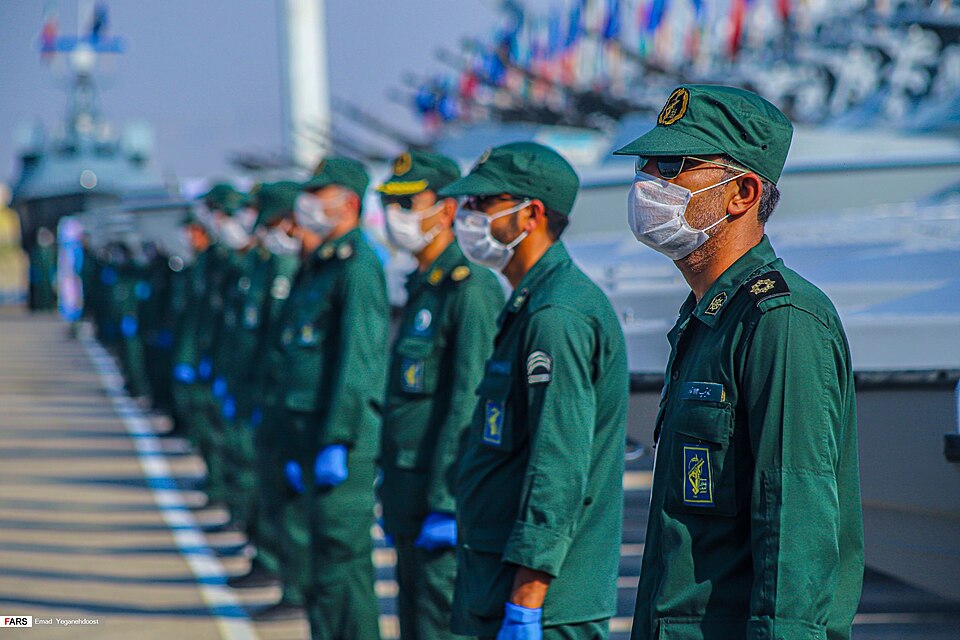
Rear Admiral Alireza Tangsiri was named head of the Islamic Revolutionary Guard Corps Navy in August 2018. By late March 2026, Israel and US Central Command were saying an Israeli operation had killed him. Tehran had not confirmed it, according to Asharq Al-Awsat, which cited Israeli media reports of a strike on Bandar Abbas.
The record of his tenure is the clearest way into what the force is.
A navy built for tight water
The IRGC Navy sits beside Iran’s regular navy and has a different job. It dates to 1985, and instead of crossing oceans it was built for cramped waters, where shipping lanes, oil and gas flows, islands and foreign warships all converge. Its tools are asymmetric: swarms of small fast boats, shore-based missiles, mines and commando teams stationed on key islands and passages.
Tangsiri fit that mold. He was born in 1962 in Bushehr province and joined the Guards during the Iran-Iraq war, learning his trade in coastal and river units rather than at a naval academy. Early commands put him at Bandar Abbas, by Hormuz. From 2010 until his promotion he was number two to Ali Fadavi. The promotion arrived as Washington, under Donald Trump, tightened sanctions after leaving the 2015 nuclear deal.
Islands as a line of defence
Under Tangsiri the Guards pushed their hold over the islands of Abu Musa and the Greater and Lesser Tunbs, building new bases and a military airstrip. A CP24 report built on CNN’s coverage described seven islands, including those three, as an “arch defence” around the strait. The researchers argued that ships must squeeze past the three in shallow water, which turns tankers and warships into easy targets for IRGC fast boats, minelayers or drones launched from the rocks.
Iranian officials call the islands “stationary and unsinkable aircraft carriers.” Tangsiri put the doctrine in his own words: “Our tactical approach dictates that we must arm and operationalize this group of islands. We have the capability to strike enemy bases, warships, and assets in the region.”
From deterrence to control
He was a fixture in the news from 2019, as US sanctions bit and encounters at sea multiplied. He was himself placed under US sanctions. He kept warning that Iran could close Hormuz if its oil exports were targeted, and spoke of swarms of fast boats and even suicide-style tactics. Under him, foreign ships and their crews were stopped or held in Gulf waters.
Over time the message changed. He said every vessel crossing the strait should give detailed information, and suggested it do so in Persian. Iran also showed off underground naval facilities and long-range strike capabilities.
The June 2025 war gave the navy no central combat role, Asharq Al-Awsat noted; the sea stayed a latent lever of pressure. That changed with the conflict that began on February 28, 2026, in which he emerged as one of the most visible Iranian field commanders before the reports of his death.
Sources
- Alireza Tangsiri: The Supreme Leader's Man in the Shipping Lanes (Asharq Al-Awsat)
- Iran war: Some islands hold the keys to Strait of Hormuz (CP24/CNN)




