
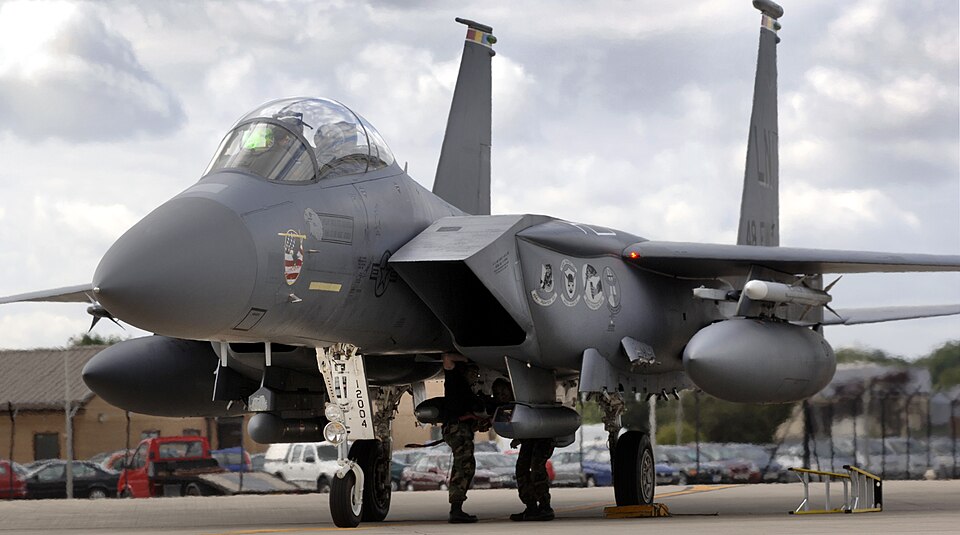
US F-15E Shot Down Over Iran Triggers Search and Diplomatic Reaction
On April 3, 2026, Iranian forces shot down a United States F-15E fighter jet while it was flying inside Iranian airspace. The downing prompted an immediate search and rescue effort for the two aircrew members aboard the aircraft.
According to U.S. officials, the pilot has been recovered safely, while operations continue to locate the second crew member. The incident has heightened tensions between Washington and Tehran.
Iran’s state-run media announced a monetary reward for any Iranian citizen who assists in capturing an American pilot, a move that has drawn further criticism from the United States and its partners.
The Islamic Republic of Iran Armed Forces, which includes the regular army, the Islamic Revolutionary Guard Corps and the Police Command, numbers about 920,000 personnel in total. Of this total, roughly 570,000 serve on active duty and another 350,000 are reserve or trained forces. The Islamic Revolutionary Guard Corps was formed in May 1979 and is charged with protecting the ideological foundations of the Islamic Republic and defending the nation against what it describes as pro‑American, pro‑Western threats.
U.S. Secretary of Defense Lloyd Austin said the Department of Defense is working to establish exactly how the F-15E was brought down and to make sure the missing crew member is returned safely.
NATO Secretary General Jens Stoltenberg voiced concern over the shoot‑down and urged all sides to exercise restraint. The AUKUS partnership of Australia, the United Kingdom and the United States released a joint statement condemning Iran’s action and reaffirming the allies’ commitment to maintaining security in the region.
The Quad grouping — comprising the United States, Australia, India and Japan — is expected to address the incident and its implications for regional stability at a forthcoming meeting of its leaders.
Iranian state media reported that the country’s armed forces have been placed on a heightened state of alert. President Ebrahim Raisi characterized the downing of the F-15E as proof of Iran’s military capability and its resolve to defend national sovereignty.
The United States Department of State issued a travel advisory warning American citizens against visiting Iran, citing an increased risk of detention and harassment.
General Michael Kurilla, the commander of U.S. Central Command, said American forces will continue to operate in the area to protect U.S. and allied interests while also seeking ways to lower tensions with Iran.
Observers warn that the shoot‑down could further destabilize an already volatile region and raise the prospect of a broader confrontation between the United States and Iran.
Senator Jim Inhofe, the ranking Republican on the Senate Armed Services Committee, called for a firm response, arguing that the United States must not let Iran’s aggressive conduct go unanswered.
The United Nations Security Council is anticipated to convene an emergency session to discuss the incident and its effect on regional peace, with the U.S. ambassador to the United Nations expected to play a central role in the deliberations.
Members of the international community have urged calm and restraint. The European Union’s High Representative for Foreign Affairs and Security Policy, Josep Borrell, appealed to all parties to avoid escalation and stressed that Iran must respect international law and the sovereignty of other states.




