
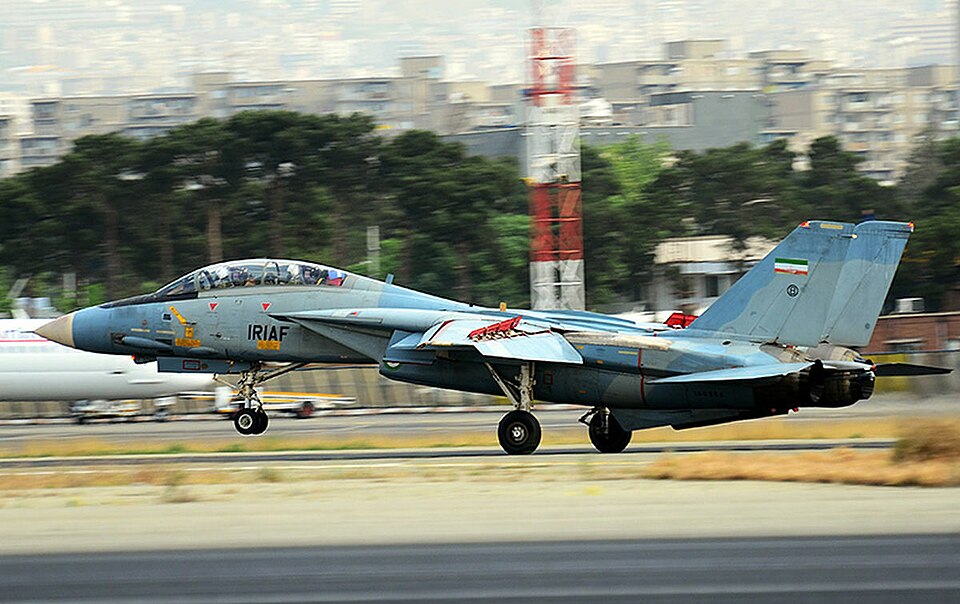
Five Tomcats sat on the ramps and taxiways of Iran’s 8th Tactical Air Base in Isfahan on 22 February 2026. Satellite images taken by Vantor on 9 March, after a round of Israeli strikes, showed what was left.
At least two of them, and more likely three, had been destroyed on the ground. One on the alert pad was hit. So was one beside the hangars, and a huge scorch mark marked the spot on the taxiway where a third had stood. The other two jets seemed to have been moved in the intervening weeks, and nobody outside Iran can say what became of them. At least 10 other aircraft, which Vantor judged to be Chinese-made F-7 fighters, lay wrecked along the taxiways.
What is actually known
The Israel Defense Forces said on 8 March that it had gone after F-14s at Isfahan, the home base of Iran’s Tomcat fleet. No imagery of those strikes has been released, and The War Zone noted that IDF videos of F-14s being hit that circulated online all looked old.
So the claim that Iran’s whole F-14 fleet is gone goes further than the evidence. NPR reported on 24 March that it was unclear whether the last Iranian Tomcats had been destroyed. Tom Cooper, an analyst of Middle East air forces, is skeptical, saying that some of what Israel has shown is “absolutely 100% wooden decoys.” He puts the number that were operational when the war began at about 10. Estimates elsewhere ranged from a handful to maybe as many as 25.
A jet that outlived its owner
Here is why people care about an old fighter. The Shah’s Iran took delivery of 79 F-14s in the 1970s, along with a maintenance package, 10 years of spare parts, the Phoenix missile system and training for Iranian pilots. Then the 1979 revolution cut the supply line. Iran was left as the only country still flying the type once the US Navy retired it in 2006.
Keeping the jets in the air meant cannibalizing airframes. Think of a garage that keeps one car running by stripping three others. During the war with Iraq that began in September 1980, Iran kept “20 to 30 operational” Tomcats and turned many of the rest into “hangar queens,” in the words of Farzin Nadimi of the Washington Institute. Some estimates credit Iranian F-14s with downing more than 160 Iraqi aircraft. Tehran also launched a “self-suffiency jihad” to reverse-engineer parts, and the effort helped spur its ballistic missile and drone programs. The smuggling of spare parts became a long-running problem for Washington.
Ward Carroll, a retired US Navy commander who flew the F-14 for much of the 1980s and 1990s, compares it to “a muscle car.” He thinks the footage may show the end of the last operational Tomcats anywhere. He told NPR he understood the tactical necessity, but felt “sadness at their demise.” He also admits the loss would be mostly symbolic. Against an F-18 or F-35, he says, “a Tomcat would have no chance.”
Israeli strike footage from the 12 Day War in 2025 had already shown at least five Tomcats being hit.
Sources
- Iranian F-14 Tomcats Meet Their Doom In Israeli Airstrikes
- Airstrikes may have destroyed Iran's last F-14s, ending a long, strange saga




