
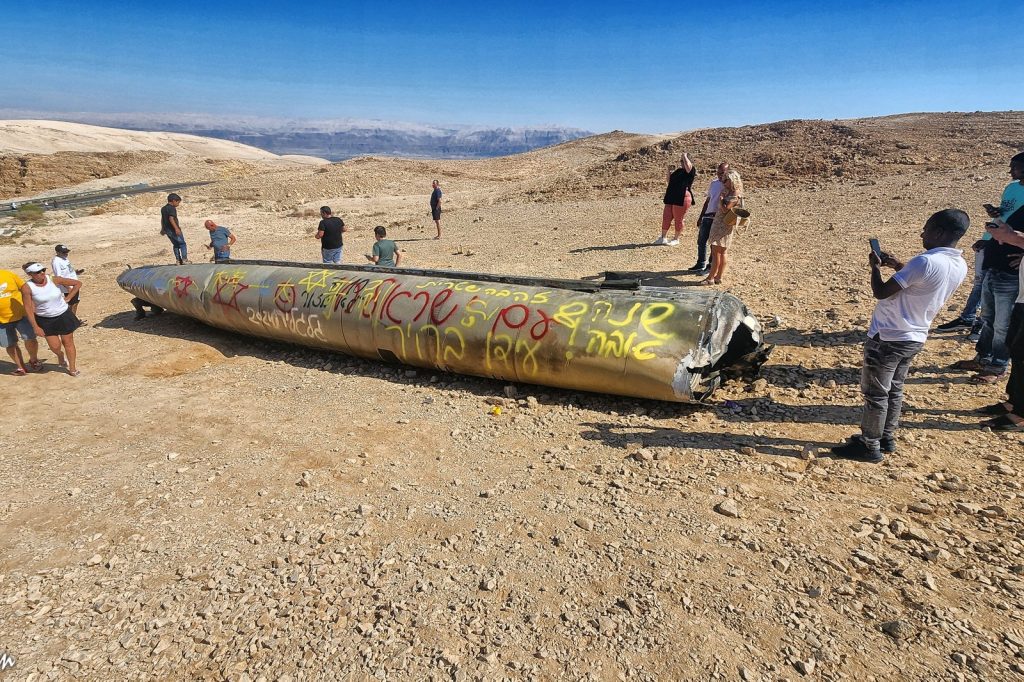
Air raid sirens went off across Israel at around 19:30 local time on Tuesday, and within minutes the explosions of intercepted missiles were rolling over Jerusalem. Millions of people ran for shelters. Israel said Iran had fired more than 180 missiles. Iranian state TV put the figure at 200 and said some were hypersonic.
About an hour later, the Israel Defense Forces told people they could come out of their protected spaces, saying they no longer saw any further aerial threats from Iran.
What got through
IDF spokesman Rear Admiral Daniel Hagari said “a small number of hits” landed in central Israel, with others in the south. The majority of the missiles, he said, were stopped by Israel and a defensive coalition led by the United States. The Pentagon’s Major General Patrick Ryder said two American destroyers fired about a dozen interceptors. He added that the barrage involved about twice as many ballistic missiles as Iran’s attack earlier this year.
US National Security Adviser Jake Sullivan said he knew of no damage to aircraft or strategic military assets in Israel. “Based on what we know at this point, this attack appears to have been defeated and ineffective,” he said, while also calling it a significant escalation and promising “severe consequences”.
The one death reported came from falling debris. A man was killed in Jericho, in the occupied West Bank, Palestinian officials said. Separately, Israeli police reported at least six people killed and nine wounded in a shooting and stabbing attack at a light rail station in Tel Aviv. The two attackers were killed by civilians and inspectors with their own firearms, and nobody has claimed responsibility.
Tehran’s stated reasons
Iran’s Islamic Revolutionary Guard Corps said the strikes answered the killings of Hamas political leader Ismail Haniyeh and Hezbollah leader Hassan Nasrallah. Haniyeh died in an explosion in Tehran in July, which Iranian officials blamed on Israel; Israeli officials did not claim it. Nasrallah and Brig-Gen Abbas Nilforoushan, operations commander of the Quds Force, the IRGC’s overseas arm, died in an Israeli air strike on the southern suburbs of Beirut on Friday.
The IRGC described the barrage as being “in line with the legitimate right of the nation to defend itself”. It said it had hit “sensitive security and military” centres, and later state media claimed hits on the Nevatim, Hazterim and Tel Nof air bases. The IRGC warned that any Israeli retaliation would meet a response “more crushing and ruinous”. On Wednesday, Iran’s chief of staff, Maj Gen Mohammad Bagheri, told state TV that the barrage “will be repeated with bigger intensity and all infrastructure of the regime will be targeted”.
In Iran, crowds celebrated. State television showed people in Mashhad waving the yellow Hezbollah flag and portraits of Nasrallah, and similar scenes took place in Tehran and other cities.
Israel and Washington respond
Prime Minister Benjamin Netanyahu said Iran had made a “big mistake” and “will pay for it”. “Whoever attacks us, we attack them,” he said. Hagari said Israel would respond “wherever, whenever, and however we choose”.
President Joe Biden said a response was “in active discussion right now” with Netanyahu, adding that the attack appeared to be “defeated and ineffective”. Vice President Kamala Harris called Iran a “destabilizing, dangerous force in the Middle East”. Secretary of State Antony Blinken called the attack “totally unacceptable”.
UN Secretary-General Antonio Guterres condemned the “broadening conflict in the Middle East”. “This must stop. We absolutely need a cease-fire,” he said. EU foreign policy chief Josep Borrell condemned Iran’s attack “in the strongest terms”. The UN Security Council scheduled an emergency meeting for October 2.
The missiles came hours after Israeli troops began what the military called a “limited” ground incursion in southern Lebanon, and Israel resumed air strikes on Beirut’s southern suburbs within hours of the barrage. In April, Iran fired more than 300 drones and missiles at Israel after a strike on its consulate in Damascus; almost all were shot down, and Israel answered with a missile that hit an Iranian air base.
Sources
- Iran launches more than 180 ballistic missiles at Israel
- Israel Vows To Retaliate As Iran Launches Massive Missile Attack




