
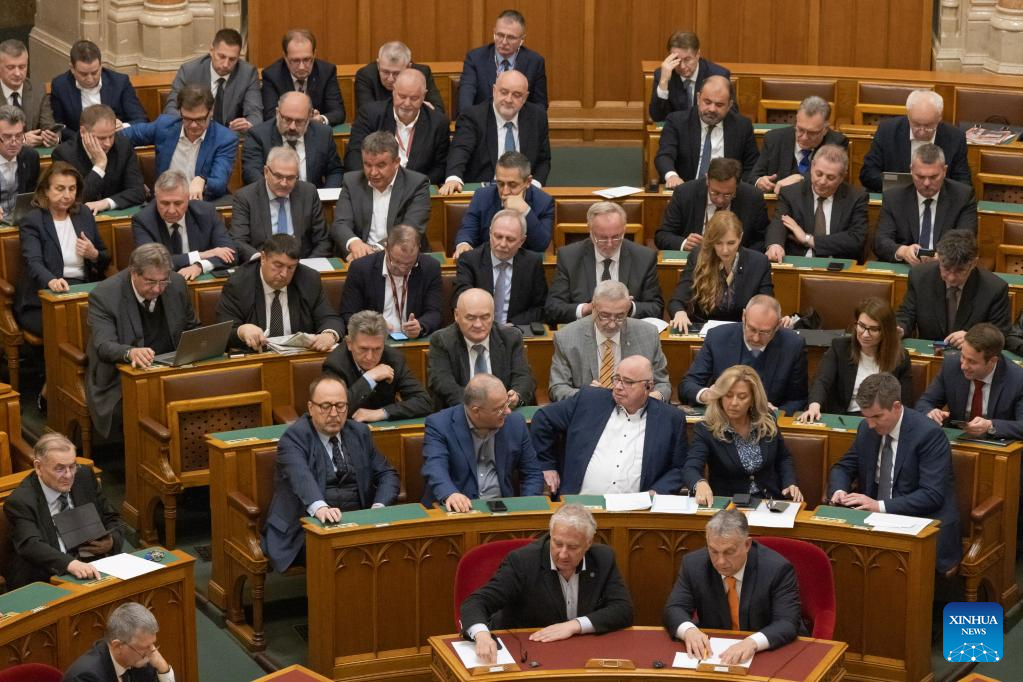
Hungary’s president has been voted out of office with a single sentence. The constitutional amendment parliament passed on Monday evening says: “On the day following the entry into force of this constitutional amendment, the mandate of the President shall terminate.”
That leaves Tamás Sulyok with two ways out. He can sign his own dismissal within five days, or he can wait to be impeached. Prime Minister Péter Magyar is likely to come out ahead either way.
A campaign promise kept at speed
Before the April 12 general election, Magyar said he would remove the people his predecessor Viktor Orban had installed. The president, the chief prosecutor and the president of the Supreme Court were all on the list. Each is seen as an Orban loyalist who could stall a new government, particularly one elected by a thin margin.
The margin was not thin. Magyar’s Tisza party won by a landslide, and it now has enough seats to change the constitution and the cardinal laws, the same power Fidesz used through its 16 years in government.
Amnesty International Hungary has criticised the method, which drew some unexpected praise from Fidesz. “We agree with the goal. We also believe that President Sulyok is unworthy of the office,” Aron Demeter, the group’s communications director, told BIRN. “But it also matters how he is removed from office.” He called the one-sentence approach “not elegant” but legal, and warned: “If we want to break with the methods used during the Orban regime, the new government should not fall into the trap of using the same methods.”
Who Sulyok is
Parliament elected Sulyok about two and a half years ago. His predecessor, Katalin Novak, had been forced to resign over a presidential pardon tied to a paedophile scandal at a children’s home, a case that shook even loyal Fidesz voters. Orban reached for the then-president of the Constitutional Court.
Sulyok was little known to the public and kept a low profile in office. His most memorable image may be a video meant to show his human side, in which he irons his own shirts. He did not criticise the government when Orban called his critics “stinkbugs”, when it threatened civil society groups and independent media with a Russian-style “foreign agents” law, or when Orban attacked Brussels and Ukraine.
He did find words for Orban’s 62nd birthday, though. On Facebook on May 31, 2025, he wrote: “Some say that it is difficult to find balance on the waves of politics. Yet you have not only maintained your balance, but built a ship, shown the way, and, when necessary, taken up the oar yourself.”
Zsuzsanna Szelenyi of the CEU Democracy Institute told BIRN the removal was a Tisza promise and that most of the public expects it. “His removal is part of the dismantling of Orban’s illiberal system,” she said. She does not expect a quick end, though. In her view Sulyok will use every legal avenue to contest his dismissal and will raise rule-of-law concerns he never voiced under Fidesz, and he only began to worry about a two-thirds majority once Tisza held one.
Fidesz, she said, will argue that Tisza is building an undemocratic system. Her reply: “A credible regime change would not be possible without replacing them all.”
Fidesz boycotts, then loses its leader of the group
Fidesz and its satellite, the Christian Democrats, now hold only 52 of the 199 seats. They boycotted the session and called the amendment unprecedented in Europe. They also objected to a 12-year limit for MPs, applied retroactively, which would stop two-thirds of the Fidesz group from standing again in four years.
The same day, parliamentary group leader Gergely Gulyas, who was Orban’s chief of staff in government and once a close friend of Magyar, announced he was stepping down. Orban was boarding a flight to the US for the FIFA World Cup semifinals and final. “Viktor Orban has abandoned his own community, Gergely Gulyas has left the sinking ship and resigned. The bubble has really burst now. It is over,” Magyar wrote on Facebook.
Demeter sees the next test in the choice of Sulyok’s successor, who would serve on an interim basis until a new constitution is written. The new constitution is expected to introduce direct election of the president, as in Poland, Austria and Czechia.




