
At least 13 people died when a missile hit Riyadh’s international airport on 10 October, the deadliest attack in Saudi Arabia in more than a decade. The Houthis fired it. Within days, the Gulf’s rival capitals were quietly talking to each other again.
Sources in Yemen say the United Arab Emirates has agreed to resume payments to some government forces fighting the Houthis in the south. In return, Saudi Arabia will provide air cover for them. It is the first tangible sign that the rift between Abu Dhabi and Riyadh over Yemen’s future may be mending, if only because the Houthi advance has alarmed every Gulf ruler.
The UAE had walked away in January and cut off funding to the southern forces it once trained, among them the Giant Brigades, regarded as some of the most effective in the loose anti-Houthi coalition.
From summer camps to insurgency
The record on the Houthis begins in the 1990s in Saada, in Yemen’s north. Officially they are Ansar Allah, a Zaydi revivalist and Shia Islamist movement named after founder Hussein al-Houthi. Its earliest form was a youth organisation running school clubs and summer camps. Between 15,000 and 20,000 students had attended those camps by 1994 and 1995.
Its enemy was the government of President Ali Abdullah Saleh, which the Houthis accused of corruption and of leaning on Saudi Arabia and the United States. In 2003, influenced by Hezbollah, they adopted their official slogan against the US, Israel and the Jewish people. Authorities noticed. One account of the period has security officials fearing that if the Houthis chanted “Death to America” today, they might chant “Death to the president” tomorrow.
In 2004 Saleh sent forces to arrest Hussein al-Houthi. He launched an insurgency and was killed on 10 September that year. His brother, Abdul-Malik al-Houthi, has led the movement since. Fighting continued on and off until a ceasefire in 2010, and the Saudis, who joined the campaigns, did not come out of it well.
Sanaa and after
The Houthis took part in the 2011 revolution and the National Dialogue Conference, then rejected the Gulf Cooperation Council deal that November, saying it divided Yemen into poor and wealthy regions. Three years later they made peace with Saleh, their old enemy, and with his help took Sanaa. The government went into exile. A Saudi-led coalition intervened in 2015.
It did not dislodge them. Years of air strikes and ground fighting left the Houthis holding between one-quarter and one-third of Yemen’s territory, home to about three-quarters of its people. The UN has linked the movement to abuses including the use of child soldiers and attacks on civilians. The war has reportedly killed more than 150,000, and over 22 million people need aid.
UN experts estimated the Houthis had recruited up to 350,000 fighters by 2024. A UN panel that year concluded that material, help and training from Iran’s Revolutionary Guards, Hezbollah and Iraqi specialists had turned them into a powerful military force. Iran denies arming them and says its support is political.
The Red Sea and the Saudi front
After the Gaza war began in October 2023, the Houthis fired missiles at Israel and attacked ships in the Red Sea, saying they acted for the Palestinians. They resumed those attacks in February 2026 after US and Israeli strikes on Iran. This July, the informal truce with Riyadh unravelled. The Houthis declared a “maritime embargo” on Saudi Arabia and began hitting its airports, oil facilities and tankers.
September brought a rapid advance. The Houthis captured as much as 130km of Yemen’s south-western coastline, including the port of Mokha and the island of Perim, and with it significant control of the Bab al-Mandab Strait. Oil prices rose further. In October the Yemeni government announced a new offensive. Pro-government forces say they have regained ground overlooking the strait with the help of heavy Saudi bombing; the Houthis deny losing territory there.
The offensive against Sanaa has so far met with limited success around Majzar, near Marib. On Friday, two Houthi missiles struck Aden’s airport as a passenger plane was preparing to take off, landing about 500 metres from the Yemenia Airways aircraft. Nobody was hurt, Information Minister Moammar Al-Eryani said. A day earlier, a Houthi attack on a presidential palace in Aden killed at least five people and injured 16.
Egypt’s president, Abdel Fatah al-Sisi, is convening an emergency session of parliament to authorise defensive action for Saudi Arabia. The UK has sent an RAF Voyager refuelling aircraft, and a Saudi request for more is under discussion. More than 200,000 people have been newly displaced, according to the UN. The Houthis, for their part, remain set on taking Taiz and Marib, the last two cities outside the old borders of South Yemen.
Sources
- UAE agrees with Saudi Arabia to re-enter Yemen conflict amid Houthi gains
- Houthis
- Who are the Houthis in Yemen and what do they want?
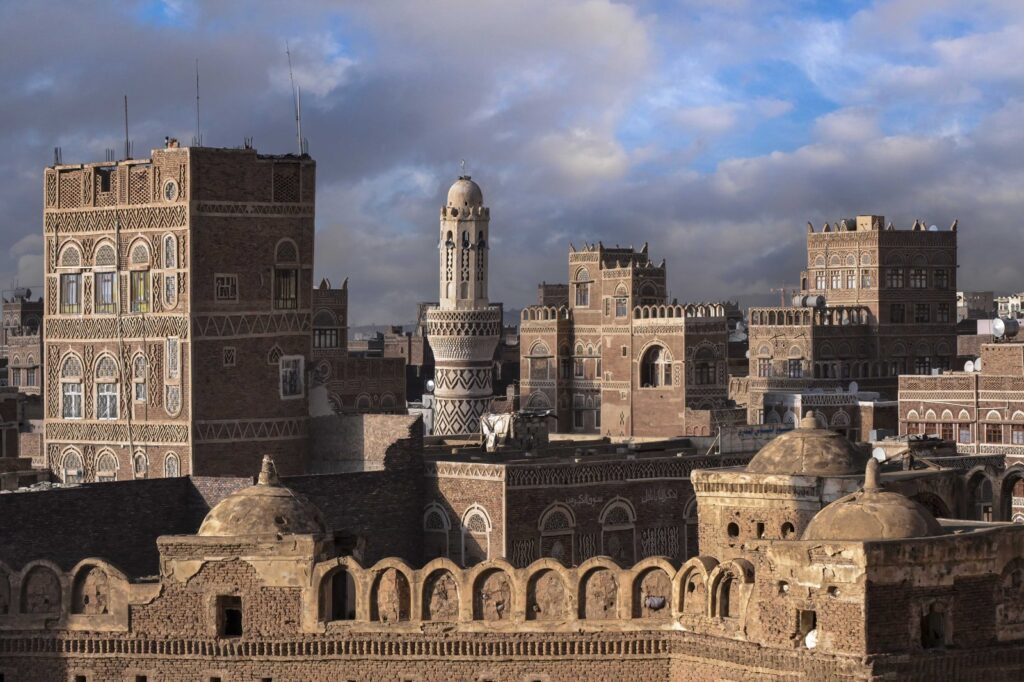
Photo: Rod Waddington from Kergunyah, Australia (CC BY-SA 2.0)




