
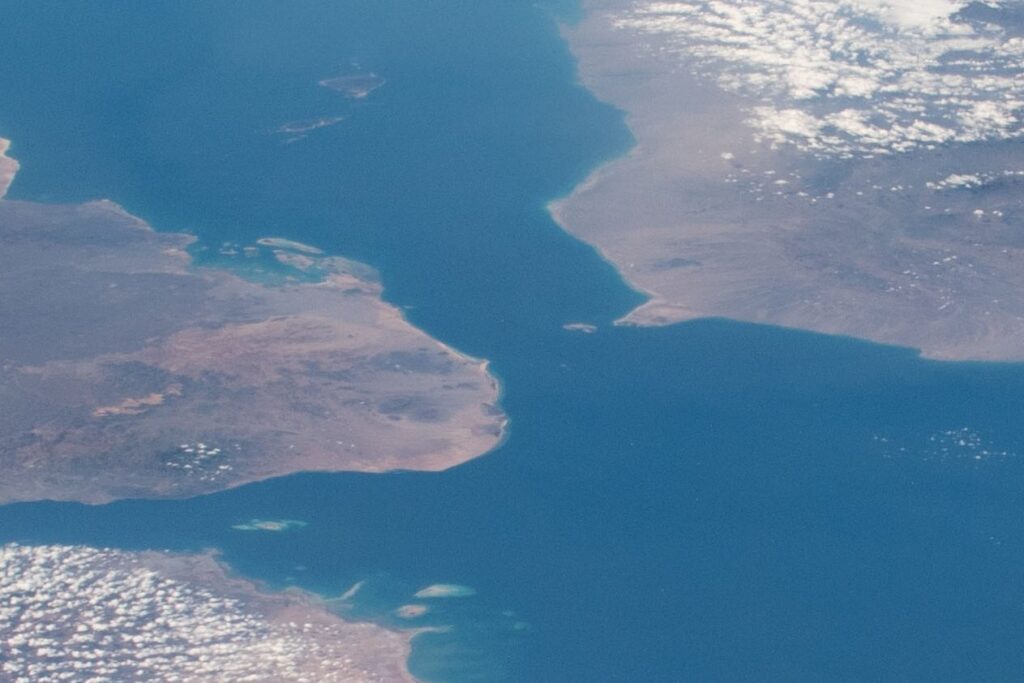
Iran-backed Houthi forces seized Yemen’s port city of Mokha and several islands near the Bab el-Mandeb Strait in September 2026, expanding their control over the waterway’s eastern approaches. The capture of Perim Island, which sits at the strait’s narrowest point roughly 20 kilometers from Djibouti, has placed the group in a position to monitor and potentially restrict one of the world’s busiest shipping lanes.
Houthi Advances at the Gate of Tears
The Bab el-Mandeb Strait carries about 30% of global container traffic, 15% of global oil and shipping transits, and 12% of global annual trade, according to the Institute for Security Studies. The Houthi advance down the Red Sea coast in September gave the group what analysts describe as a veto over shipping through the chokepoint. Perim Island, also known as Mayun, dominates the narrowest passage between Yemen and the African shore. Control of this territory allows the Houthis to threaten vessels with missiles, drones, and small boat attacks at close range.
Yemeni government forces backed by a Saudi-led coalition launched a counteroffensive in early October and recaptured some coastal areas. However, the Houthis retain a significant foothold near the strait. The group has been firing on merchant ships since the start of the Gaza war in 2023, but the territorial gains in 2026 represent a shift from intermittent harassment to potential physical control of the waterway’s geography.
The Hormuz Model: Legal Cover for Toll Collection
Since March 2026, Iran has asserted authority to charge commercial vessels for passage through the Strait of Hormuz, offering a template the Houthis could replicate. On March 30, the Iranian Parliament approved the Hormuz Transit Fee Law, which authorizes charges of up to two million dollars per voyage. Iranian authorities describe the fees as compensation for security and environmental maintenance.
In May 2026, Iran established the Persian Gulf Strait Authority, which claims that no vessel may pass without a permit it has issued. The authority’s fees reportedly fund the Islamic Revolutionary Guard Corps. Presidents Masoud Pezeshkian and Donald Trump signed a memorandum of understanding on June 17 that suspended the charges for sixty days, but that period lapsed on August 17 without a wider settlement. The legal basis for such tolls remains contested under the law of the sea, which generally guarantees transit passage through straits used for international navigation without prior permission or payment.
Evidence of Houthi Intent to Charge for Passage
Analysts and tracking firms see signs that a similar toll system is emerging in the Red Sea. Kpler suspects Gulf producers are paying Iran for safe passage through Hormuz, with exporters passing these costs to consumers. Michelle Brohard, head of policy and geopolitical risk at Kpler, stated she suspects there is a toll being paid that gives ships safe passage through the Persian Gulf chokepoint.
Gustavo de Arístegui, a diplomat and international analyst, warned that paying tolls to the Houthis directly funds Iranian terrorism. Traffic through the Strait of Hormuz has fallen by 40 percent, according to de Arístegui, as shippers reroute crude toward Fujairah and the Red Sea. The Houthi attacks on Saudi airports in Abha and Riyadh in October 2026, which killed three civilians and injured 36, demonstrated the group’s willingness to strike land-based infrastructure to enforce its maritime demands.
Eritrea’s Shore: The Other Side of the Gate
The African shore of the Bab el-Mandeb belongs to Eritrea, a highly militarized state that views the strait as vital to its security. Eritrea’s coastline sits roughly 20 kilometers from Djibouti and a 20-minute flight from Ethiopia. The strait’s geography means that effective control requires presence on both the Yemeni and African sides.
Eritrea’s government, led by President Isaias Afwerki, maintains a system of indefinite national service that fuels one of the world’s most regimented societies. Education Minister Halima Mohammed told Reuters that all school graduates are assigned mandatory roles in the military or civilian service. This militarization is driven partly by Eritrea’s perception of Ethiopian expansionism. Ethiopia’s internal fragmentation and demands for sovereign maritime access are viewed by Eritrea and Somalia as a continuation of historical expansionism, prompting border militarization and diplomatic isolation of Addis Ababa.
The Red Sea has fused the crises of Yemen and the Horn of Africa into a single theater. Competing external alignments — Egypt, Saudi Arabia, Eritrea, and Somalia versus Ethiopia and the UAE — combined with reported Houthi-Somali weapons smuggling and the resurgence of piracy, have erased any buffer between Middle Eastern proxy conflicts and Horn of Africa instability.
Global Trade Impact and Regional Responses
If the Bab el-Mandeb Strait becomes impassable, shipping companies would have to make detours via the Suez Canal or the southern tip of Africa, increasing costs passed to consumers. African economies are already suffering from the crisis in the Strait of Hormuz, which has made fuel and fertilizer scarce and more expensive. The human cost hit Djibouti almost immediately; the UN Refugee Agency reported at least 3,700 arrivals from Yemen in the early days of the escalation.
President Trump has thus far delegated to Saudi Arabia the responsibility to contain the Houthis, but the escalating crisis has led him and other Saudi partners, including the UAE, Türkiye, and Pakistan, to reconsider initial decisions not to intervene directly on Saudi Arabia’s behalf. The United States-Israel attack on Iran in February 2026 led to the Iran-backed Houthi militia seizing territory at the entrance to the Red Sea, with grave potential consequences for Africa and the world. Growing ties between the Houthis and al-Shabaab could turn Red Sea instability into a more dangerous security threat for the continent.
Sources
- Another Hormuz? What to Know About the Houthi Threat to the Red Sea | Council on Foreign Relations
- Kpler suspects Gulf producers are paying Iran for safe passage – Oil & Gas 360
- Charges for Passage in the Strait of Hormuz: The Law Governing Tolls and Service Fees in Straights Used for International Navigation
- Gustavo de Arístegui: “Traffic through the Strait of Hormuz has fallen by 40 per cent, and paying tolls to the Houthis directly funds Iranian terrorism”
- The Houthi-Saudi conflict is directly affecting African countries in the Red Sea region — and beyond
- Outside Powers Respond to Instability in the Red Sea
- How Houthi military aggression in the Red Sea threatens Africa | ISS Africa
- For this African hermit nation, the Red Sea’s upheaval is a chance to return from the wilderness
- The Horn Of Africa States: The Gate Of Tears And Fears – OpEd
- Houthis
- Who are the Houthis in Yemen and what do they want?
Photo: Earth Science and Remote Sensing Unit, NASA Johnson Space Center (Public domain)




