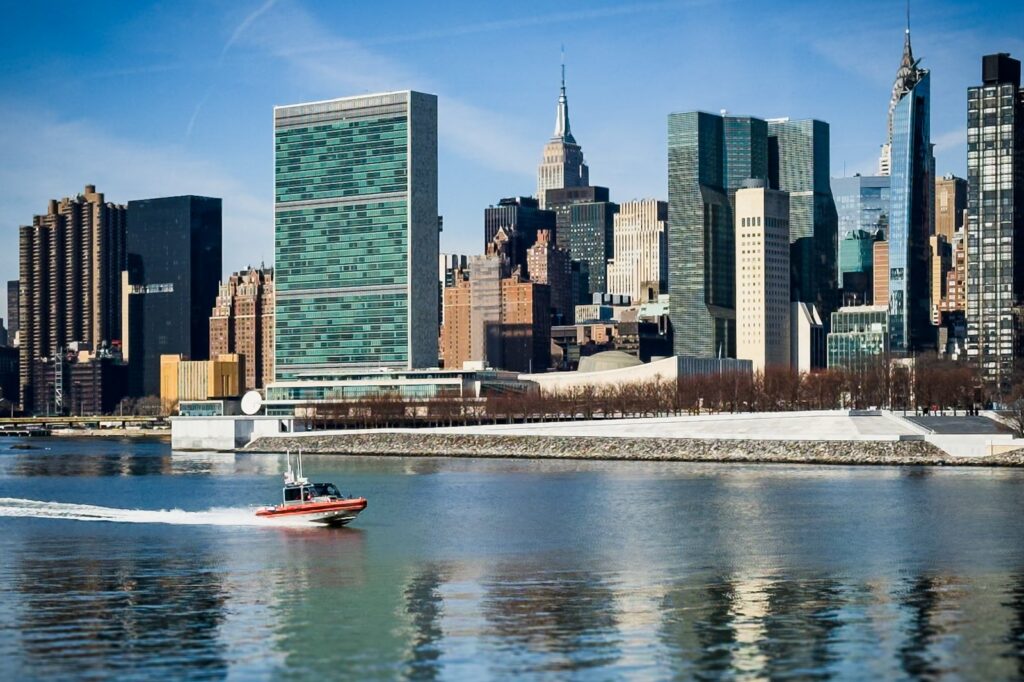
Speaking to reporters in New York before a trip to Egypt, UN Secretary-General António Guterres asked the world to look at the people marching in the streets and the wars far away as one story. “We must connect the dots,” he said, tying “very real and peacefully expressed grievances” to “the wider turmoil in our world.”
What families are feeling at the till
Protests over the cost of living have rolled through Europe and beyond. Guterres condemned the violence and destruction seen over days of unrest in France, Italy and elsewhere, and said those behind criminal acts must answer for them. But he would not wave away the anger behind it. “Everywhere, pressures are building over the price of food, fuel and other basics,” he said. “Interest rates are up, for people and countries. And for young people, the promise of a better future is slipping further out of reach.”
An “El Niño of war”
Guterres compared today’s fighting to the El Niño weather pattern, which starts in one region and upends lives thousands of kilometres away. “We are now witnessing an El Niño of war,” he warned. “Conflict is feeding conflict. And the consequences are travelling farther and faster.”
He named the Middle East, Ukraine and Sudan, where homes, hospitals, schools, airports and power stations are being deliberately hit. The damage does not stay near the front lines, he said. It reaches energy markets, shipping, supply chains and financial systems.
The burden falls unevenly. Some households and governments can absorb higher prices and borrow cheaply to shield their people, while others must pick between food and heat, or between paying debt and funding health and schools. War, Guterres said, “feeds and exploits” these gaps and exposes the unfairness of a system that makes those with the least absorb the biggest shocks.
Yemen, Gaza and the West Bank
The answer, he insisted, “cannot be an ever-widening circle of confrontation, including in the Middle East.” In Yemen he voiced alarm at escalation around the city of Taiz and at continued Houthi attacks on civilian targets in Saudi Arabia, and called for restraint and political dialogue.
On the Occupied Palestinian Territory, he said Israel is still severely restricting essential aid ahead of winter. Palestinians in the West Bank face daily attacks by Israeli settlers, he added, and journalists and diplomats have been attacked too. He asked donors to fund the World Food Programme, which urgently needs $450 million for Gaza and the West Bank over the next six months, and repeated the call for a two-State solution.
His message in Egypt, he said, will center on stopping the widening of war, protecting civilians and making room for diplomacy. “People everywhere want security. They want dignity. They want governments and international institutions to deliver.”
A stalled race to succeed him
Meanwhile the search for his successor is stuck. The United Arab Emirates has formally nominated Lana Nusseibeh, a Minister of State who served as the UAE’s ambassador to the UN from 2013 to 2024. Her entry follows six rounds of informal Security Council voting in which no leading candidate won backing from all five veto-holding powers. Rebeca Grynspan, Rafael Grossi and Carolyn Rodrigues-Birkett each drew at least two “discourage” votes, and Michelle Bachelet withdrew after concluding she could not overcome an American veto. The Council wants a Latin American, and the next term starts on January 1, 2027. Nusseibeh told Reuters she is running “to act sooner, to unite people beyond differences.”
Sources
- António Guterres
- ‘Connect the dots’ between street protests and global turmoil, urges Guterres
- United Arab Emirates Nominates Lana Nusseibeh To Succeed António Guterres As UN Secretary-General: 20 outlets compared | NewsCord
Photo: Jdforrester (CC BY 4.0)