
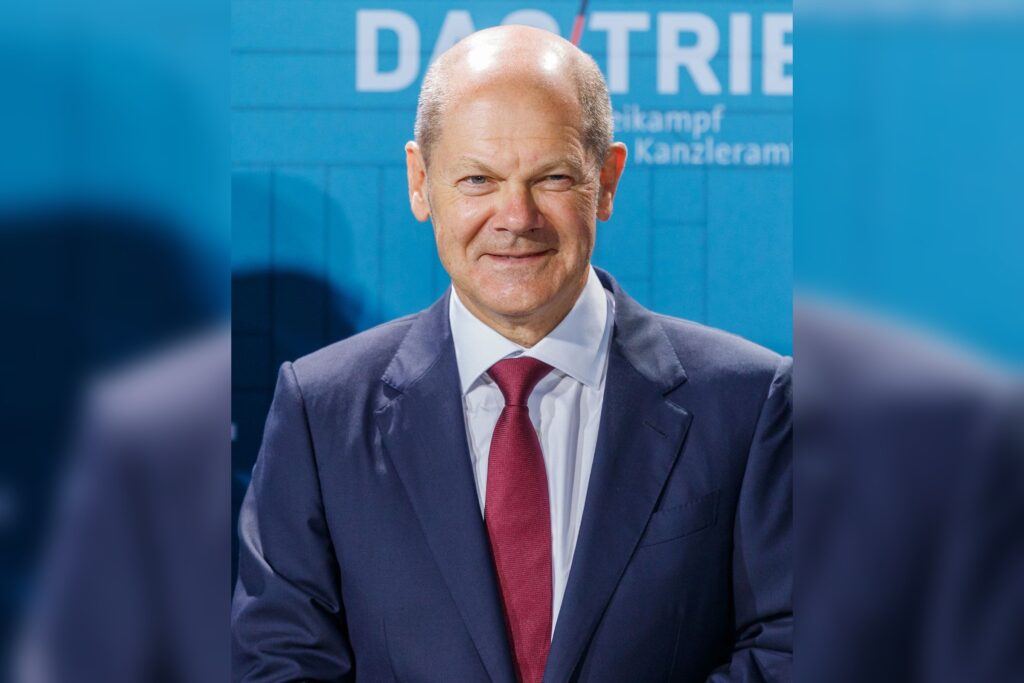
Two-thirds of the German companies surveyed in China say they face “unfair competition.” That finding, from a poll of 150 businesses cited by the Observer Research Foundation, sits awkwardly beside the line Chancellor Olaf Scholz keeps repeating in Beijing: Germany wants to cut its exposure to China, not leave.
Where “de-risking” came from
The idea began in Berlin. In November 2022 Scholz went to Beijing, the first Western leader to do so since Xi Jinping was all but assured a third term, and told him Germany did not want to decouple. His word was “smart diversification.” Around five months on, at the end of March, Ursula von der Leyen, the European Commission president, unveiled Europe’s China strategy under a new label, “de-risking.” Nils Schmid, a Social Democrat in the Bundestag, told the Hankyoreh that the chancellor had been first to use the concept, and that he had laid out his thinking in an op-ed in the Frankfurter Allgemeine Zeitung before the trip.
Germany then wrote it down. A national security strategy came out on June 14 and a “Strategy on China” on July 13, a 64-page document, per the ORF, that recognized China had changed. Schmid said the national security paper treats China as partner, competitor and systemic rival, with the last category growing more prominent.
The catch
On closer reading, the strategy’s logic is about dependency, not distance. Schmid pushed back on one common picture: the biggest German trading partner, he said, is the European Union as a whole, and China only looks larger because the single market is split into so many countries. German firms, he said, “have every latitude to continue doing business there.” They only need to watch for lopsided dependencies on certain raw materials and supply chains.
Follow the money, though, and the numbers move slowly. German trade with China fell by 15.5 percent in 2023 to €250 billion, yet German direct investment in China hit a record €12 billion that year. Imports of chemicals, computers and raw materials for the green transition did not decline, and reliance on China for rare earths and pharmaceuticals grew, even as Chinese imports overall dropped by 20 percent between 2022 and 2023. In Germany’s 5G network, Huawei’s share is 59 percent. BASF and BMW are building new plants in China.
That was the backdrop when Scholz returned on April 14, 2024, to Beijing, Shanghai and Chongqing, traveling with three cabinet ministers and executives from Bayer, Volkswagen, Mercedes-Benz, BMW and Siemens. He asked for a level playing field for the 5,000 German companies there, with “no dumping, no overproduction, and no violation of intellectual property rights,” yet urged the EU not to act out of “protectionist motives.” The EU’s trade deficit with China reached €400 billion in 2022, and Brussels has opened an anti-subsidy probe into Chinese electric vehicles.
A full break would hurt. In a major break, the Kiel Institute estimates, Germany’s economy would contract 5 percent over the near term; trade wound down gradually could avoid those costs altogether.
Sources
- Blueprint for de-risking came from Scholz's smart diversification, says German lawmaker (Hankyoreh interview with Nils Schmid)
- Germany continues its risky China habit (Observer Research Foundation)




