
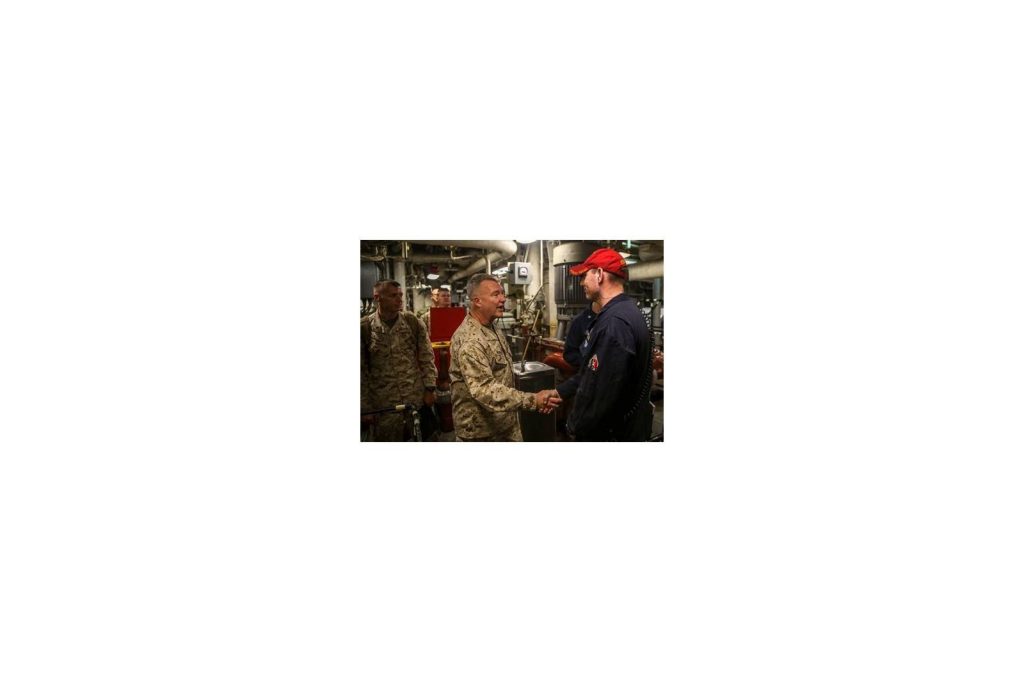
WASHINGTON, July 10 — When you think about the world’s most critical maritime chokepoint, picture a narrow hallway where a significant portion of the world’s oil moves every single day. That’s the Strait of Hormuz. And for three years, one man was the U.S. military’s lead guard on that hallway.
General Kenneth F. McKenzie Jr., who served as the Commander of U.S. Central Command (CENTCOM) from March 2019 to April 2022, oversaw every major U.S. military operation in the Middle East during one of the region’s most volatile periods.
His tenure covered the 2019 tanker attacks, the downing of a U.S. drone by Iran, and the U.S. killing of Iranian General Qasem Soleimani in January 2020. In plain terms, McKenzie was the person in the room deciding how the U.S. military would respond when Iran kept poking.
The Strait of Hormuz and the IMSC
Think of the Strait of Hormuz like a single-lane highway that everyone needs to use. When Iran threatened to close it in 2019, McKenzie was responsible for forming the International Maritime Security Construct (IMSC). That’s the coalition — including the U.S., UK, Australia, and other allies — that was set up specifically to protect commercial shipping in the strait.
The practical upshot: instead of the U.S. Navy patrolling alone, the IMSC spread the burden and the political cover across multiple nations. McKenzie was blunt about the stakes.
He publicly stated that the U.S. would not allow Iran to close the strait. That wasn’t just a talking point — it was a direct warning to Tehran that any attempt to block the waterway would be met with military force. Here’s what it means in concrete terms: if Iran had mined the strait or attacked a tanker, McKenzie’s command had the authority and the coalition to respond immediately.
Escalation and the Soleimani Strike
The tensions didn’t stop at shipping. In January 2020, the U.S. killed Iranian General Qasem Soleimani in a drone strike. McKenzie was the CENTCOM commander at the time, meaning he oversaw the planning and execution of that operation.
It was one of the most consequential U.S. military actions in the Middle East in decades, and it happened on his watch. The 2019 tanker attacks and the downing of a U.S. drone by Iran were earlier flashpoints that tested McKenzie’s command.
Each incident required a calibrated response — not so aggressive that it triggered a full-scale war, but strong enough to signal that the U.S. would not back down. The drone shootdown, in particular, was a direct challenge to U.S. air power in the region.
McKenzie’s Background
McKenzie wasn’t just a CENTCOM commander. He was a Marine Corps officer who also served as Director of the Joint Staff — essentially the chief operational planner for the entire U.S. military. That combination of roles gave him a rare vantage point: he understood both the strategic-level decisions made in Washington and the tactical realities on the ground in the Middle East.
His leadership during the 2019-2020 period was critical. The U.S. was simultaneously managing a military buildup, a series of Iranian provocations, and the aftermath of the Soleimani strike.
McKenzie’s job was to keep the military machine running smoothly while the political situation remained volatile.
What to Watch Now
As of July 2026, McKenzie is no longer in command — he stepped down in April 2022. But the Strait of Hormuz remains a flashpoint. Iran continues to threaten shipping, and the IMSC still operates.
The question for the current administration is whether the coalition McKenzie built is still robust enough to handle the next crisis. Given that the same players — the U.S., UK, Australia, and others — are still involved, the structure he created remains the primary framework for maritime security in the region.
The practical upshot for ordinary readers: the next time you hear about a tanker being seized or a drone being shot down near Iran, remember that the playbook for responding to it was largely written by a Marine Corps general who believed the U.S. would not allow the strait to be closed. That commitment hasn’t changed, even if the commander has.




