
About 50 tankers pass through the waters between the Persian Gulf and the Gulf of Oman every day. For families across Asia that rely on Gulf fuel, that stream is a household matter, and in July 2019 it became the problem of one Marine general.
Gen. Kenneth F. “Frank” McKenzie Jr., then the senior U.S. commander for the Middle East, was boarding a plane for the Persian Gulf when CBS News reported that Iran had seized an oil tanker, the Riah, reportedly owned by the United Arab Emirates. Iranian naval vessels escorted it to an anchorage off an Iranian island. “Obviously, we would take that very seriously,” McKenzie said.
He stopped in Oman, whose waters extend into the Strait of Hormuz. His message was about deterrence. “Our ability to bring forces into the theater has acted to deter them,” he said, adding that Iran seemed to be “recalculating”. The carrier Lincoln and B-52 bombers were in the region to keep Tehran from closing the strait. Days earlier, Royal Marines had seized an Iranian tanker near the Mediterranean, and a British warship had warned off Iranian forces trying to seize a British tanker in Hormuz.
The career behind the command
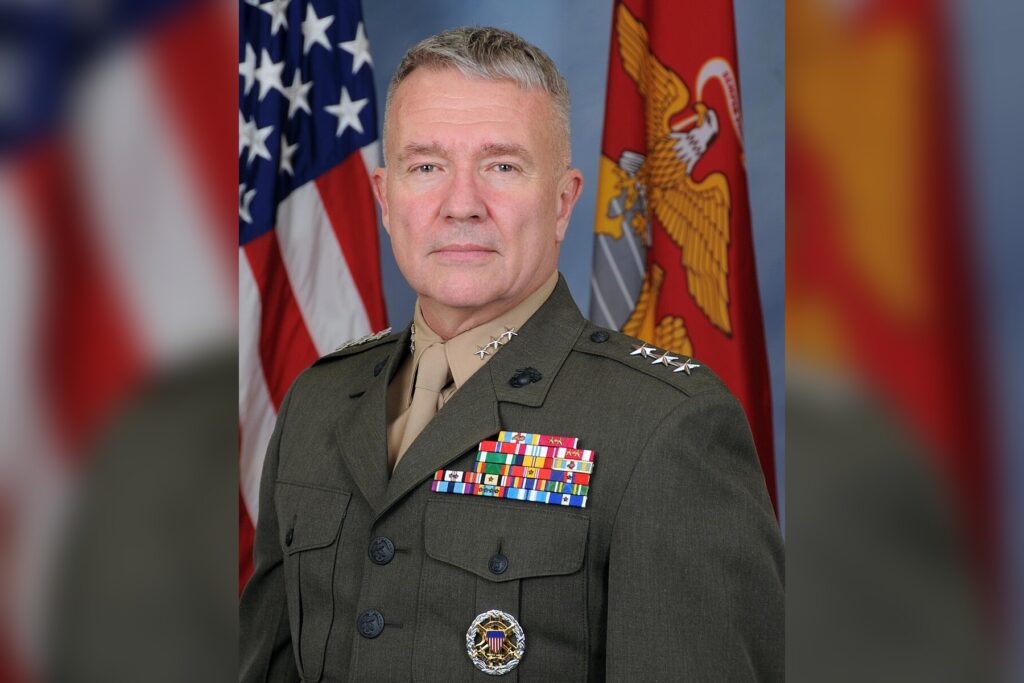
McKenzie, a native of Birmingham, Alabama, graduated from The Citadel in 1979 and was commissioned an infantry officer in the Marine Corps. He led the 22d Marine Expeditionary Unit on combat deployments to Afghanistan in 2004 and Iraq in 2005-06. Later posts included director of strategy, plans and policy at Central Command in 2010, commander of Marine Corps Forces, Central Command in 2014, and director of the Joint Staff in 2017.
He took over Central Command in March 2019 as a full general and held it until April 2022. He retired after more than 42 years in uniform. In May 2022 he became executive director of the University of South Florida’s Global and National Security Institute.
Soleimani
McKenzie was also at the center of the strike on Iranian General Qasem Soleimani. Speaking to PBS NewsHour about his book, he defended it: “the risks of inaction were greater than the risks of action.” Soleimani, he said, “was going to coordinate attacks on our embassy…across the region.”
He called the Iranian commander “their best planner…best leader…best executor,” and argued that his removal weakened Iran’s operational capability, while conceding that getting proxies “to sail in the same direction” is hard. The strike on “Route Irish…right outside the Baghdad Airport” was placed there deliberately, he said, to limit harm to civilians.
Sources
- General (Ret.) Frank McKenzie Biography
- CBS News travels with top U.S. military commander in the Middle East amid Iran tensions
- Former CENTCOM head's new book reflects on leading most active command in U.S. military




