
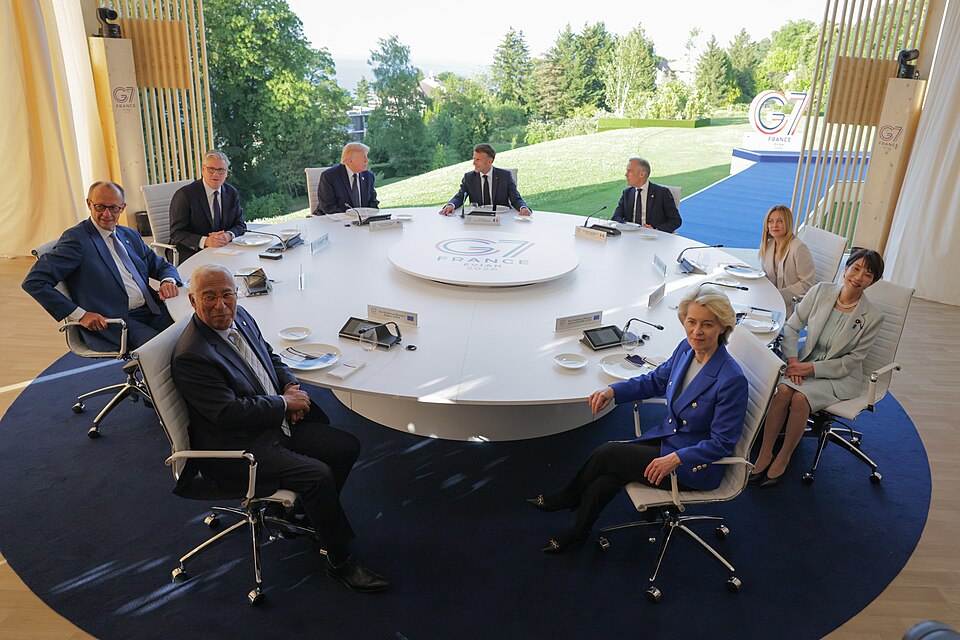
Donald Trump arrived in Évian-les-Bains with a deal in hand. He announced a provisional ceasefire with Iran shortly before landing for the G7 summit in France, which began on June 15, and the agreement set the tone for the opening talks.
In their geopolitical statement, the leaders called the deal a “historic opportunity” and backed follow-up diplomacy to keep Iran from getting nuclear weapons. They also said a defensive, multinational maritime security initiative led by France and the United Kingdom could help restore commercial shipping through the Strait of Hormuz and verify mine clearance.
Ukraine and AI
The statement repeated the G7’s “unwavering support” for Ukraine’s freedom, sovereignty and territorial integrity. It promised more air-defense and interception systems, floated licensing military production to expand Ukraine’s defense manufacturing, and covered winter energy resilience and further sanctions on Russia’s wartime economy.
Ukrainian President Volodymyr Zelensky attended as a guest. Al Jazeera reported that Trump met him and said he would “do what he can to end the war.” The Guardian reported that European leaders asked Trump to help arrange direct talks between Ukraine and Russia.
Artificial intelligence got less attention. Reuters reported that France invited executives from OpenAI, Google, Anthropic and Mistral AI to speak with leaders about regulation, infrastructure and online safety. It followed a digital agenda set by G7 technology ministers the month before, in which protecting minors online was a particular focus of the French presidency.
China’s counter-programming
China is not a G7 member, and its state media used the week to attack the group. A Global Times commentary published June 15 called the G7 an “exclusive club of a handful of countries” and said it is “often portrayed as a hypocritical, self-interested, and disconnected group.” The paper argued that the G7 countries, dealing with slow growth, high debt and a fall in European trust in the United States, were putting trade imbalances, overcapacity and mineral alliances on the agenda to contain China. Challenges such as supply chains and energy security need the Global South, including China, it said. It added that a group representing less than 10% of the world’s population cannot present itself as the “leader of the world.”
On the summit’s opening day, the SCO, led by China and Russia, held a ceremony for its 25th anniversary. It was founded in Shanghai in June 2001 by China, Russia, Kazakhstan, Kyrgyzstan, Tajikistan and Uzbekistan. India, Pakistan, Iran and Belarus joined later, making ten members.
Its members do not all line up. India, an SCO member, is deepening security cooperation with the United States, Japan and Australia, and the Central Asian states balance between Beijing and Moscow. The SCO is not a military alliance. It works more as a loose platform where countries unhappy with the West coordinate on specific issues.




