
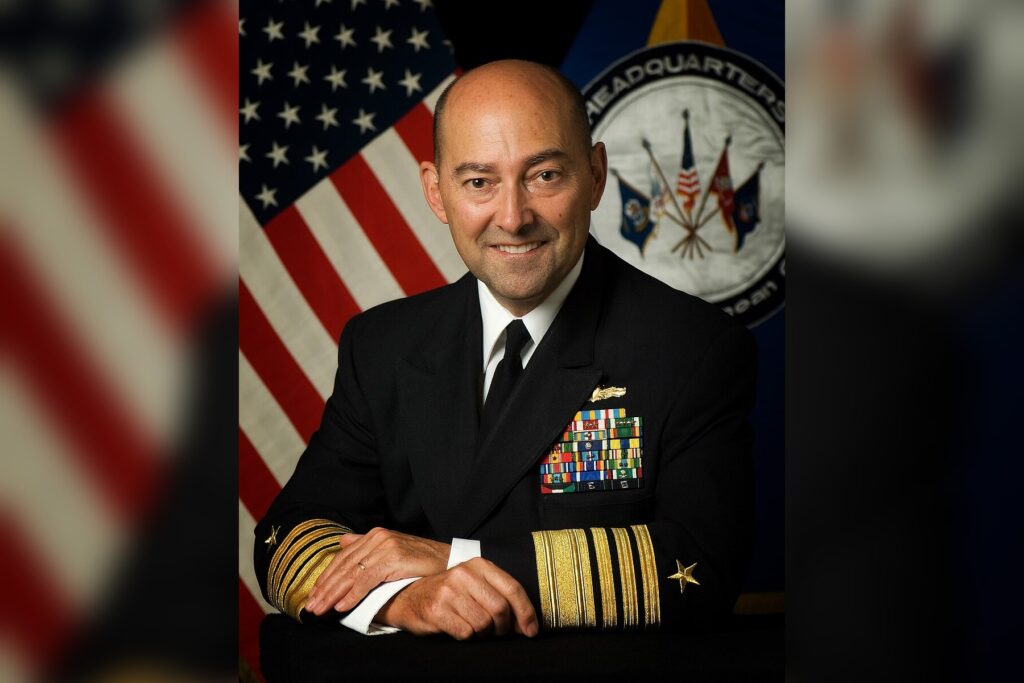
The claim came from a familiar quarter: as the Iran war ground on, retired Admiral James Stavridis went on CNBC and argued that the United States might end up having to force the Strait of Hormuz back open. The framing, laid out on the 12 May 2026 edition of Squawk Box, was blunt enough for a headline: Washington may need to reopen the passage “with force”.
Follow the money, and the booking itself is the story. The speaker is a retired U.S. Navy admiral and former Supreme Allied Commander of NATO, but these days he earns as a partner and vice chairman of the Carlyle Group, the private-equity house, and as co-author of the novel “2084”. A warrior turned financier, asked on a markets program about a waterway that traders watch the way generals watch terrain: segment length, nine minutes and change, at 8:38 in the morning, New York time.
On closer reading, this is not his first turn at the chokepoint. In June 2019, after Iranian forces brought down an American drone in international airspace above the same strait with a surface-to-air missile, Stavridis delivered a one-line verdict on NBC’s Today show: “It’s a very dangerous situation”. That was a Thursday shootdown; by the weekend he was television’s explainer-in-chief for the Gulf. Seven years on, the vocabulary has shifted from tense standoff to active war, but the geography has not moved.
The mechanics here are worth spelling out. A former supreme commander discussing forcible reopening of Hormuz is not forecasting; he is walking a markets audience through what the option would involve. Per the segment description, the talk ranged across the war’s latest turns, the state of U.S.-Israel relations and the future of warfare, with the strait as the hinge question. The catch is that no transcript accompanied the clip, so the argument lives in its framing rather than its detail.
What to watch is the pattern. Since at least 2019, whenever Tehran and Washington collide, the same admiral reappears with the same strait and the same warning, now upgraded from danger to prescription. If the war drags on, the odds that the question migrates from television studios to the Gulf itself rise with it. The reassuring read is consistency; the unsettling one is that the question has become not whether the passage is threatened, but what opening it by force would look like.
Sources
- Adm. James Stavridis on Iran war latest: The U.S. may have to open the Strait of Hormuz 'with force'
- US and Iran tensions are a ‘dangerous situation, ’ says Adm. James Stavridis




