
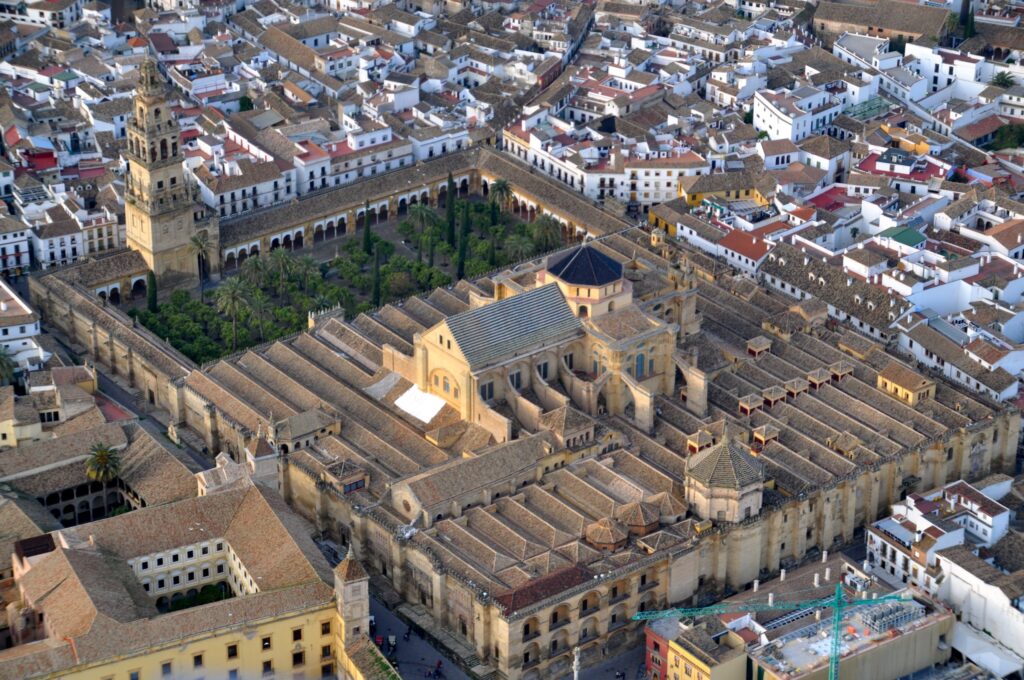
Videos shared widely on Friday night showed flames and smoke pouring from inside the Mosque-Cathedral of Córdoba. The blaze began at about 9:00 pm (1900 GMT) on August 8, 2025. For a few hours, people thought of Notre Dame in Paris, which burned in 2019.
By Saturday the picture looked much better. Córdoba’s mayor, Jose Maria Bellido, stood outside the building as it opened to visitors on schedule. “There is some damage, significant damage, but it is very, very localised,” he told reporters.
Most of it sits in the chapel where the fire started. Its roof “completely collapsed”, Bellido told Spanish public television, brought down by the flames and by the weight of the water poured on them. Two chapels next door suffered what he called “collateral damage”, mostly smoke harming altarpieces and other works of art. He put the burned area at 50 to 60 square metres of a vast interior.
“Fortunately yesterday a catastrophe was avoided that could have meant losing the entire mosque-cathedral,” he said.
Why crews got it under control
Thirty-five firefighters stayed through the night, watching the area and cooling the walls once the flames were out, said Daniel Munoz, who heads Córdoba’s firefighting service. He credited annual drills held at the building since an earlier fire there in 2001. “That allowed them to know all the entrances, the hallways, where they could hook up their hoses,” Munoz said.
Forensic police were at the scene on Saturday trying to establish the cause. ABC and other Spanish newspapers reported that a mechanical sweeping machine had caught fire inside the site. An AFP photographer saw fire engines and police along a nearby street while people gathered to look at the building. The damaged section, known as the Almanzor nave, was fenced off with waist-high barriers.
A building of many layers
The site was built as a mosque, on the ground of an earlier church, between the 8th and 10th centuries by Abd ar-Rahman, an emir of the Umayyad dynasty who ruled the city. After Christian forces retook Spain in the 13th century under King Ferdinand III of Castile, it became a cathedral, and later centuries brought further changes to the structure.
Two million people visit each year. UNESCO named it a World Heritage Site in 1984, describing “an architectural hybrid that joins together many of the artistic values of East and West and includes elements hitherto unheard-of in Islamic religious architecture, including the use of double arches.”




