
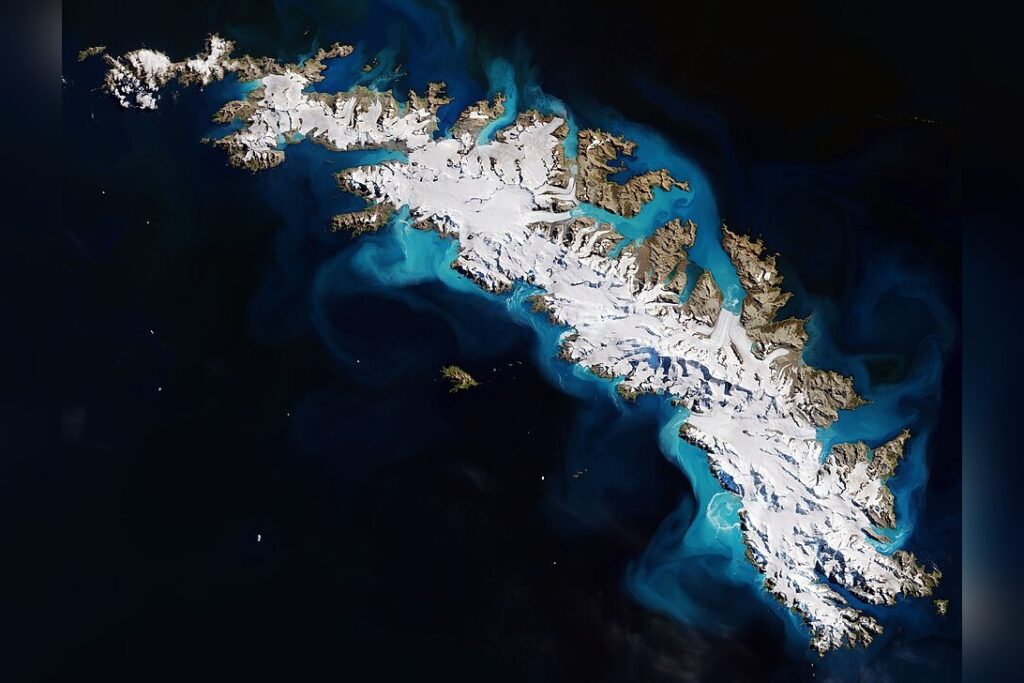
The islands lie 8,000 miles from Britain, and Britain still sent a fleet. On 2 April 1982 Argentine forces landed on the Falkland Islands, then took South Georgia the next day. The United Nations condemned the occupation. Sir Rex Hunt, the British governor, was deported along with Naval Party 8901, the small Royal Marines contingent that had defended the capital before it was forced to surrender.
Argentina’s President Leopoldo Galtieri had decided to seize by force what Buenos Aires has disputed since 1833. Most islanders were of British descent and wanted no part of the claim. General Mario Menéndez was installed as governor and commander of the garrison. In the weeks that followed, the Imperial War Museums records, some islanders were deported and others jailed.
A task force sails
Prime Minister Margaret Thatcher authorised a military operation, codenamed Corporate, and on 5 April the British government dispatched its naval task force. Within days 127 warships, submarines and requisitioned merchant ships were heading south with troops, aircraft and equipment. It was the first operation since the Second World War in which every branch of the British armed forces deployed together.
South Georgia came back under British control on 25 April through Operation Paraquet. On 30 April the task force declared a 200-mile Total Exclusion Zone around the Falklands, closing it to all ships and aircraft.
Ships lost at sea
Two days later the submarine HMS Conqueror sank the Argentine cruiser ARA General Belgrano. More than 300 of her crew died. Argentina answered fast. On 4 May an Exocet missile fired from a Super Etendard strike fighter hit the destroyer HMS Sheffield from six miles away, and the fire that followed destroyed the ship. Twenty men were killed.
The Argentine air force kept coming with Exocets and bombs. Seven British ships were lost in all. The landing ships Sir Galahad and Sir Tristram were hit on 24 May, and the container ship Atlantic Conveyor on 25 May. The Conveyor’s loss mattered on land too: the helicopters meant to carry troops across the island went down with her.
The land campaign
From 21 May the task force put 4,000 troops ashore unopposed at San Carlos and Ajax Bay on East Falkland. They faced a larger, largely conscripted army, and with no air cover they fought at night. Goose Green fell first, on 28 and 29 May, in a hard battle in which Lieutenant-Colonel Herbert “H” Jones of 2nd Battalion, Parachute Regiment, was killed. He and Sergeant Ian McKay, who died at Mount Longdon on 11 and 12 June, both received the Victoria Cross after death.
Then came the march. Half the troops covered the 56 miles to Port Stanley on foot, through minefields and bad weather. A photograph of Corporal Peter Robinson of 45 Commando, a Union flag tied to his radio antenna, became one of the war’s best-known images, and the Royal Marines slang for such a slog, “yomp”, entered everyday English.
After heavy fighting in the mountains above the town, Argentine forces surrendered on 14 June. More than 11,000 Argentine troops were disarmed and sent home. The war had lasted 74 days.
The toll and the unfinished dispute
In total 907 people died: 649 Argentine, 255 British and three Falkland Islanders. The defeat cost Galtieri his job, as his own government removed him, and the IWM calls the outcome a turning point for Thatcher’s leadership.
The dispute has never been settled. The islands remain a British overseas territory under British Forces South Atlantic Islands. In 2024 President Javier Milei told the BBC, “We are not going to relinquish our sovereignty, nor are we going to seek conflict with the United Kingdom,” and on the war’s anniversary on 2 April 2026 he promised to “respond with all necessary diplomatic measures to protect its rights and defend its interests.”
In October 2026 the quarrel turned to oil. On 13 October Argentina asked the International Tribunal for the Law of the Sea for provisional measures against development of the Sea Lion project, a venture of Navitas Petroleum and Rockhopper Exploration. The same day Foreign Secretary Ed Miliband announced new measures under Protection of Trading Interests legislation, calling Argentina’s attempts to intimidate businesses “unacceptable.” About 100 British soldiers had just finished a six-day wargame on the islands that echoed the 1982 landings, and their commander, Major Aaron Nunkoosing, told The Times it was a chance “to walk in the footsteps of our forefathers.”
Sources
- British Soldiers Rehearse Falklands Landing From 1982 War as UK Warns Argentina Over 'Aggressive' Remarks | IBTimes UK
- Falklands conflict | Imperial War Museums




