
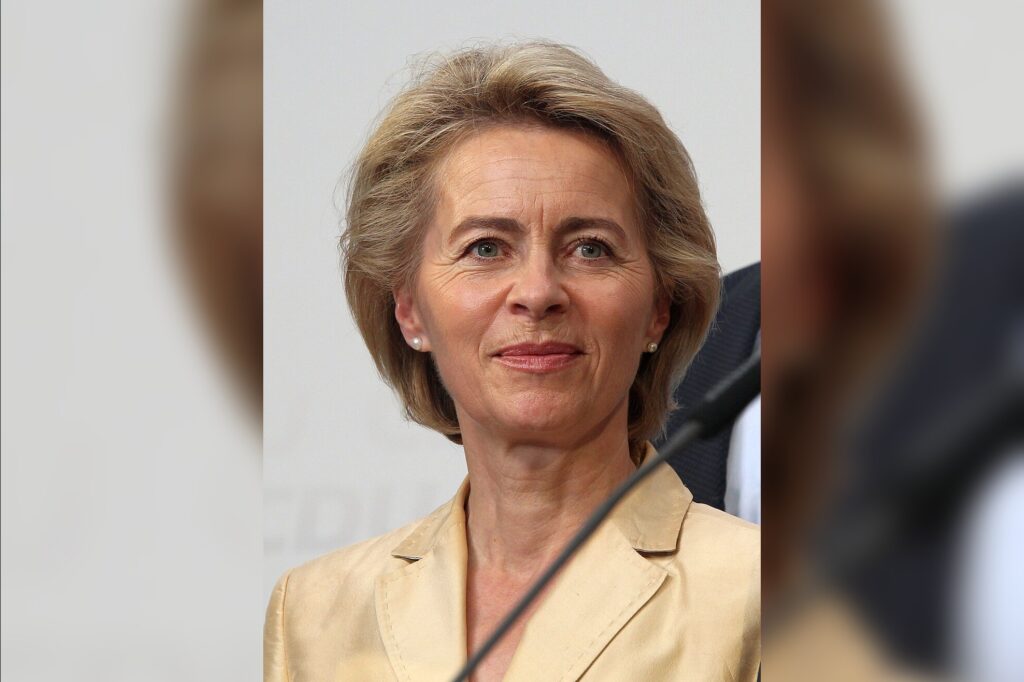
Mark Carney was in the front row of the European Parliament in Strasbourg when Ursula von der Leyen turned to him mid-speech. “I would like to work with you on opening the door for Canada being the first associate member of the EU,” she said. The Canadian prime minister nodded, got to his feet, embraced her and kissed her on both cheeks while lawmakers gave a standing ovation.
The moment came during von der Leyen’s annual State of the European Union address on Wednesday, and it landed at a delicate time. President Donald Trump’s tariffs and his repeated talk of making Canada the 51st state have pushed Ottawa to look across the Atlantic. About 70% of Canadian exports go to the United States, and Carney has called for a “unique alliance” with the EU to reduce that dependence.
What she offered
Von der Leyen said the broader alliance would aim to create “a common prosperity and economic security space.” She rooted it in more than trade. “Above all, dear Mark, Europe and Canada believe in democracy,” she said. “We believe that power does not belong to the strongest, the richest or the loudest, but to all of us.”
The partnership would reach into advanced manufacturing, technology, defence production, the Arctic, energy, critical minerals, batteries, artificial intelligence, quantum computing, cybersecurity and economic security. “This is a partnership not against anyone else, but for our common strength,” she said.
What she did not say was how associate membership would actually work, or how it would sit alongside the countries negotiating full membership. A Canadian official had told The Associated Press a week earlier that Ottawa was exploring ties that could stop just short of membership, including visa-free living and working in Europe for Canadians. Carney’s office welcomed the proposal and said Canada was deepening ties with the EU “to strengthen our sovereignty,” moving beyond the existing free trade agreement, known as CETA.
Two different roads with Washington
Canada has retaliated against U.S. tariffs and turned down trade terms Carney says would weaken its sovereignty. The EU chose a deal instead, setting a 15% U.S. tariff ceiling on most EU exports while Europe dropped tariffs on U.S. industrial goods. Canada this year also became the first non-European country to join the EU’s 150-billion-euro SAFE defence programme, which gives its companies access to joint procurement.
In January in Davos, Carney urged middle powers to work together. “When we only negotiate bilaterally with a hegemon, we negotiate from weakness. We accept what is offered,” he said. That speech drew a personal rebuke from Trump, and von der Leyen’s overture to America’s neighbour could raise the temperature again.
Iratxe García Pérez, who leads the Socialists & Democrats group in the Parliament, praised Carney for “great courage confronting Donald Trump.” Barry Andrews, chair of the Development Committee, called Canada “a perfect ally for Europe” and noted that more than 10% of Canadians claim Irish ancestry.
The wording fight
By the time the Canada-EU summit opened in Montreal in late October, the label itself was in dispute. The BBC reported that Germany and other states had successfully lobbied to drop the title from a draft statement, replacing it with softer language about an “ever closer association.” Germany’s ambassador to Canada, Matthias Lüttenberg, told CTV News that some member states were “a little surprised,” and that Germany uses “associate membership” for the EU’s relationship with Ukraine and potentially Moldova.
Von der Leyen kept using the term, calling it “a partnership that comes close to membership than anything we have done before.” Canadian officials say Canada does not plan to pay a membership fee and would instead join selected EU programmes. Trump has called the idea “laughable” and threatened “very serious tariffs” on Europe if he saw it as a hostile act. Carney’s answer on the name was brief. “What matters is the difference it will make to the lives of Canadians,” he said.
Sources
- Von der Leyen lays out vision for new Canada-EU partnership at Montreal summit
- EU's Ursula von der Leyen says she wants Canada to become an associate member




