
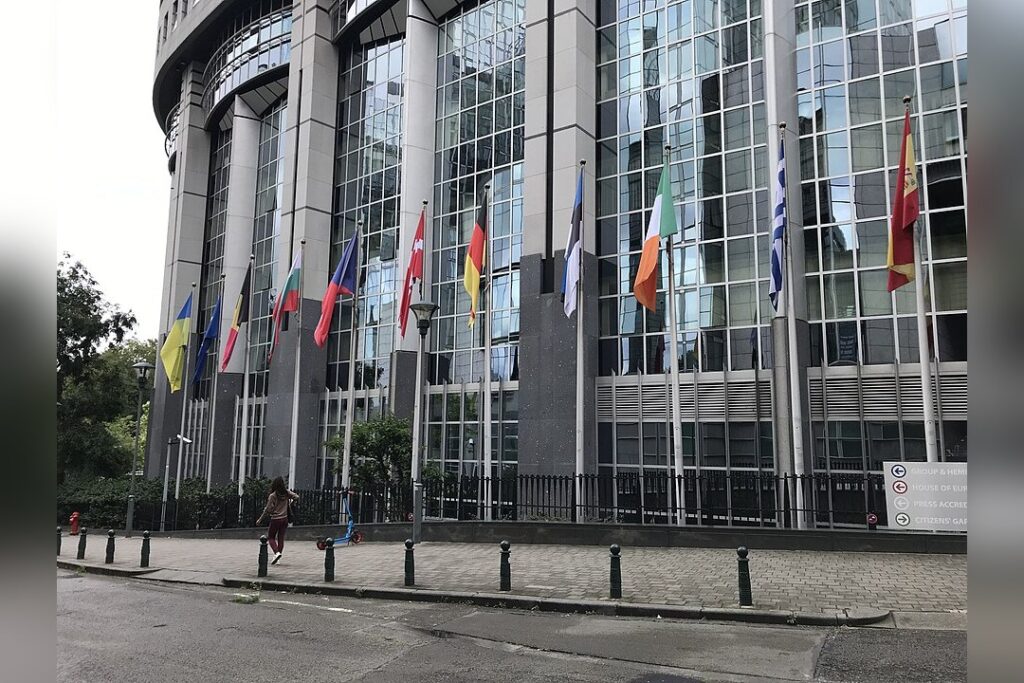
In the corridors of Brussels, the Gulf used to be a line on an energy spreadsheet. The war that the United States and Israel launched against Iran has turned it into a problem of strategy. Adriana Lukaszewicz, a professor of economics and international relations at Kozminski University in Warsaw, argues in an analysis for the Al Jazeera Centre for Studies that the Union’s answer is best described as selective engagement: limit exposure to a volatile region, keep the strategic interests there.
A dependence swapped, not removed
The starting point is Russia. Before its attack on Ukraine, Russia was the EU’s biggest supplier of crude, at 16.5% of imports, ahead of the United States at 8.2%, Norway at 7.5%, Iraq at 4.5% and Libya at 3.7%. It also led on natural gas in 2019. In May 2022 the European Commission put forward REPowerEU, a plan to end that reliance through savings, faster renewables and a wider pool of suppliers.
Not every capital started from the same place. Slovakia drew almost 80% of its oil imports from Russia, while Western and Southern European countries sat below 5%. Between 2022 and 2026 the EU cut its Russian imports step by step. The United States and Norway filled much of the gap, and the Gulf states filled more of it as time went on.
Then came the war in Iran. Lukaszewicz’s point is that diversifying does not abolish dependence; it moves it. A supplier region prone to instability can undercut the very security it was meant to provide.
Hormuz and the gas problem
The Atlantic Council set out the scale of the exposure in mid-March, when the conflict was in its third week. Roughly 20 percent of the world’s oil supply passed through the Strait of Hormuz each day before the fighting, and approximately 20 percent of global LNG trade, much of it from Qatar. For Europe the sharper worry was gas. Storage stood below 30 percent, a five-year low, with EU rules demanding at least 90 percent by December. Europe would need to inject nearly 60 billion cubic meters just to get there.
On March 2 an Iranian drone struck QatarEnergy’s Ras Laffan facilities and production stopped. Two days later the company declared force majeure. European gas benchmarks jumped by more than 50 percent on March 2, the biggest single-day rise since the 2022 crisis. The Council’s analysts noted that new clean-energy or nuclear capacity takes years and offers no answer to the present squeeze.
Poland, a test case
Warsaw shows the dilemma in miniature. After the invasion of Ukraine, Poland bought far more from Riyadh and Doha: Saudi crude reached approximately 46–60% of refinery supplies during 2024–2025, and Qatar supplied approximately 20% of Poland’s LNG. The shift cut Russian dependence but tied Polish fuel prices, inflation and growth to events in the Gulf.
Yet Poland’s diplomatic attention lies elsewhere, Lukaszewicz writes. Its economic diplomacy is thin, and its security concerns centre on its own frontier. The largest Polish business mission ever sent to Saudi Arabia, with approximately 70 companies, travelled to Riyadh on 7–9 February 2026. She calls for a coherent Gulf strategy that treats the region as more than a pump. She also grants the other side of the argument: the EU and US markets absorb about three-quarters of Polish exports, so concentrating there may be a rational use of scarce diplomatic effort for a frontline state.
What lies ahead
The trade numbers hint at how much is at stake. In 2024 EU direct investment in the Gulf came to EUR 163.1 billion, while Gulf investment in the EU reached EUR 189.8 billion. The EU is the Gulf’s second-largest trading partner, with 10.9% of the region’s goods trade in 2025. Lukaszewicz expects cooperation to widen across energy, security, diplomacy, trade and investment, a more pragmatic partnership than the old buyer-and-seller arrangement.
Sources
- The Iran War and EU–Polish Strategy toward the GCC (Al Jazeera Centre for Studies; author Adriana Lukaszewicz, Professor of Economics and International Relations, Kozminski University)
- How the Iran war could trigger a European energy crisis (Atlantic Council)




