
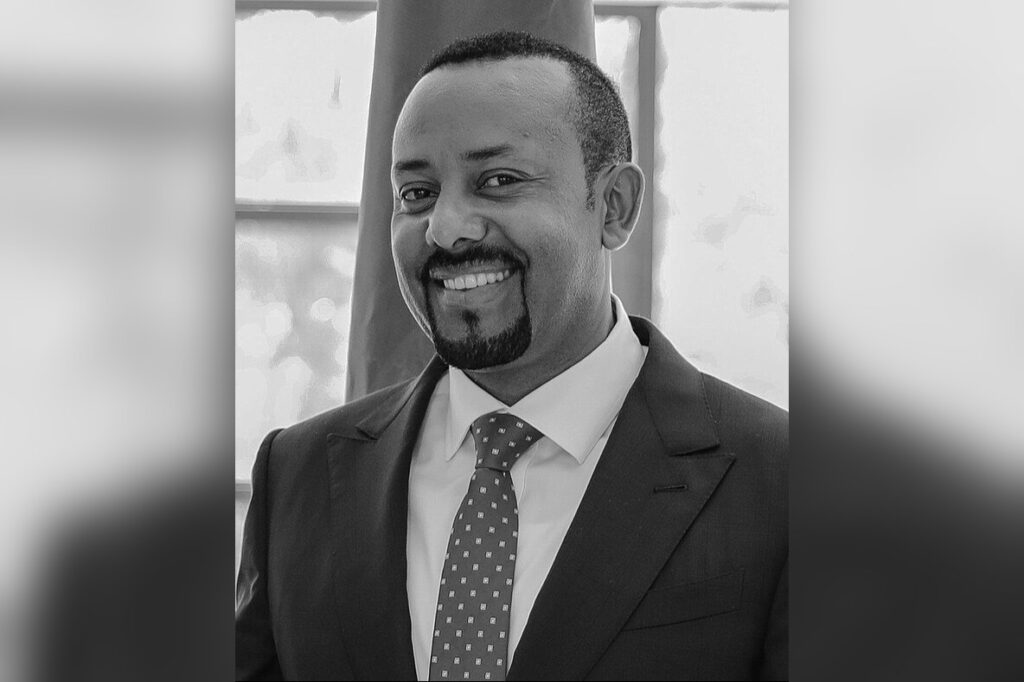
Ethiopia’s Prosperity Party took nearly 90% of parliamentary seats in the June 1 elections, which makes another term for Prime Minister Abiy Ahmed very likely. Results came out on Sunday. Voting had been suspended at several polling stations because of security problems, and for the second election running nobody voted in northern Tigray. Abiy now waits for the formality of election by the House of Peoples’ Representatives.
From soldier to prime minister
Abiy’s rise did not start in 2018, when he burst onto the world stage as a young, dynamic leader. In the 1990s he served in the Ethiopian National Defense Force (ENDF) and later headed the country’s cyber-intelligence service, INSA. He became known nationally as a politician in 2010, climbing through the Oromo People’s Democratic Organization (OPDO), which renamed itself the Oromo Democratic Party in 2018. He was elected to the House of Representatives and in 2016 became Minister of Science and Technology. Soon after, he went home to Oromia to run the OPDO Secretariat.
Born in 1976 in western Ethiopia to a Muslim father and a Christian mother, Abiy became the first Oromo to chair the ruling four-party coalition, the EPRDF. That mattered. Oromos make up around a third of Ethiopia’s roughly 136 million people, yet Tigrayans had dominated national politics. The Tigray People’s Liberation Front (TPLF), the strongest force in the coalition, had shaped the country’s political and economic fortunes since the fall of Mengistu Haile Mariam’s military regime in 1991, and it controlled the ENDF and the intelligence services.
Peace with Eritrea, then war at home
Abiy won international attention by reaching out to Eritrea, which Ethiopia had fought between 1998 and 2000 in a war that killed more than 80,000 people. He promised to accept the boundary commission ruling that gave the border town of Badme to Eritrea, something earlier governments had refused to carry out. Flights and phone lines were restored, embassies reopened, and Abiy and Eritrean leader Isaias Afwerki visited each other’s capitals. He ended 2019 with the Nobel Peace Prize.
At home, he freed political prisoners, unbanned parties, boosted women’s political participation and amended repressive laws. Western observers hailed him as a new hope for the Horn of Africa.
In 2019 he also founded the Prosperity Party, merging nine parties under his leadership. Some observers say its main purpose was to weaken the TPLF. Tigrayan leaders called the merger illegitimate and pulled their personnel and resources back to the regional capital, Mekelle, and the slide toward conflict was quick.
Tensions peaked in late 2020. The federal government postponed national elections; Tigray held its own regional vote in September, which Addis Ababa declared illegal before cutting ties with the regional administration. In November, after Tigrayan forces attacked ENDF bases in Tigray, Abiy ordered a military operation against the TPLF. Eritrean forces later joined the federal side. Many estimates put the death toll in the hundreds of thousands, and multiple parties faced allegations of atrocities, including Eritrean soldiers accused of killing Tigrayan civilians.
The Pretoria peace agreement of November 2022 formally ended major fighting, though implementation has been uneven and Eritrean troops were reported to remain in parts of Tigray. The war damaged Abiy’s peacemaker image abroad and led to tighter limits on individual freedoms at home.
Fano, the Nile dam and the Red Sea
Government forces are now fighting the Fano militia in the Amhara region. Those same fighters backed the ENDF against the TPLF.
One landmark came with the completion of the Grand Ethiopian Renaissance Dam on the Blue Nile, under construction since 2011. It cost $5 billion (€4.35 billion), was funded domestically, and is seen as a major investment in energy and water security. It also set Ethiopia against downstream neighbours Sudan and Egypt, where the dam has long been viewed as an existential threat. Abiy says it will bring prosperity to the whole region.
His wish to make Ethiopia a regional power with direct Red Sea access has put Eritrea on edge. The brief warming of 2018 has faded, and Eritrea now says it is guarding its interests against a perceived threat of war with Ethiopia.




