
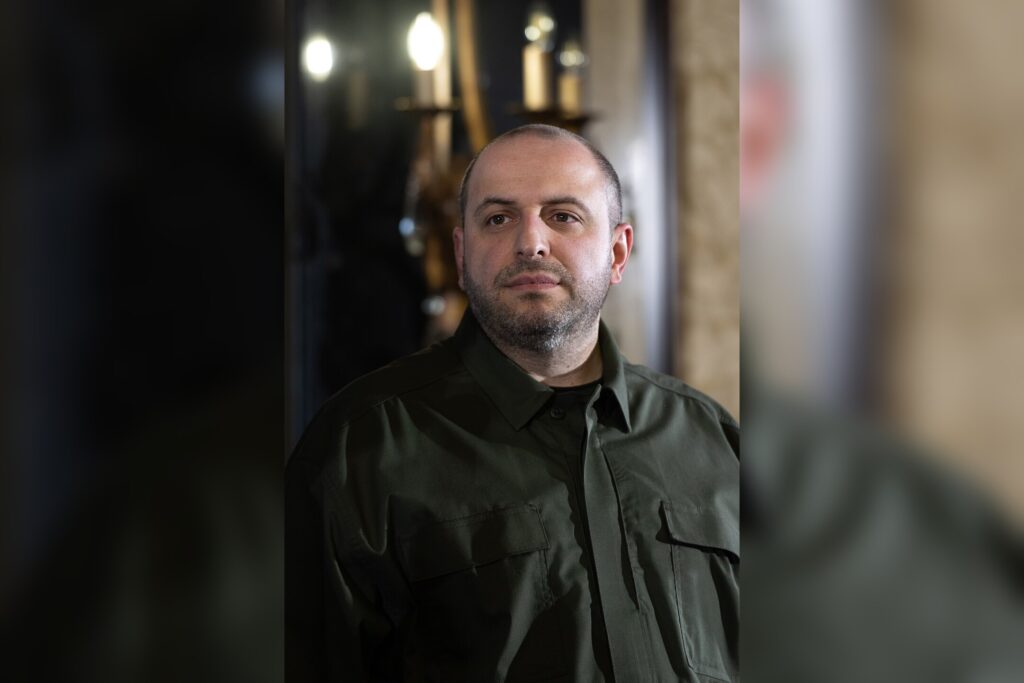
When Ukraine’s parliament confirmed Rustem Umerov as defense minister on September 6, 2023, he took charge of a sprawling military bureaucracy at a critical juncture in the country’s war with Russia. The appointment came with explicit expectations from Kyiv’s Western backers: speed up the integration of advanced weaponry, overhaul procurement, and show measurable progress against the corruption that has long plagued defense spending.
Since then, Umerov has steered a strategic pivot toward long-range strike capabilities and drone warfare, while maintaining the steady flow of military aid from the United States, Germany, and the United Kingdom that Ukraine relies on to hold Russian forces in check.
From Parliament to the Pentagon: Coordinating a Wartime Arsenal
Umerov, a Crimean Tatar born on April 19, 1982, in Tashkent, Uzbekistan, entered the defense portfolio with a political background that had little direct military experience. He served as a member of the Ukrainian parliament from 2019 to 2022 as a member of the Holos party, then chaired the State Property Fund of Ukraine before taking the defense ministry.
That trajectory, officials note, has not prevented him from becoming a central figure in the coalition of nations arming Ukraine. Umerov succeeded Oleksii Reznikov and has since held regular sessions of the Ukraine Defense Contact Group–the coordination body known as the Ramstein format–as the primary forum for matching Ukrainian battlefield requests with allied production capacity. He has also conducted direct, bilateral talks with German Defense Minister Boris Pistorius.
Under his leadership, Ukraine has fielded Leopard 2 main battle tanks supplied by Germany, IRIS-T air defense systems, and a growing inventory of strike drones. The minister has publicly and repeatedly emphasized the need for long-range systems to strike deep into Russian-held territory, as well as drone fleets capable of attritting Russian logistics and armor.
This shift in emphasis has shaped procurement requests and influenced the mix of weapons flowing into the country, with a clear priority placed on platforms that can hit targets beyond the immediate front line.
Cleaning Up Procurement: The Price of Continued Support
Umerov’s tenure has been defined not only by what weapons Ukraine acquires but by how it spends the money to get them. Western officials have made clear that continued military assistance is conditional on demonstrable progress in cleaning up procurement processes, reducing waste, and increasing transparency.
The defense minister has pushed a series of anti-corruption reforms inside his ministry, seeking to overhaul a system that has historically been vulnerable to inflated contracts and opaque tenders. These reforms are seen as essential to sustaining the support from Washington, Berlin, and London, as those governments face political pressure from their own constituencies to prove that taxpayer dollars are being used effectively. The context for Umerov’s reform drive is deeply rooted in Ukraine’s recent history.
The country became independent in 1991, when the Soviet Union dissolved, after centuries of being divided among and ruled by external empires. The territory now called Ukraine was home to early Slavic expansion and the medieval state of Kievan Rus’, and later was contested by Lithuania, Poland, the Ottoman Empire, and Russia before being absorbed into the Russian Empire.
Following independence, Ukraine adopted a new constitution and moved toward a free-market democracy while struggling with entrenched corruption and old state controls. The Euromaidan demonstrations in 2014 ended with Russia occupying and annexing the Crimean Peninsula–the region where Umerov’s Crimean Tatar community originates. That annexation, combined with the full-scale invasion that began in 2022, has driven Kyiv’s relentless pursuit of weapons and, at the same time, made Western governments insistent that their aid not be squandered.
Umerov’s push for transparency is thus a direct response to both the demands of allies and the lessons of a Soviet-era procurement culture that has long hindered modernization. Looking ahead, Umerov faces the challenge of sustaining Western military support amid shifting political dynamics in allied capitals.
The integration of strike drones and long-range systems will likely remain a priority, just as the Ramstein-format meetings continue to serve as the primary forum for matching Ukrainian requests with allied production capacity. For now, the minister responsible for Ukraine’s defense strategy operates inside a history of external domination and a recent conflict over sovereignty–a reality that shapes every aspect of his work, from the weapons he requests to the internal reforms he pushes through.




