
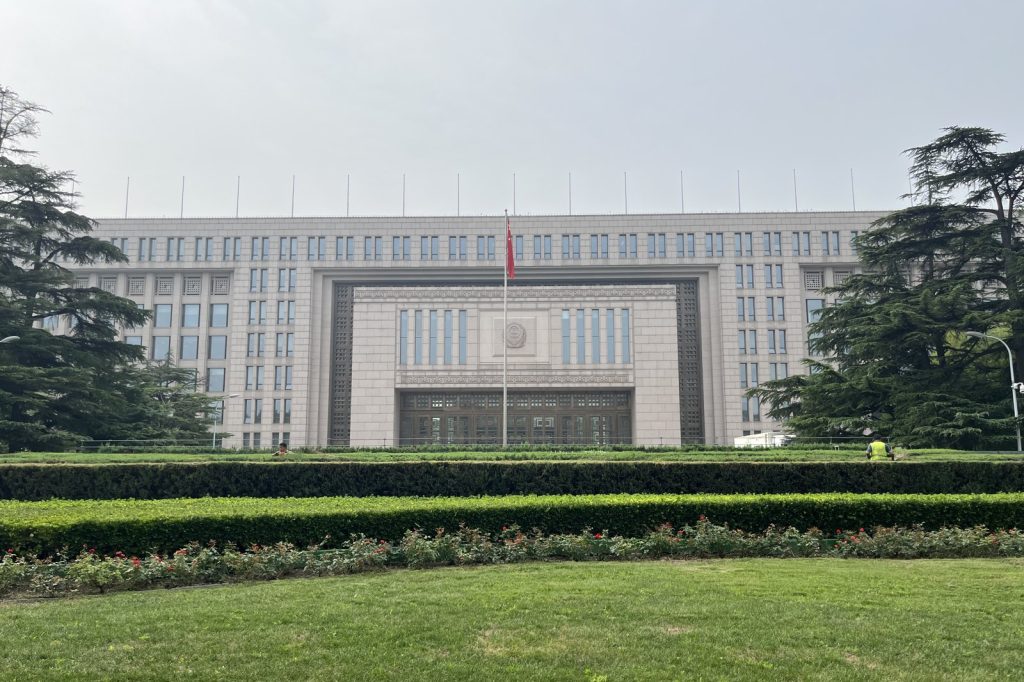
A former high-ranking Chinese law enforcement official has been handed a death sentence with a two-year reprieve, marking a significant moment in the country’s ongoing anti-corruption campaign. Sun Lijun, who previously served as vice-minister of Public Security, was convicted on bribery and corruption charges that authorities say undermined state authority.
The sentence, typically commuted to life imprisonment after the reprieve period, represents the most severe punishment short of immediate execution. It underscores the gravity of the offenses found by the court, which involved a figure who once oversaw critical domestic security operations. Sun’s downfall began in April 2020 when the Chinese Communist Party’s anti-graft agency launched an investigation.
The probe stretched over two years, suggesting a complex web of misconduct that extended beyond a single individual. Court documents indicate Sun was connected to a network of corrupt officials linked to former top leader Jiang Zemin, highlighting how corruption cases in China often implicate broader political networks.
During his career, Sun held two particularly sensitive positions. As director of the First Bureau of the Ministry of Public Security, he was responsible for domestic political security, including internal stability and political dissent management. He also headed the ministry’s Hong Kong, Macao, and Taiwan Affairs Office, which handled delicate territorial relations.
The corruption at these posts raised concerns about compromised policy implementation and intelligence flows, though the full impact may never be publicly known. The case sends a clear message throughout China’s law enforcement and political ranks.
Other officials who shared Sun’s political orbit or benefited from his patronage now face heightened scrutiny. The anti-graft agency has demonstrated its capacity to reach the highest levels of power, establishing a benchmark for accountability. For thousands of domestic security officials, the conviction serves as a stark warning about the consequences of corruption.
The sentence also carries political implications, weakening the Jiang Zemin faction by removing one of its powerful members. In China’s opaque political landscape, the anti-corruption campaign functions not only as a governance tool but also as a mechanism for central authorities to check rival power structures.
For the public, the case serves as a demonstration of institutional effectiveness. A figure who once wielded enormous authority over political security and territorial affairs now faces the ultimate penalty, reinforcing the principle that no position exempts an individual from legal consequences.




