
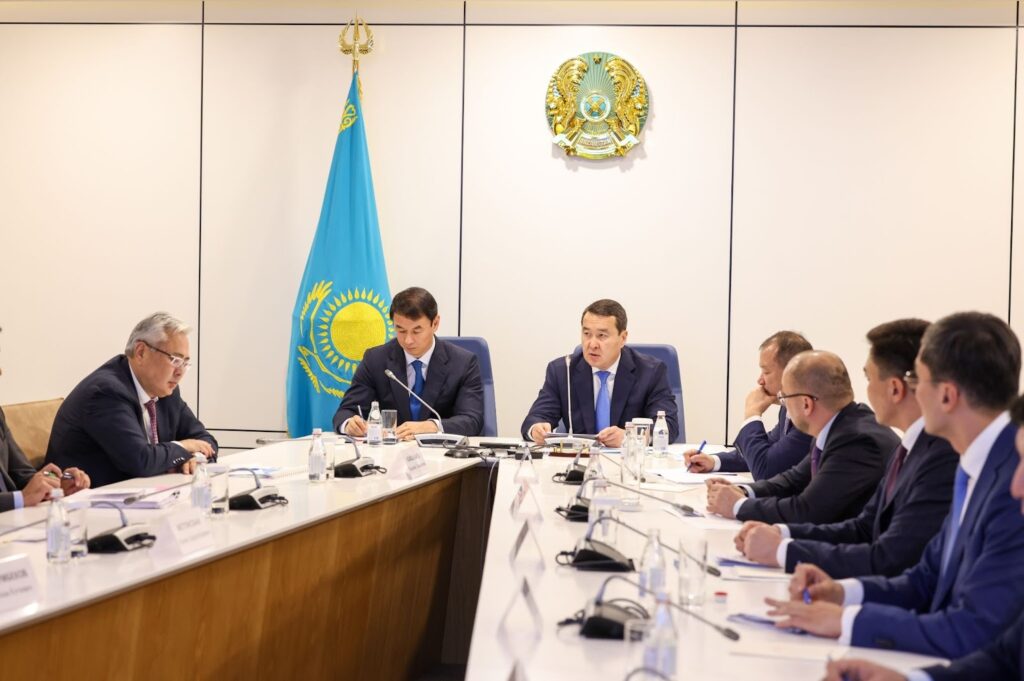
Almaty — The most telling scene of the season’s diplomacy played out in Omsk, Siberia. Seated beside Vladimir Putin at the 22nd Russia-Kazakhstan forum on July 25, President Kassym-Jomart Tokayev suggested it was “perhaps time to freeze this conflict” and return to an “Istanbul 2.0 formula”. “All this must stop”, he concluded. The Kremlin dismissed the idea. The significance was in the posture: the leader of Central Asia’s foremost power addressing Russia’s president as a partner whose choices can be questioned.
The backdrop was economic, and immediate. Ukrainian drone attacks have disrupted the Caspian Pipeline Consortium terminal at Novorossiysk, the Black Sea outlet for roughly 80% of Kazakhstan’s oil exports, and Astana said it had slashed production after the shutdown. The 1,500km pipeline across the steppes carries the sour CPC blend — named for the consortium that counts Chevron, ExxonMobil and Shell among its partners — from fields that make Kazakhstan the European Union’s second-largest crude supplier. Oil and gas account for about a fifth of the country’s GDP. “This is a direct strike on the economy and budget,” regional expert Daniil Kislov told Al Jazeera.
From Indebted To Independent-Minded
The Omsk intervention was not improvised. In 2022, weeks before Russia’s full-scale invasion, Tokayev had invited CSTO troops in to steady his domestic position — an apparent debt to Putin. He repaid none of it: that June, at the St Petersburg forum and in Putin’s presence, he refused to recognise the self-proclaimed Donetsk and Luhansk republics, calling them “quasi-state territories”. In September 2022, Kazakhstan rejected the annexation referendums. In November 2023, he opened a meeting with Putin in Kazakh, sending Lavrov and Peskov scrambling for their headsets in a region where diplomacy had run exclusively in Russian.
The balancing act is deliberate. Kazakhstan has not joined Western sanctions but has moved to limit their circumvention. China is now its largest individual trading partner; the European Union leads when counted as a bloc and remains the top source of foreign investment. The Trans-Caspian Corridor links China to Europe without Russian territory, and the “Central Asia 2040” project with Uzbekistan aims to give the region interests of its own.
What The Oil Shutdown Revealed
Dependencies cut both ways. The two countries share a border of more than 7,500 kilometres — the world’s longest continuous land frontier; trade reached 28.1 billion dollars in 2024; Rosatom leads the consortium building Kazakhstan’s first nuclear power plant. When the Novorossiysk attacks began in November 2025 and intensified this month, Astana’s Foreign Ministry on July 19 called them an “unacceptable encroachment” designed to “destabilise legitimate international trade, world energy markets”. Ukraine’s ambassador Viktor Mayko answered that there was “no proof” the drones were Ukrainian and warned against “hasty and ungrounded accusations”.
Ordinary Kazakhs have blunter priorities. “I don’t care, because the money doesn’t reach me anyway,” said Alzhas, a bank clerk in Almaty, noting that people around him had “stopped talking, arguing about the war” because only food prices matter now. In Romania, which gets over 60 percent of its crude from Kazakh fields, interim premier Ilie Bolojan said no supply problems were expected — while conceding gasoline output could fall by up to 15 percent if shipments do not resume.
Washington’s Quiet Hand
Because US oil companies hold stakes in the Kazakh fields, the pressure has diplomatic weight. Analyst Volodymyr Fesenko of Kyiv’s Penta think tank suggested there could be “informal pressure” from the White House — “persistent recommendations” to President Zelenskyy “not to touch this very terminal in Novorossiisk” — though he expected no “any cardinal, fatal, negative consequences”. The Wall Street Journal reported Chevron chief Mike Wirth approached White House officials, and that the Trump administration warned Ukraine against strikes on non-Russian shipping in the Black Sea, where drones have struck almost 200 “shadow fleet” vessels in recent weeks.
The broader reading, offered by IRIS analyst Lukas Aubin, is that the post-Soviet space itself is dissolving: Russia remains a pole in Eurasia, but no longer the sole centre of gravity, and middle powers like Kazakhstan convert oil, uranium and geography into freedom of manoeuvre. Tokayev can propose freezing the war. He cannot impose it — which is precisely the measure of both his leverage and its limits.
Sources
- ‘Freeze the conflict’: Drones slow Kazakh oil flow amid Russia-Ukraine war | Russia-Ukraine war News | Al Jazeera
- Kazakhstan asserts itself in relation to Russia: an emancipation more apparent than real? – IRIS




