
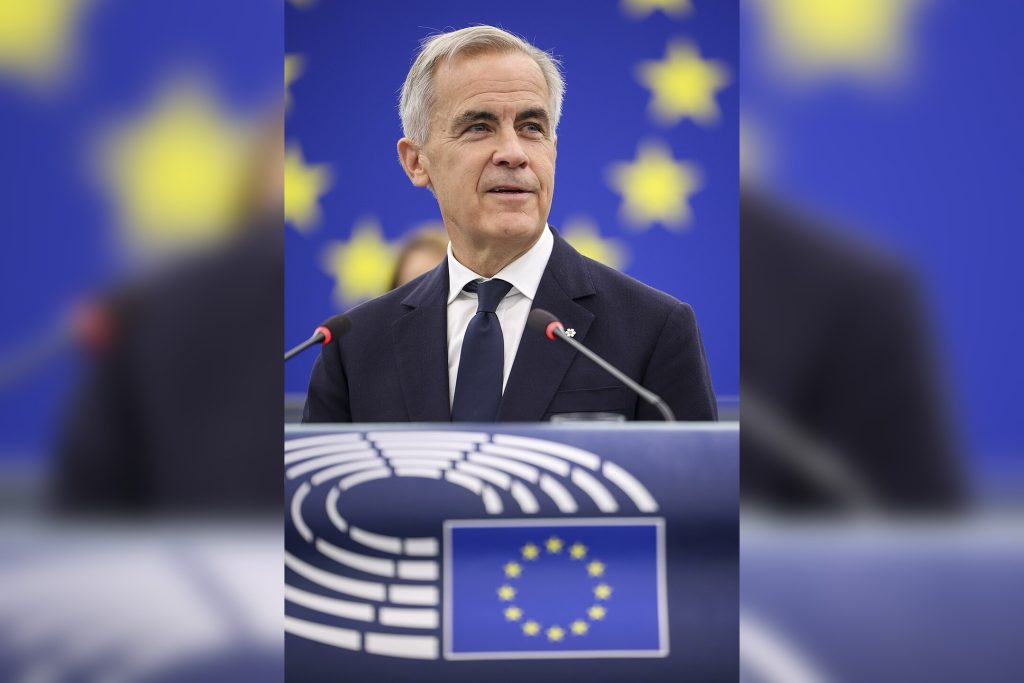
“I would like to work with you on opening the door for Canada to be the first associate member of the EU.” Ursula von der Leyen said that in the European Parliament in Strasbourg on Wednesday, with Canadian Prime Minister Mark Carney sitting in the room. Nobody had heard the phrase before. Even EU diplomats were caught off guard, since she had not used the term when she briefed them on her speech the previous Friday.
The Commission president said the EU and Canada “see the world with the same eyes” on questions from AI and climate to the war in Ukraine. She wants the existing trade deal upgraded into an “alliance for the future” and a “common prosperity and economic security space.” Her list ran on: a tech alliance, integrated defense industrial bases, the Arctic as a “flagship joint project,” and work on energy, critical minerals, batteries, quantum computing and cybersecurity. EU officials are especially interested in Canada’s energy and natural resources.
Carney, who was due to address the parliament on Thursday, has been calling for a “unique alliance” with the bloc as Canada tries to cut its heavy dependence on US trade. He later posted: “Canada and the EU are natural partners, united by shared values.” A summit is planned for late October.
A category that does not exist
The 27-member EU has never had an associate membership. Norway, Iceland and Switzerland have deep economic ties and follow many EU rules, but none holds that label. During Brexit talks, EU officials said again and again that no status allowed a country to be half in and half out of the single market.
Some in Brussels are skeptical. One EU diplomat said member states backed the ambition but had worried in recent weeks that von der Leyen was overpromising. “‘Associate membership’ sounds like a nice headline but in reality 10 member states have still not ratified Ceta,” the diplomat said, referring to the trade agreement struck 10 years ago. A second diplomat called the idea “an empty phrase.”
Martin Leng of the Brussels Institute for Geopolitics read the speech as ambitious in breadth, yet suggested Canada’s membership might amount to “plugging in” to existing programs such as the European Defence Agency. Roland Paris, who directs the Graduate School of Public and International Affairs at the University of Ottawa and advised Justin Trudeau, thinks the label matters little. “What I expect is that we’re going to see a collection of agreements rather than membership in any institutional sense,” he said. He doubted any Canadian leader would accept subordinating Canadian law to Europe.
Trump, and the view from Ottawa
The push comes as both partners have clashed with Donald Trump over tariffs, and as he has kept talking about Canada as the 51st US state. Last month Carney broke off trade talks with Washington, saying Canada would not be subjugated, and brought in retaliatory tariffs on billions of dollars of US goods. The EU accepted 15% tariffs last year on many European goods and dropped its own duties. Many MEPs have praised Carney’s approach. Javier Moreno Sánchez, a Spanish socialist who leads the parliament’s Canada delegation, said the EU had lessons to learn because “Trump respects people who are strong.”
At home, Conservatives were furious. Leader Pierre Poilievre wrote that Canadians “struggling to pay their rent” would be taxed “to fund the European Union’s heavy bureaucracy.” He added: “We will NEVER be the 51st American state. And we will NEVER be the 28th state of the European Union.” Another Conservative, Jamil Jivani, said the party would never back a plan to have Canada join the EU.




