
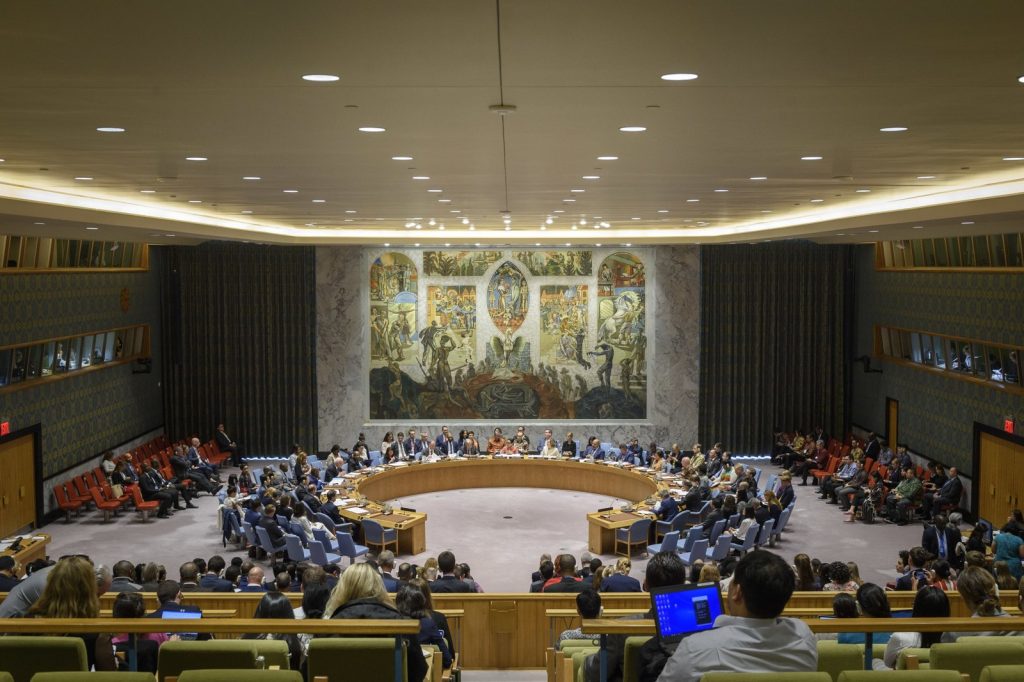
The clock on United Nations Security Council Resolution 2231 had a built-in deadline, and everyone in the Iran file knew the date: October 18, called “termination day”. After it, the legal authority to trigger “snapback” sanctions would expire unless a new resolution blocked it. In 2025 three European governments decided not to wait.
What the resolution does
Resolution 2231 gave the Security Council’s backing to the 2015 nuclear deal with Iran, known as the JCPOA, and set out how it would be carried out. Under it, UN sanctions on Iran were suspended in return for limits on its nuclear program and outside monitoring. It also contains the snapback clause, which lets any JCPOA participant restore the suspended measures if it decides Iran is not keeping its commitments. Its negotiators built it so that no veto at the UN could stop it. Arms Control Association reporting from 2020 also notes that the resolution carries the expiry date of the arms embargo, which was scheduled for October 2020.
2020: the first attempt
The United States formally abandoned the deal in May 2018. The resolution, though, was never rewritten, and it still lists Washington among the participants. The Trump administration weighed arguing that this was enough to invoke snapback and keep the embargo alive. Secretary of State Mike Pompeo said on May 9, 2020 that Washington “will exercise all diplomatic options”.
The other parties pushed back. Josep Borrell, the EU’s foreign policy chief, said Europe no longer regarded the United States as a party to the deal. Russia’s ambassador, Vassily Nebenzia, said the US “has lost any right” to snap back UN restrictions. China’s UN mission said Washington had failed its obligations under the resolution by withdrawing. Iranian President Hassan Rouhani warned that “Iran would never accept the extension of an arms embargo”.
2025: the Europeans pull the trigger
On August 28, 2025, Britain, France and Germany wrote to the Security Council stating that Iran’s nuclear activities breached the deal. That started a 30-day process. They said Iran’s non-compliance was “clear and deliberate”, and pointed to the International Atomic Energy Agency’s report that Iran was stockpiling uranium enriched to as much as 60 per cent in May 2025. Foreign Secretary David Lammy said Britain and its partners had negotiated in good faith, and that “the ball remains in Iran’s court”.
No agreement was reached. On 29 September 2025, UN nuclear-related sanctions on Iran came back, without any vote from Russia or China, according to the law firm Covington & Burling. Every UN member state must now reinstate them in national law. They rest on resolutions from 2006 to 2015 and include export controls on military and nuclear-sector goods and asset freezes that reach firms such as Bank Sepah.
The EU’s Council adopted three regulations the same day, restoring both the UN-mandated measures and its own earlier sanctions. In Britain, new regulations took effect on 1 October 2025.
Sources
- U.S. Aims to Extend Iran Embargo (Arms Control Association, Arms Control Today)
- European countries trigger snapback sanctions against Iran (The Jewish Chronicle)
- Reimposition of UN-Mandated Sanctions Against Iran and Additional EU and UK Sanctions (Covington & Burling LLP)




