
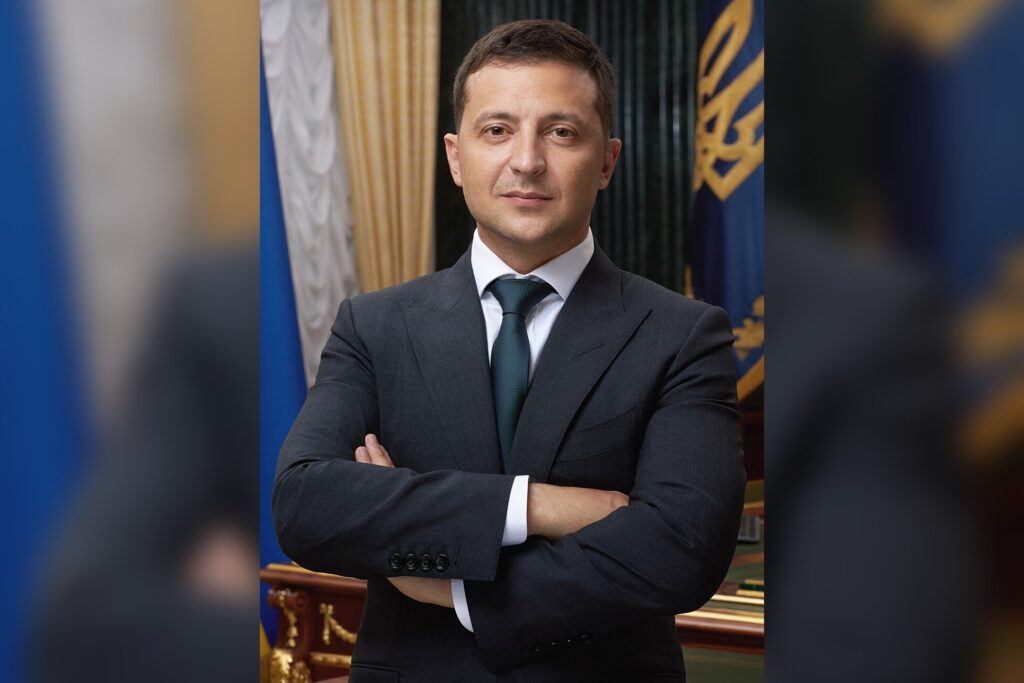
KYIV, July 7 — Against the backdrop of a war that has now stretched into its fifth year, Volodymyr Zelenskyy remains the figure around whom Ukraine’s resistance continues to turn. The former comedian, elected president on April 21, 2019, with 73.2 percent of the vote, has undergone a transformation that few could have predicted when he took office.
From the studios of the television series ‘Servant of the People,’ where he played a teacher who becomes president, to the bunkers of a nation under full-scale invasion, the arc of his leadership has been defined by the Russian assault that began on February 24, 2022. Zelenskyy’s decision to remain in Kyiv as Russian forces advanced on the capital in those early days of the invasion set the tone for his wartime presidency.
It was a choice that resonated deeply within Ukraine and across European capitals, where the question of what is at stake in this conflict has never been abstract. His approval rating, which stood above 60 percent as of mid-2024, reflects a domestic resilience that has weathered the grinding nature of the war, even as the front lines have shifted and the costs have mounted. In the corridors of international diplomacy, Zelenskyy has been a persistent and often urgent voice.
He addressed the United States Congress on December 21, 2022, and has spoken multiple times before the United Nations General Assembly since the invasion began. These addresses have consistently carried a central demand: Western military aid, particularly long-range weapons, to allow Ukrainian forces to strike deeper into Russian-held territory and beyond.
A Shift in Strategic Reach
A significant marker of how Ukraine’s military capabilities have evolved came on September 22, 2024, following a strike on the Omsk refinery deep inside Russia. In the aftermath of that operation, Zelenskyy stated that Siberia was now “within reach” of Ukrainian forces. The declaration signaled an expansion of the war’s geography, moving the conversation from defensive operations and the liberation of occupied territories to the possibility of striking targets far from the front lines.
The wider picture here is one of a conflict that has consistently defied expectations. What began as a Russian attempt to seize Kyiv in a matter of days has become a protracted war of attrition, with Ukraine repeatedly demonstrating an ability to innovate and strike beyond the immediate battlefield.
Zelenskyy’s public framing of these capabilities has been deliberate, aimed both at reassuring a war-weary domestic audience and at signaling to Western partners that their military aid is producing tangible results.
The Goal of 1991 Borders
Zelenskyy has stated clearly that Ukraine’s war aim is the restoration of its 1991 borders, which would include the return of Crimea, annexed by Russia in 2014. This position has remained consistent even as the battlefield realities have shifted and as some Western voices have quietly suggested that a negotiated settlement might be the more realistic outcome. For Zelenskyy, the territorial integrity of Ukraine is not a negotiating chip but a red line.
Born on January 25, 1978, in the industrial city of Kryvyi Rih in central Ukraine, Zelenskyy came to politics from a world of entertainment. His transition from comedian to commander-in-chief has no modern parallel in European politics.
It is a story that has been told many times, but its resonance has not faded, particularly in European capitals where the fragility of democratic institutions is a live concern. As of this writing, on July 7, 2026, the war continues. The question that hangs over the coming months is whether the Western alliance, under the current administration in Washington, will sustain the level of support that Zelenskyy has argued is necessary for Ukraine not merely to survive but to achieve its stated objectives.
The corridors of power in Brussels, London, and Washington will be watching closely.




