
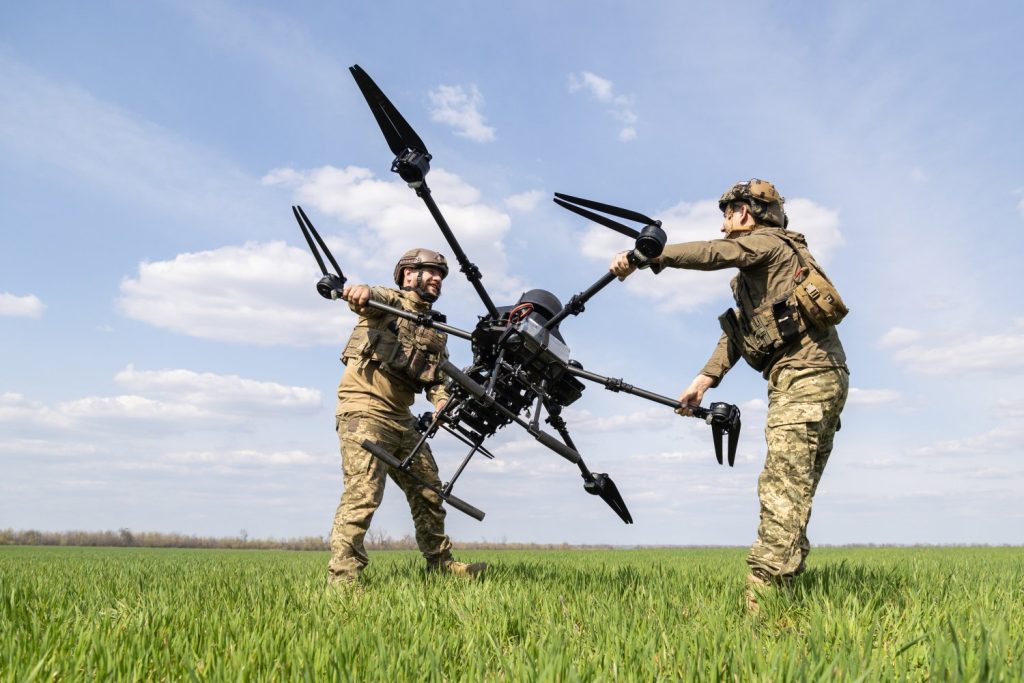
In June, Ukrainian drones hit 11 oil refineries and more than eight defense-industrial enterprises. “There were only a few days when nothing was burning in the enemy’s strategic rear. Moscow burned twice in June,” the 1st Separate Unmanned Systems Center of Ukraine’s Unmanned Systems Forces told RBC-Ukraine.
The center says its deep-strike assets struck 697 targets in Russia in the first half of 2026 and knocked out a record 43% of the country’s oil refining capacity. It puts the rise in deep strikes since the start of the year at 1,150%. These are the unit’s own figures, given to a Ukrainian outlet.
Ukraine’s National Security and Defense Council (RNBO) says the country deployed six times more long-range drones in 2025 than in 2024. Asked about plans, the center would say only: “We do not disclose specific plans or future targets, of course. But the effort is systematic, and every next step is part of our broader strategy.” Its current focus is the fuel sector, defense industry and the logistics networks serving them.
Omsk, and the distance flown
In July, the center and other Defense Forces units hit Russia’s largest oil refinery, at Omsk. The city is about 2,400 kilometers away in a straight line. Counting route deviations and maneuvering, the drones covered as much as 3,000 kilometers, according to the center. It also says it has more assets, sharper reconnaissance and a shorter preparation cycle.
What makes a drone fly that far
Developers of the Bars long-range drone say the main difference from shorter-range models is fuel capacity and battery storage: more reserves, more distance. Oleh Krot, chairman of the board of Culver Aerospace, puts it as a design question. “Deep-strike drones are engineered from the outset to cover vast distances, operate for extended periods and complete missions in a challenging environment,” he said.
Short-range drones prize simplicity, speed of deployment and low cost. Long-range ones need energy efficiency, aerodynamics, engine stability, reliable electronics and navigation that holds up in contested airspace.
DG Industry’s Shpatel drone, which can fly hundreds of kilometers one way, was built as a universal platform. It can strike under manual control or with pre-programmed or updated coordinates, serve as a decoy to overload air defenses, or work as a communications relay.
Routes are planned before launch, with the target, range, platform limits and navigation conditions all weighed. Manual control suits tactical systems, but long-range platforms lean on autonomy and mission planning, and the military makes the final call on flight paths. Makers would not describe how they beat electronic warfare. DG Industry said it has adapted drones to satellite communication links, so jamming is “not currently critical” for its platform. Krot called it a race of adaptation: “The edge belongs to whoever learns faster, implements changes more quickly and better integrates combat experience into its systems.”
Cost matters too. Developers say large-scale deployment forces the enemy to spend far more expensive air-defense assets on comparatively cheap targets. Over the next one to two years, they expect deep-strike drones to become more autonomous, harder to jam and more tightly tied into the wider intelligence network.




