
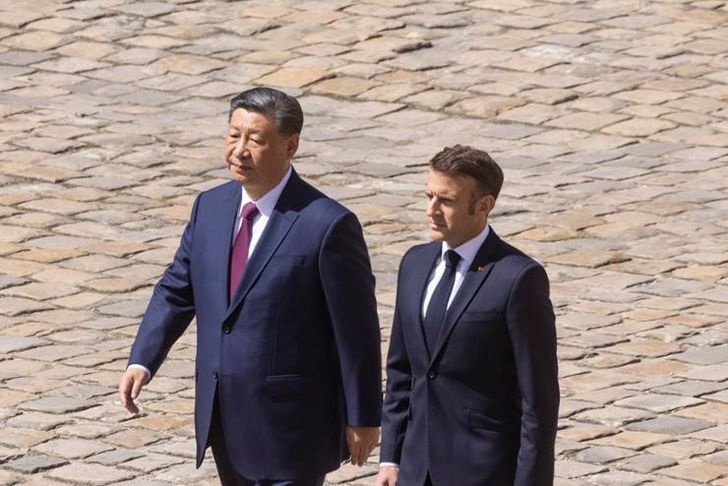
Protesters were already on the pavements of Paris, shouting “Free Tibet,” when Xi Jinping’s motorcade arrived on Sunday. French Prime Minister Gabriel Attal met the Chinese president that afternoon. It was the start of Xi’s first European tour in five years, and the first stop was France.
Xi, who is 70, goes on from Paris to Serbia and Hungary. Monday brought the main business: talks with President Emmanuel Macron and European Commission chief Ursula von der Leyen.
What is on the table
The Élysée Palace listed four topics for Paris: the war in Ukraine, the Middle East, economic cooperation and climate protection. Trade will be the sharp edge. Brussels has threatened stiff new tariffs on Chinese electric vehicles, which European regulators say benefit from heavy state subsidies and sell abroad at artificially low prices. Beijing has hit back with its own investigation into brandy imports, most of them French.
France also wants better access to the Chinese market for its farm exports. Officials said Paris will raise the cosmetics industry’s worries over intellectual property rights. China, for its part, may announce an order for about 50 Airbus aircraft during the visit.
On Ukraine, France hopes to nudge Beijing into leaning on Moscow. Progress has been thin. The one visible result of Macron’s trip to Beijing last year was Xi’s decision to phone President Volodymyr Zelensky for the first time. Europe has also criticized China for refusing to take a stand against Russia’s invasion and for keeping close ties with Moscow.
Warm words from Xi, a divided Europe
In a statement issued on his arrival, Xi called relations between China and France “a model for the international community of peaceful coexistence and win-win cooperation between countries with different social systems.” Chinese state media took a similar tone. “China-EU economic and trade cooperation is huge, and bumps and bruises are inevitable,” the People’s Daily wrote. The Global Times said Beijing’s wish to widen cooperation and back Europe’s strategic autonomy “remains unwavering.”
Macron was more guarded. In an interview with La Tribune before the visit he conceded, “In Europe, we are not unanimous on the subject because certain players still see China as essentially a market of opportunities.” Paris wants a tougher line on the electric vehicle probe. Berlin prefers to move with more caution, sources said, and German Chancellor Olaf Scholz did not join the Paris meetings because of earlier commitments.
Macron told the Economist that Europe should do everything to involve China in the big global questions, and that it is in Europe’s interest “to ensure that China has a say in the stability of the international order.” At the meeting itself he spoke of a future that depends on “a balanced relationship with China.”
Strained since 2019
Relations have worsened since Xi last came to Europe in 2019. A proposed investment deal between China and the European Union was put on hold over tensions and human rights concerns, and some EU leaders have warned against leaning too heavily on the Chinese economy. Before Xi left home, state media argued that Europeans had let themselves be pushed into dependence on Washington, especially after the war in Ukraine began.
The trip falls on the 60th anniversary of Franco-Chinese diplomatic relations. Macron has invited Xi to the Tourmalet Pass in the Pyrenees on Tuesday, a place he visited as a child to see his grandmother. It is meant as a return gesture: last year Xi took Macron to the governor’s residence in Guangdong province, where Xi’s father once lived.
Serbia and Hungary come next. Both are friendly to Beijing and belong to the Belt and Road Initiative. Chinese Foreign Ministry spokesman Lin Jian spoke of expanding China’s “iron friendship” with Serbia and called the Hungary trip a “landmark visit.” Hungary’s government under Prime Minister Viktor Orbán is considered China-friendly.
Sources
- China's Xi arrives in Paris for first European trip in five years
- China's Xi in Paris to meet Macron, with trade, Ukraine talks planned
- HEAD POST: Xi Jinping visits France in first post-pandemic trip to Europe




