
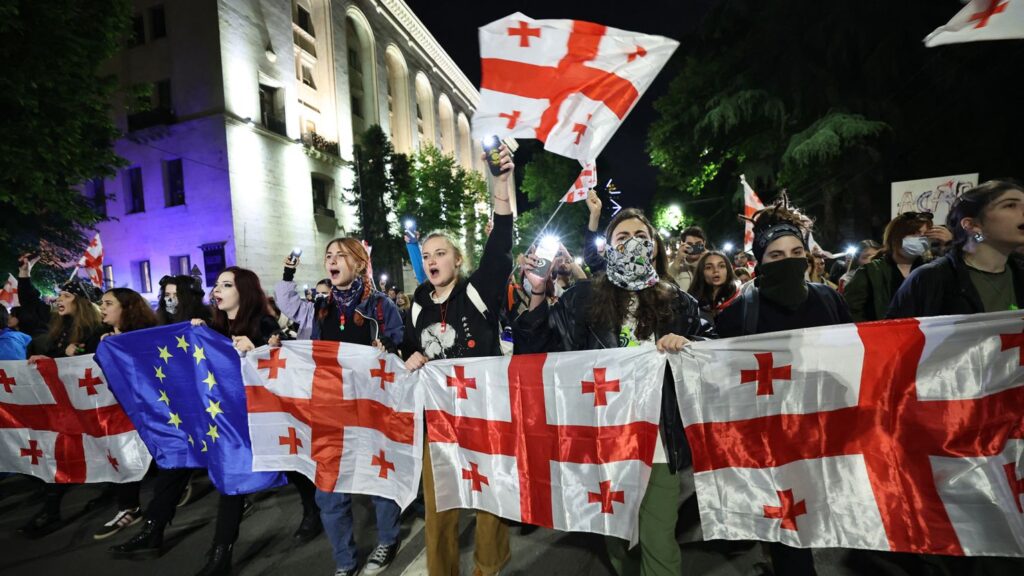
Aleko Elisashvili, an opposition lawmaker, punched Mamuka Mdinaradze, leader of the governing Georgian Dream party, in the face during a brawl in the Georgian parliament. National television broadcast the footage on Monday. A day later, the chamber voted the “foreign agents” bill through anyway, and thousands of protesters clashed with police outside the building in central Tbilisi.
The measure, officially titled the “transparency of foreign influence” bill, passed with 84 of 150 members voting in favour. Under it, any NGO or media outlet that draws more than 20 percent of its funding from outside Georgia must register as a body “pursuing the interests of a foreign power”. Groups that refuse, or that decline to hand over sensitive details about their foreign money, face a fine of 25,000 lari ($9,360). A further 20,000 lari ($7,490) is added for every month they stay out of compliance.
A bill that came back
Georgian Dream, in power since 2012, first proposed the law last year and pulled it after street protests. It returned in March, shortly after Irakli Kobakhidze became prime minister. April brought more demonstrations, and masked riot police answered them with violence and arrests. About 50,000 people gathered in Tbilisi on the Sunday before the vote.
What the government says
Officials describe the bill as a transparency tool that protects Georgian sovereignty and pushes back against “pseudo-liberal values” promoted by foreigners. Bidzina Ivanishvili, the billionaire who backs Georgian Dream, has called NGOs foreign puppets and accused them of plotting a revolution. Kobakhidze warned that without the law Georgia would lose its sovereignty and “easily share the fate of Ukraine”, though what he meant was not immediately clear. The government also points to the Foreign Agents Registration Act in the United States and to similar measures planned in France and other EU states.
Opponents call it the “Russian law”, after the legislation the Kremlin has used against critics of President Vladimir Putin. President Salome Zourabichvili told CNN it was an “exact duplicate” of the Russian original. She has promised a veto, but a simple majority in parliament can override it, and Georgian Dream has that majority.
Fear inside civil society
Eka Gigauri runs the Georgian branch of Transparency International, which has worked in the country for 24 years. She told France24: “The implication would be that they might freeze our assets.” Nato Shavkaladze, who operates a shelter for women fleeing domestic abuse, put it more bluntly to AFP: “If we don’t register, we will probably cease to exist.”
Baia Pataraia, head of the women’s rights group Sapari, said she has faced harassment, threats and accusations of being a foreign agent since the bill returned. She will not register.
Western reaction
Ursula von der Leyen, president of the European Commission, said on May 1 that Georgia was “at a crossroads”. EU spokesman Peter Stano was direct about the stakes: “EU member countries are very clear that if this law is adopted it will be a serious obstacle for Georgia in its European perspective.” Georgia applied for EU membership in 2022 and won candidate status in December last year.
Washington had urged Tbilisi to hold back right up to the vote. “We’re deeply troubled by Georgia’s Kremlin-style foreign agents legislation,” US Press Secretary Karine Jean-Pierre said on Tuesday. “If this legislation passes, it will compel us to fundamentally reassess our relationship with Georgia.” US ambassador Robin Dunnigan said on May 2 that Kobakhidze had been invited to talks with senior American leaders. Georgia’s foreign ministry said he turned the invitation down, and Kobakhidze accused the US of backing “revolutionary attempts” by NGOs such as Transparency International Georgia and ISFED.
Ministers from Iceland, Lithuania, Latvia and Estonia also urged Georgia to drop the bill and were due to meet the Georgian president, foreign minister and parliamentary head on Wednesday. Human Rights Watch wrote on X that the law aims to “silence media and civil society” and “threatens rights”.




