
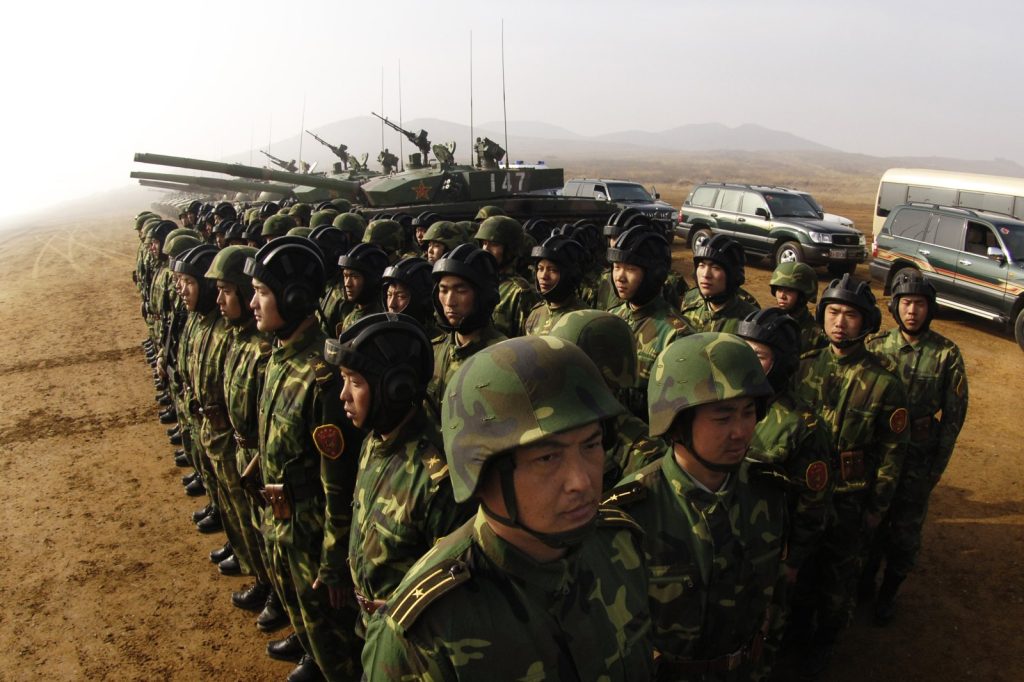
A Pentagon report to Congress says China’s military planners no longer picture a war with the United States as a fight between armies and navies alone. They call the concept “national total war,” and the report describes it as a “clash of national systems” in which civilian industry, the economy and ordinary society are pulled into the fight.
The People’s Liberation Army, the report says, expects future combat to include high-tech and autonomous systems. It also expects maritime blockades, forced isolation and sweeping sanctions. Pentagon analysts say the PLA took those lessons from the Western response to Russia’s 2022 invasion of Ukraine.
One caution from the authors: “total war” does not mean here what it meant in the twentieth century. The term usually points to an all-out struggle that ends in unconditional surrender. The report says the PLA uses it to mean full mobilization of strategic resources against the United States and its allies, while the political goals stay limited.
Taiwan and the civilian fleet
The Taiwan sections show the idea at work. Analysts often doubt that China has enough military ships to carry out an amphibious invasion. The report points to a workaround: the PLA Navy keeps training with civilian roll-on/roll-off commercial vessels, which may be a way to cover a shortfall in lift capacity with dual-use ships. Dozens of civilian ferries could add capacity without drawing much notice.
Many observers expect a move on Taiwan around 2027, the so-called “Davidson Window.” It is named after Admiral Philip Davidson, who told Congress in 2021 that “the threat is manifest during this decade, in fact, in the next six years.” The date also matches the PLA’s centenary, which Xi Jinping has set as the milestone for “world-class” military modernization. Beijing’s own five-year plan, published in 2020, had already named 2027 as a goal for modernizing the PLA.
Chips, laws and cyber
The report treats Beijing’s push for military-civil fusion as a whole-of-nation effort. It says Chinese companies and research institutions keep buying components from US suppliers for work on dual-use technologies, among them AI, biotech, quantum technology, advanced semiconductors and energy storage. Chips are a pressure point. China’s AI sector was held back in 2024 by limited access to high-performance accelerators such as GPUs, and the Pentagon says Beijing has responded by stockpiling and trying to get around export controls.
It marks a set of reforms announced in Beijing in July 2024 as a turning point. They were presented as an anti-corruption effort but also included changes meant to improve military-civilian integration and to refine national defense mobilization systems, along with changes to border and coastal defenses to draw more support from civilian sectors and local governments.
Cyber operations fit the same picture. The report says campaigns such as Volt Typhoon “burrowed into U.S. critical infrastructure” in 2024, “demonstrating capabilities that could disrupt the U.S. military in a conflict and harm American interests.” In a conflict, such tools would aim at electric and water utilities, military command and control, and logistics hubs, using denial-of-service attacks and physical disruption. The goal, the Pentagon says, would be to “deter U.S. involvement” and weaken public support for it at home.
Limits the Pentagon sees
The report does not call the plan easy. It points to organizational problems and rigid structures that slow adaptation. Chinese military doctrine is issued in generations, last updated in 2020 and before that in 1999, which makes it hard to fold in lessons from Ukraine or new technology.
Sources
- Inside China’s plans for 'national total war,' according to the Pentagon
- 50 years later, is China 'preparing for war' again?




