
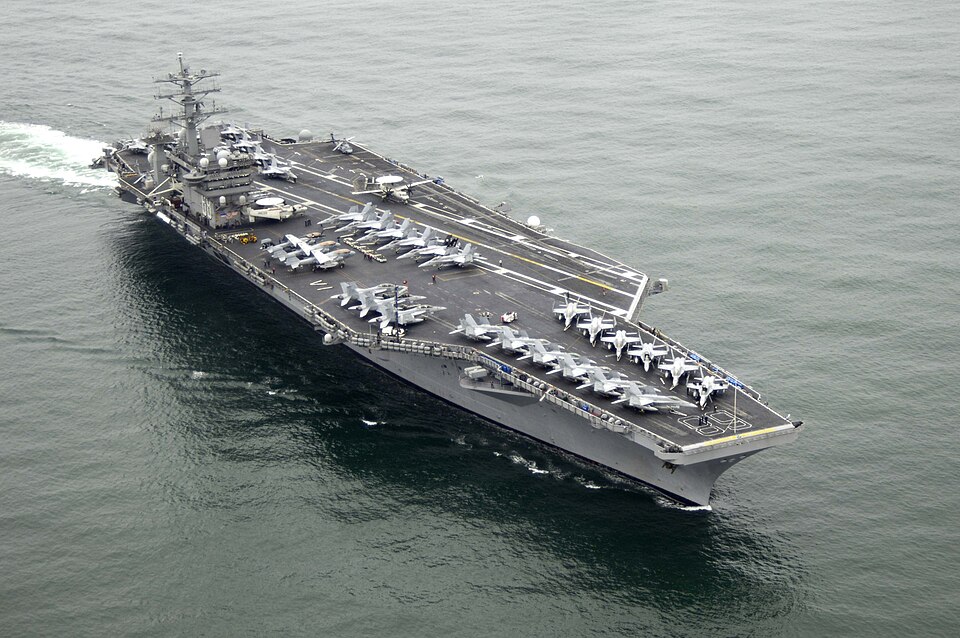
The Pacific Fleet announced it on social media, in a feed already running thin because of the U.S. government shutdown: two aircraft from the carrier USS Nimitz had gone into the South China Sea, one after the other, on Sunday, October 26.
The helicopter came first. Around 2:45 in the afternoon, local time, an MH-60R Sea Hawk of the “Battle Cats” (HSM-73) dropped into the sea during routine work off the ship. Thirty minutes on, an F/A-18F Super Hornet belonging to the “Fighting Redcocks” of VFA-22 followed it down. Both pilots ejected. The Navy has not said why.
Everyone lived. Three people came out of the helicopter and two out of the jet, and search and rescue teams from the carrier group picked up all five. The Pacific Fleet described them as safe and in stable condition and said an investigation into both losses had begun.
A carrier near the end of its career
The Nimitz is the oldest carrier in the U.S. Navy. It was commissioned in 1975 and is due to retire in 2026, and this was its last deployment. It sailed from home waters in March 2025 bound for the Indo-Pacific, stopped in Bahrain in August and had spent much of the summer in the Middle East answering Houthi attacks on commercial shipping. When the aircraft were lost, it was heading home to Naval Base Kitsap in Washington.
The Super Hornet is priced at $60m. It was the fourth F/A-18 the Navy had lost that year.
Fuel, China and a long salvage
President Donald Trump, speaking to reporters aboard Air Force One on his way from Malaysia to Japan, called the pair of crashes “very unusual.” He floated a cause. “They think it might be bad fuel. We’re gonna find out,” he said. The Navy has never published findings that confirm a fuel problem, and officials have said they saw nothing “nefarious” behind either loss.
China’s foreign ministry used the moment to make its own point. Spokesperson Guo Jiakun said Beijing would give humanitarian help if the United States asked, then criticized what he called regular American shows of force in the waterway, which China claims almost entirely.
The wrecks stayed on the seabed for weeks. On December 5 the Navy lifted both from about 400 feet, using a contracted ship carrying an unmanned system, with salvage and diving units alongside. Lt. Cmdr. Christopher Andersen, who led the salvage, credited “a true Navy team effort.” Both aircraft came up intact and were taken to a US military site somewhere in the region for detailed analysis. The investigations remain open, and the Navy has published no cause for either crash.
Sources
- Crews Safe After USS Nimitz Loses Sea Hawk and Super Hornet (The Aviationist)
- Two US Navy aircraft go down 30 minutes apart in South China Sea
- Crashed USS Nimitz Super Hornet and Seahawk Recovered




