
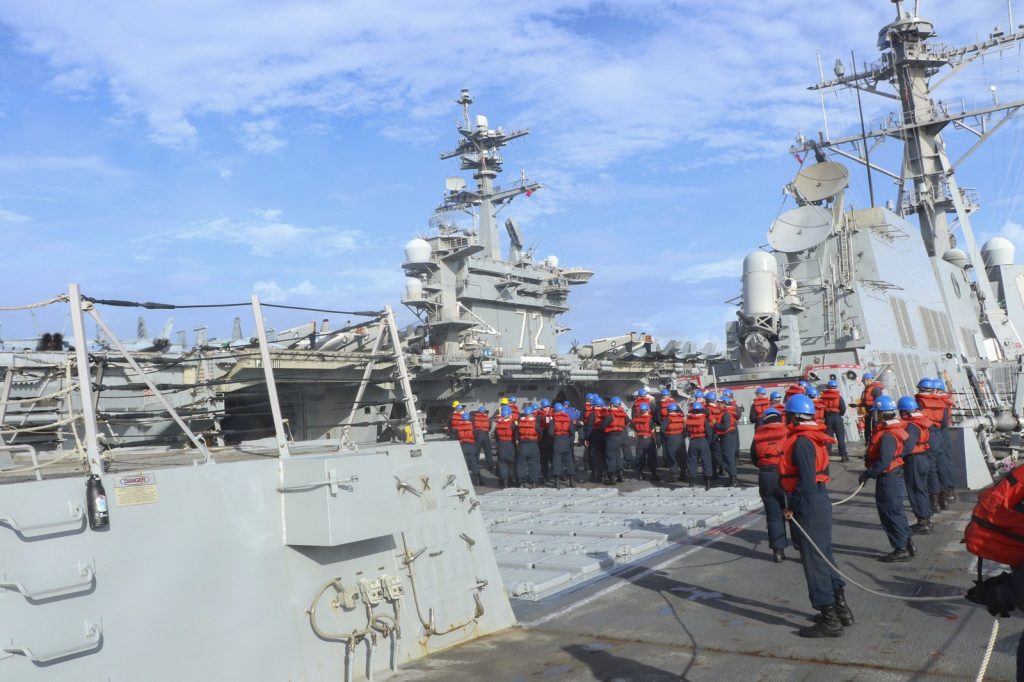
Nobody can say yet how many mines are sitting in the Strait of Hormuz, or how long it will take to get them out.
Two US Navy destroyers, the USS Frank E. Petersen and the USS Michael Murphy, crossed the strait on Saturday and are now in the Persian Gulf, US Central Command announced. Both are Arleigh Burke-class guided-missile ships. CENTCOM said they are “setting conditions for clearing mines.” Axios reported that the move was not coordinated with Tehran. It was the first big American move in the area since the two-week ceasefire announced on Tuesday, April 7.
Drifting mines and thin resources
The New York Times reported Friday, citing American officials, that Iran has lost track of some of its mines. Iran kept a narrow path open through an already narrow waterway, those officials said, but some mines were laid so that they could drift.
The Navy has retired its minesweepers and now relies on littoral combat ships for the job. Two of the three that had been working in the CENTCOM area were sent to Singapore in March. CENTCOM said more forces, including underwater drones, will join the mission soon, though it is not clear which other surface ships will take part. Seven more guided-missile destroyers are in the Arabian Sea, according to USNI News’ fleet tracker, and two others are in the Red Sea. One of them, the USS Spruance, sails with the USS Abraham Lincoln carrier strike group. The Tripoli Amphibious Ready Group, with a Marine Expeditionary Unit aboard, is also nearby.
Mines threaten warships as well as merchant vessels. In 1991, during Operation Desert Storm, the cruiser USS Princeton struck two mines in the Persian Gulf. Three crew members were injured and the ship was pulled from the war for repairs.
Shipping and the talks
The strait carries oil and chemicals that countries around the world depend on. The war, now weeks old, has disrupted traffic through it and pushed energy prices up, even before any mines were laid.
The crossing came while American and Iranian negotiators met in Islamabad. Pakistan, the main mediator and a broker of Tuesday’s ceasefire, said on state TV that Vice President JD Vance and Iranian Foreign Minister Abbas Araghchi met face to face, with Pakistani army chief Asim Munir in the room. Before the war, mediators had carried messages between the parties in separate rooms. Iranian media reported at least two rounds of talks so far. The future of the strait is still a major point of contention, as is the continued bombing of Lebanon.




