
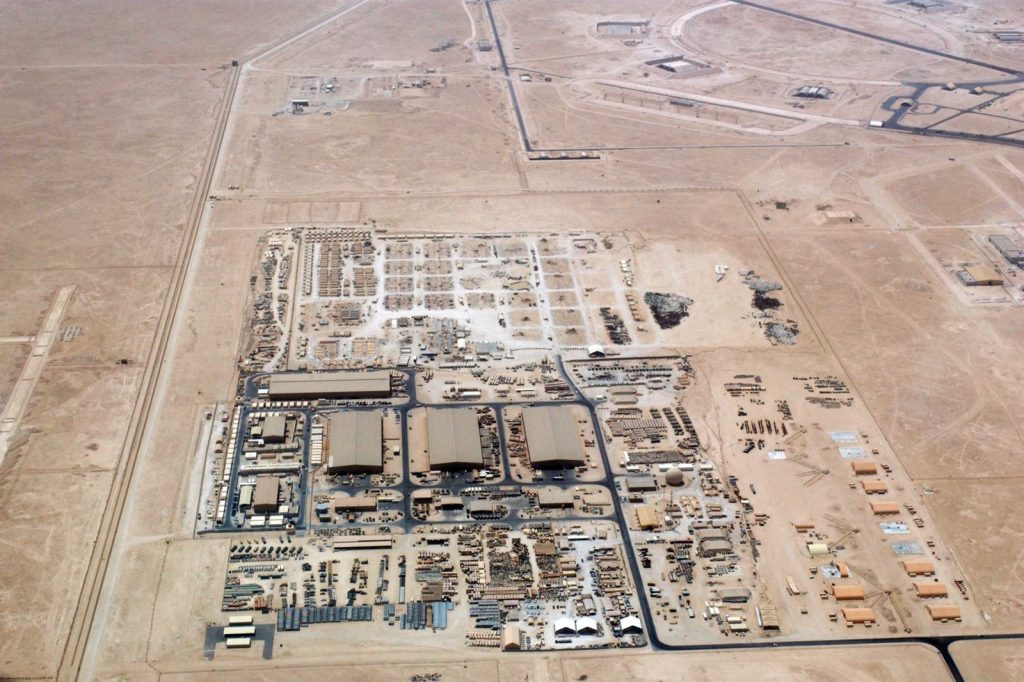
DOHA, July 25 — The rumble of a B-52 taking off shakes the desert floor at Al Udeid Air Base, a sound that anchors the vast American military web stretched across the Persian Gulf. By nightfall, F-35s will cut through the same sky, and in the waters off Bahrain, the USS Dwight D. Eisenhower steams with its carrier strike group.
This is the infrastructure of US Central Command — a network of bases, runways, berths and missile batteries that keeps approximately 30,000 American troops stationed in Gulf states as of 2023, with additional rotational forces aboard ships and aircraft.
The Basing Network
Al Udeid Air Base in Qatar serves as the forward headquarters of CENTCOM, the nerve center from which the Pentagon directs operations across a region stretching from Egypt to Pakistan. Not far away, on the island kingdom of Bahrain, Naval Support Activity Bahrain provides the homeport for the US Navy’s Fifth Fleet — the surface and submarine force that patrols the Strait of Hormuz and the shipping lanes of the Indian Ocean.
Kuwait hosts Camp Arifjan, a logistics hub that funnels supplies and equipment to American and allied forces throughout the theater. The United Arab Emirates contributes Al Dhafra Air Base, a key airfield for tanker and surveillance aircraft.
And in Saudi Arabia, Prince Sultan Air Base, reactivated after years of reduced operations, now hosts American air power and missile defense crews. Together, these installations form a continuous arc of American military reach.
Force Posture
The Pentagon does not rely on bases alone. Rotational forces aboard aircraft carriers — including the USS Dwight D. Eisenhower — allow the Navy to surge combat power into the region on short notice.
On the ground and in the air, the arsenal includes F-35 stealth fighters, F-16 multirole jets, and B-52 strategic bombers, each capable of striking targets hundreds of miles inland. Missile defense is a constant presence.
Patriot batteries and THAAD systems are deployed at key bases, ready to intercept ballistic missiles and drones.
Security Concerns
American commanders worry about more than just incoming rockets. The source material notes that compromise of imagery from these bases could expose vulnerabilities in force protection and readiness. Satellite photos, open-source intelligence, and drone surveillance — any of these could reveal patterns in aircraft parking, troop movements, or missile-defense placements.
In a region where adversaries have invested heavily in reconnaissance assets, even a single leaked image can become a target list. What happens next depends on the shifting calculus in Washington and across the Gulf.
The administration continues to calibrate the American footprint — balancing deterrence, cost, and the willingness of host nations to keep the runways open. For the troops at Al Udeid, Camp Arifjan, and the naval base in Bahrain, the mission remains the same: stand ready, fly patrols, and watch the horizon.




