
For residents of Olongapo, a city northwest of Manila, the news of an expanded American military presence in the area has brought back memories of a time when thousands of US sailors injected money, life, and hope into their community. The city, located near the former US Navy base in Subic, now a thriving commercial freeport and tourist destination, is once again at the forefront of a significant development in the region’s military landscape.
The decision by the Philippine government to permit rotating batches of American forces to access four more Philippine military camps, in addition to five other local bases, has sparked a mix of emotions among locals. Some, like those who benefited from the economic boost brought by the US military presence in the past, may view this development as a positive step.
However, others, such as Mamba, a concerned citizen, have expressed worries about the potential risks associated with hosting American troops. “It will be extremely risky for us. The Philippines could be targeted by nuclear weapons if the conflict over Taiwan escalates,” Mamba said.
The fear of being drawn into a conflict is a legitimate concern, especially given the complex geopolitical dynamics at play in the region.
Regional Tensions and Military Alliances
The US has been taking steps to rebuild its military power in the Philippines, more than 30 years after the closure of its sizable bases there. This move is part of a broader effort to fortify an arc of military alliances in Asia, as the region navigates a post-Cold War era marked by an increasingly aggressive China. The South China Sea, where China, the Philippines, and four other governments have had increasingly tense territorial rifts, has become a focal point of these tensions.
Beijing’s claims to Taiwan as its own territory, which it says should be brought under Chinese control by force if necessary, have further complicated the situation. According to Manila-based political scientist Andrea Chloe Wong, the location of the Philippine camps would give the US military the presence it needs to be a “strong deterrent against Chinese aggression” in the South China Sea.
The Enhanced Defense Cooperation Agreement, signed in 2014, has paved the way for US-funded constructions to accelerate, with the aim of building barracks, warehouses, and other buildings to accommodate an anticipated sizable number of visiting troops. While the exact number of troops has not been specified, the agreement has been hailed as a significant development in the region’s military landscape.
Military Presence and Joint Exercises
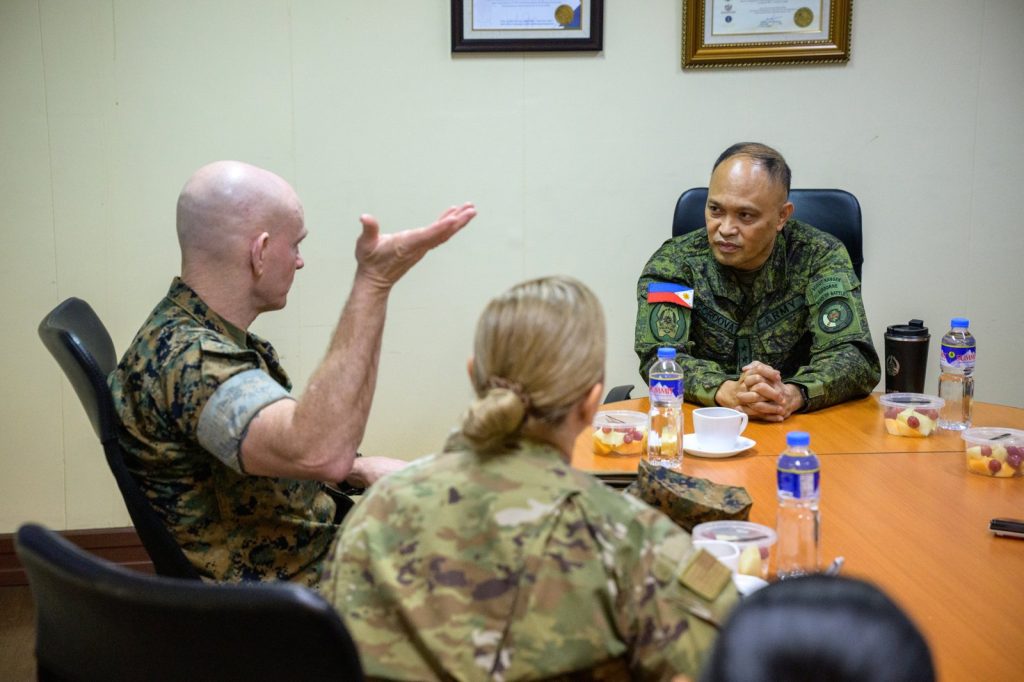
US Defense Secretary Lloyd Austin has stated that Washington is not attempting to reestablish permanent bases, but rather increase its military presence under the Enhanced Defense Cooperation Agreement. This agreement, according to Austin and his Philippine counterpart Carlito Galvez Jr., may include joint combat-readiness exercises between American and Philippine military personnel. The presence of US troops is expected to enhance the military capabilities of the Philippines, but it also raises concerns about the potential risks and consequences of being drawn into a conflict.
Mamba’s concerns about the Philippines being targeted by nuclear weapons if the conflict over Taiwan escalates are not unfounded. The presence of American troops could be perceived as a provocation, potentially drawing the Philippines into a conflict that it may not be able to control.
As Mamba noted, “If they stay here, whoever is their enemy will become our enemy.” The situation is further complicated by the fact that the presence of US troops could create the perception that the Philippines has nuclear capabilities, even if that is not the case.
Looking Ahead
As the situation in the region continues to evolve, it is essential to monitor developments closely. The expansion of the US military presence in the Philippines is a significant step, with potential implications for the entire region. As the US and the Philippines move forward with their plans, it will be crucial to watch how China responds to these developments. The coming months will be critical in determining the trajectory of the region’s military landscape, and it is essential to stay informed about the latest developments. What to watch next is how the US and the Philippines will balance their military cooperation with the need to avoid provoking China, and how the situation in the South China Sea will unfold in the face of these changing dynamics.




