
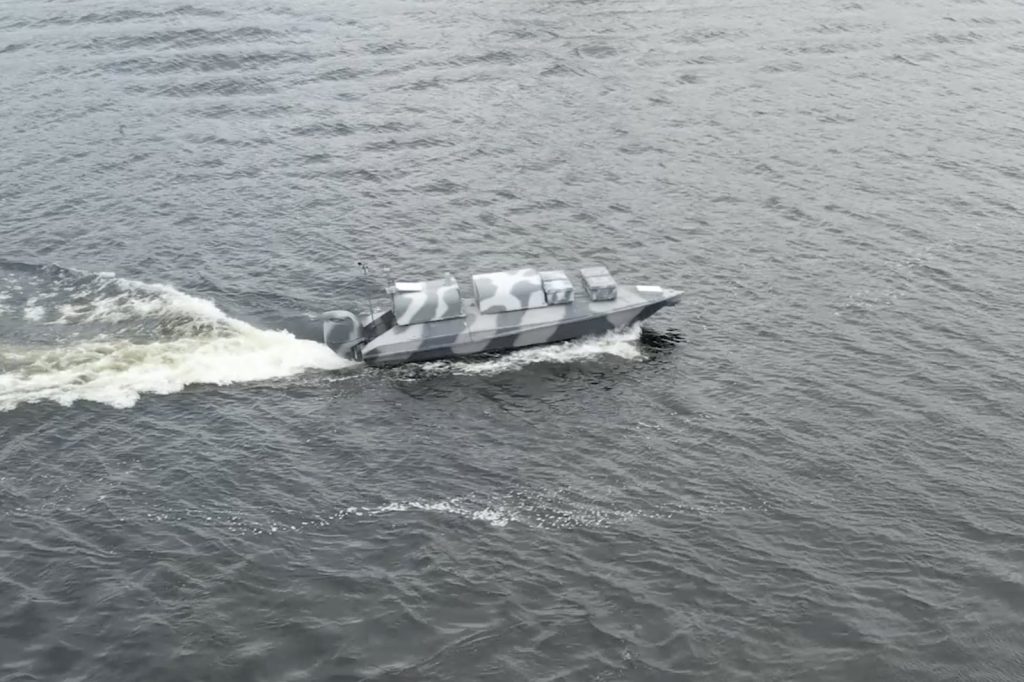
MOSCOW, July 11 — Ukrainian forces have employed unmanned surface vehicles, commonly described as naval drones, against Russian naval targets in the Black Sea and Azov Sea since 2023, according to official statements and confirmed operational records. The drones, including the Magura V5 model, are small, fast, and semi-submersible, characteristics that make them difficult to detect. Ukraine’s Security Service, the SBU, has claimed responsibility for attacks on Russian tankers near the Kerch Strait in August 2023 and again in September 2024.
The vessels carry explosive payloads and can operate either autonomously or via remote control, according to available technical assessments. By October 2024, Ukrainian forces had reportedly deployed over 100 naval drones in the course of their operations.
The cumulative effect, officials confirmed, has been the damaging or sinking of at least 15 Russian vessels. Among the confirmed losses are the landing ship Saratov, struck in March 2022, and the missile carrier Ivanovets, hit in February 2024. This asymmetric warfare tactic represents a deliberate strategic choice by Kyiv to challenge Russian naval dominance in the region.
The Black Sea Fleet has been forced to adapt its posture. According to the record, Russia has redeployed naval assets and implemented protective measures, including a halt to shipping in the Azov Sea.
Strategic Consequences and Force Posture
The Kerch Strait, a narrow waterway connecting the Black Sea to the Azov Sea and a critical chokepoint for Russian logistics and commercial traffic, has emerged as a focal point of these engagements. The SBU’s claimed attacks on tankers in that vicinity underscore the vulnerability of even protected maritime routes. The drones’ low profile and ability to operate in shallow waters, officials noted, make them particularly suited to the confined geography of the Azov Sea basin.
The operational tempo has forced the Russian Navy to adopt what analysts describe as a more defensive stance in the western Black Sea. Vessels that once patrolled openly now operate with heightened caution, and some have been withdrawn to safer anchorages east of Crimea.
The shift has not been total, but it has reduced the frequency and reach of Russian naval patrols in waters near the Ukrainian coast.
Technical and Tactical Dimensions
The Magura V5, one of the models identified in these operations, is designed for speed and stealth. Its semi-submersible hull allows it to ride low in the water, presenting a minimal radar cross-section. When operating autonomously, the drone follows a pre-set course to a target, using onboard sensors for terminal guidance.
Remote control mode, by contrast, allows a human operator to steer the vessel from a safe distance, adjusting course in real time based on intelligence feeds. The explosive payload is sufficient to inflict catastrophic damage on a ship’s hull, particularly at the waterline, where even a relatively small breach can lead to flooding and loss of stability.
This vulnerability has been demonstrated repeatedly, according to the record, with the sinking of the Ivanovets serving as a prominent example.
Broader Implications for Maritime Security
The use of USVs in the Black Sea has broader implications for naval doctrine worldwide. The conflict has become a testing ground for unmanned systems in contested maritime environments, and the results are being studied by defense establishments in the United States, Europe, and Asia. The relatively low cost of these drones compared to the ships they target makes them an attractive option for navies with limited budgets but ambitious strategic goals.
For Russia, the challenge is not merely tactical but operational. Protecting fixed assets such as ports, bridges, and chokepoints from swarming drone attacks requires new sensor networks, layered defenses, and rapid-response protocols.
The Azov Sea shipping halt, implemented as a direct result of the threat, illustrates the economic as well as military costs of this new form of warfare.
What to Watch Next
As of mid-2026, the trajectory of this conflict at sea remains uncertain. Ukrainian forces have demonstrated both the will and the technical capability to sustain USV operations, while Russia continues to adapt its defenses. The question now is whether either side can achieve a decisive advantage in this domain, or whether the Black Sea will remain a contested battlespace where no single force can claim full control.
The coming months will likely see further refinements in both drone technology and countermeasures, as the strategic competition at sea continues to evolve.




