
“There are fewer gunfights because there are more drone fights.” That is how Denys, a soldier in Ukraine’s Khyzhak brigade, described the war to The Guardian in January 2025, in a barracks workshop, piles of basic first-person-view drones at his back.
The small FPV quadcopter, about seven inches across and able to carry a kilogram of explosive, is flown by a pilot wearing goggles and holding a controller. Samuel Bendett, a drone expert at the Center for Naval Analyses, summed up its path: a novelty in 2022, a favored weapon by 2023, and by now something roaming the entire tactical space. The aircraft flies at around 37mph, or 60kmh, so a person on foot cannot outrun it. “It is impossible to outrun them, you have to shoot them down,” said Oleksii, an infantryman in training near Sumy.
Built in living rooms
Ukrainians describe the drone effort as an effort of ordinary citizens that started outside the state. Soldiers, friends and relatives paid for the aircraft through fundraisers, and it is not unusual for people far from the front to put parts of drones together at home or in a garage. The machines then go to brigade workshops, such as the Khyzhak brigade’s barracks near Lyman, for final changes. One catch remains: many components still come from China. “Ukrainian company, China elements,” Denys said, though efforts are under way to find other suppliers.
The state has since stepped up. The defence ministry reported handing over 1.1m one-way FPV drones by mid December, plus 100,000 more sophisticated craft. Bendett put Russian supply at “1.2m to 1.4m,” which he said amounts to near parity. Serhii Sternenko, a Ukrainian blogger with 2 million subscribers, said he had helped buy 120,000 FPV drones, 100,000 of them in the past year, and could get them to any unit within 24 to 48 hours.
An older root
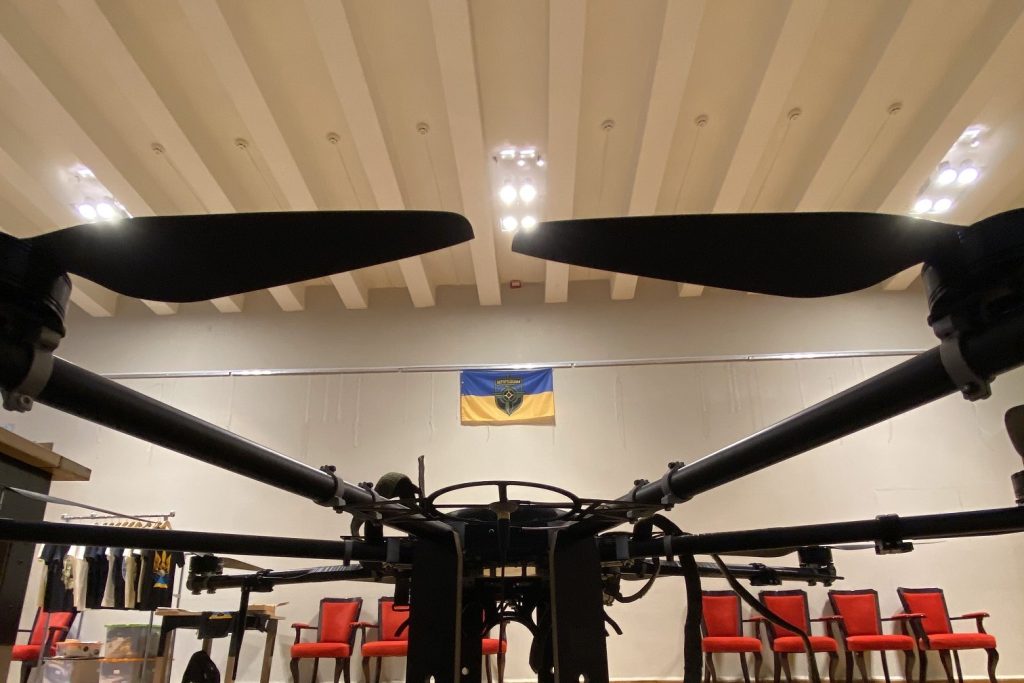
The groundwork came earlier. RFE/RL traced one strand to Aerorozvidka, a group that started as drone enthusiasts and today works closely with the military. When Russia began using DJI’s AeroScope system to track drone operators from their flight paths, Aerorozvidka built its own aircraft to slip past the sensor. The result was the R18, an octocopter that first flew in 2019. It can drop up to 5 kilograms of explosives and reaches as far as 4 kilometers. Its designers left off the landing legs to save weight, so it takes off from a platform and is caught by hand when it returns. A thermal camera lets it work at night.
DJI later called the use of its drones in combat “inappropriate” and, in April 2022, stopped sales in both Russia and Ukraine.
What the numbers mean on the ground
Lines that once sat a gunshot apart have turned into killing zones several miles deep, with drone teams hiding one to three miles behind them. Pilots train hard. Khimik, a Khyzhak member, said it takes “70 hours in the simulator and 70 hours with a drone.” A kamikaze FPV in good weather can fly as far as 20km, but crews save money by using returning bomber drones, so the working radius is closer to 5km.
Cost matters too. Sternenko said air defence “could cost $100,000 to $1m for one hit,” while a drone might be only a few hundred dollars. He pointed to Ukrainian FPV pilots who have been downing Russian Orlan and Lancet drones for several months. The next targets are helicopters, two of which were claimed in the summer, and large Shaheed drones.
Sources
- 'It is impossible to outrun them': how drones transformed war in Ukraine (The Guardian)
- Drone Wars: Ukraine's Homegrown Response To 'Deadly' Chinese Detection Tech (RFE/RL)




