
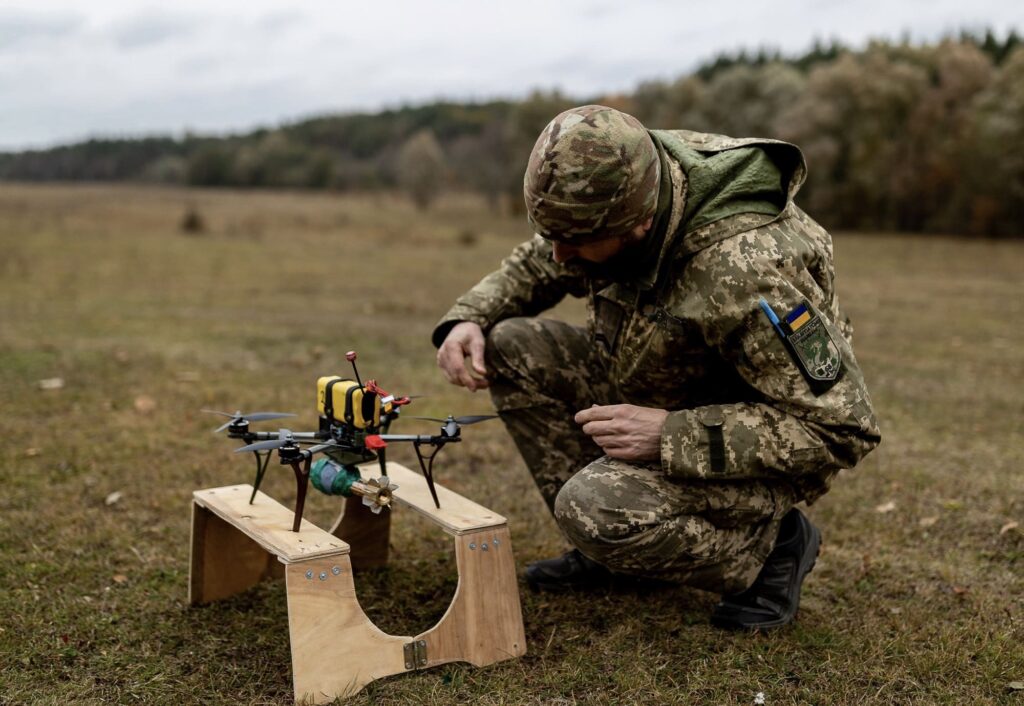
KYIV, July 10 — Ukraine’s drone program has undergone a transformation since the 2022 Russian invasion, evolving from a battlefield improvisation into a long-range strike capability that now reaches deep inside Russian territory. The mechanics here are worth examining, because they reveal how a country facing a much larger conventional military has built a relatively low-cost, high-impact aerial arm. The starting point was modest.
In the early months of the war, Ukrainian forces relied heavily on small commercial quadcopters, such as the DJI Mavic, for reconnaissance. These are off-the-shelf consumer devices, not designed for combat.
But necessity drove adaptation. By 2023, Ukraine had introduced the ‘Malyuk’ drone, a purpose-built platform with a range of over 1,000 kilometers. That is not a typo — a domestically produced unmanned aircraft capable of flying more than 1,000 kilometers from its launch point. ## From reconnaissance to strategic strikes The catch is that building such a capability from scratch in wartime is extraordinarily difficult.
Ukraine’s solution was a hybrid approach: domestic production lines combined with Western technology and training. The government allocated $1 billion for drone procurement in 2024, a significant sum for a country fighting a war.
Production increased tenfold in 2023. Follow the money, and you see a deliberate industrial strategy taking shape. By 2024, Ukraine was fielding drones like the ‘Liutyi’ and the ‘UJ-22 Airborne’ for strikes on Russian oil infrastructure.
These are not small reconnaissance aircraft. They are often modified from civilian models and carry payloads of up to 20 kilograms of explosives. The operational reach is substantial.
In January 2024, Ukrainian drones hit targets over 800 kilometers from Ukrainian-controlled territory, striking Russian oil facilities. That is the distance from Kyiv to Moscow, or from London to Berlin.
On closer reading of the available data, a pattern emerges. Ukraine is not simply buying drones from abroad and launching them. It is building its own supply chain, modifying civilian airframes for military use, and integrating Western guidance and navigation systems.
The $1 billion procurement budget suggests this is a sustained commitment, not a one-off experiment. ## The infrastructure beneath the wings The attacks on Russian oil infrastructure in January 2024 are a case study in how drone warfare has shifted the strategic calculus. Hitting targets over 800 kilometers from Ukrainian lines requires not just a capable drone, but also a logistics chain to move the aircraft to launch sites, maintain them, and train operators.
Ukraine’s domestic production lines are the backbone of that effort. Western technology and training have accelerated the process, but the manufacturing is Ukrainian. The ‘Malyuk’, with its 1,000-kilometer range, opens up a vast target set inside Russia.
The ‘Liutyi’ and ‘UJ-22 Airborne’ have demonstrated that they can penetrate Russian air defenses, at least against fixed infrastructure targets. The payload of up to 20 kilograms of explosives is sufficient to damage oil refineries, storage tanks, and pipeline nodes — the kind of targets that are difficult to defend comprehensively across thousands of kilometers of border. ## What to watch next The evolution is not finished. Ukraine’s drone production increased tenfold in 2023, and the government has committed $1 billion for procurement in 2024.
That suggests the pace of innovation and deployment will continue to accelerate. The question is whether Russia can adapt its air defense network to counter this growing threat, or whether Ukraine will maintain the advantage of being the innovator in a rapidly changing technological domain.
The mechanics here are clear: a smaller military power has built a long-range strike capability from a combination of domestic manufacturing, Western technology, and battlefield experience. The catch is that every military innovation eventually meets a countermeasure. For now, Ukraine’s drones are reaching targets over 800 kilometers from Ukrainian-controlled territory.
The next phase of this conflict will test whether that reach can be sustained.




