
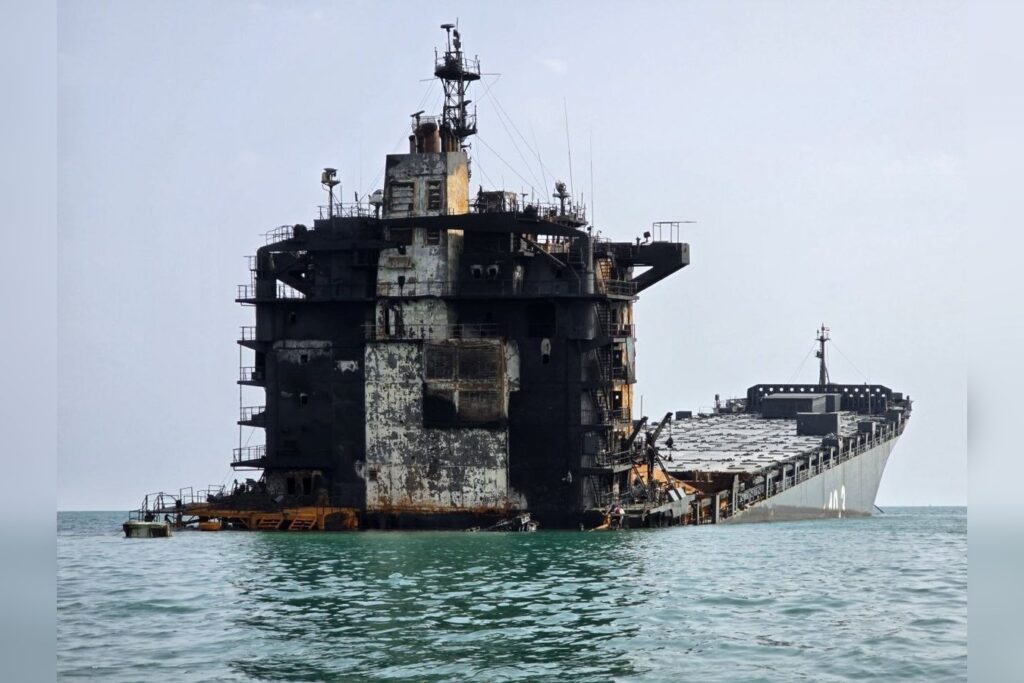
SEVASTOPOL, July 9 — Against the backdrop of a grinding war that has reshaped the Black Sea’s strategic geography, Ukrainian forces have delivered what military officials describe as the most punishing single week for Russian naval power since the Second World War. Over a 72-hour period in early February 2024, Ukrainian military officials announced that their forces had struck and destroyed 21 Russian naval vessels in the Black Sea and the Sea of Azov.
The figure, if confirmed, would represent a staggering blow to a fleet already reeling from two years of asymmetric warfare. Russia’s Defense Ministry acknowledged damage to several vessels but disputed the total number, claiming only five ships were hit.
The operation, coordinated between the Ukrainian Navy, the Security Service of Ukraine (SBU), and the Main Intelligence Directorate (GUR), relied on a combination of unmanned surface drones and Neptune anti-ship missiles. The targeted ships included landing craft, patrol boats, and a logistics vessel. Ukrainian officials stated the campaign was designed to disrupt Russian supply lines and reduce the threat of amphibious assaults along Ukraine’s southern coast.
What is at stake in these waters is nothing less than the viability of Russia’s logistical lifeline to occupied southern Ukraine. The Black Sea Fleet, headquartered in Sevastopol on the Crimean peninsula, has been a persistent target since the full-scale invasion began in February 2022.
Ukraine, which lacks a conventional navy, has turned to asymmetric tactics as its primary means of contesting Russian maritime dominance. In the corridors of European defense ministries, the February 2024 blitz is seen as part of a broader pattern of escalating drone warfare in the region. The strikes follow previous high-profile successes: the sinking of the Moskva cruiser in April 2022, and the damage to the Rostov-on-Don submarine in September 2023.
Each operation has demonstrated Kyiv’s growing capacity to strike at range and with precision, even without traditional naval assets. The wider picture for Russia’s naval posture is increasingly fraught. The 72-hour blitz represents the highest claimed toll on Russian naval assets in a single week since World War II.
No civilian casualties have been reported from the February 2024 strikes, a point Ukrainian officials have emphasized in their public statements. Against this backdrop, the Black Sea has become a laboratory for a new kind of naval warfare — one where small, cheap drones can challenge a major fleet’s ability to operate with impunity.
The Neptune missile, a Ukrainian-designed anti-ship weapon, has proven particularly effective, while the use of unmanned surface drones has allowed Kyiv to strike at vessels in port or at anchor, where they are most vulnerable. For Russia, the cumulative effect of these losses extends beyond the immediate tactical setback. Each damaged or destroyed vessel reduces the fleet’s ability to project power, to resupply garrisons in occupied territory, and to threaten amphibious operations that could open new fronts along Ukraine’s southern coast.
The psychological impact on Russian naval morale, analysts note, should not be underestimated.
A Fleet Under Siege
The Black Sea Fleet has been a fixture of Russian power projection in the region for centuries. Its base in Sevastopol, leased from Ukraine until the 2014 annexation of Crimea, has long been considered one of the most strategically valuable naval installations in the world. Since 2014, Russia has invested heavily in modernizing the fleet and expanding its capabilities.
Yet the war has exposed vulnerabilities that conventional naval doctrine had not fully anticipated. The loss of the Moskva, the fleet’s flagship, was a humiliation that resonated far beyond the naval community.
The September 2023 strike on the Rostov-on-Don submarine, one of Russia’s most advanced diesel-electric boats, demonstrated that even submerged assets were not safe. The February 2024 operation, however, marked a quantitative leap. Twenty-one vessels in three days — the scale of the claimed success has prompted intense scrutiny from Western intelligence agencies, who have been tracking the attrition of Russian naval assets in the Black Sea with growing interest.
Independent verification of the Ukrainian claims remains difficult, given the fog of war and Russia’s tight control over information from the front lines.
The Asymmetric Advantage
Ukraine’s reliance on unmanned systems and precision missiles is born of necessity. With no surface fleet capable of challenging the Russian Navy in a conventional engagement, Kyiv has invested heavily in technologies that allow it to strike from a distance, often using platforms that are difficult to detect and intercept. The unmanned surface drones used in the February 2024 operation are small, fast, and low to the water, making them hard to spot on radar.
They can be launched from concealed positions along the coast and guided to their targets using satellite communications and onboard cameras. The Neptune missile, meanwhile, is a subsonic anti-ship cruise missile that flies low over the water to evade defenses.
This combination of systems has allowed Ukraine to impose a kind of naval siege on Russia’s own fleet, forcing Russian commanders to keep their most valuable assets in port or to operate at greater distances from the coast. The threat of drone and missile attacks has effectively contested Russia’s ability to control the northwestern Black Sea, a development that has not gone unnoticed in NATO capitals.
What to watch next: whether Russia can adapt its naval tactics and defenses to counter the drone threat, or whether the pattern of attrition will continue to erode its maritime capabilities. The Black Sea remains a critical theater in the broader war, and the outcome of this asymmetric contest could shape the strategic balance for years to come.




