
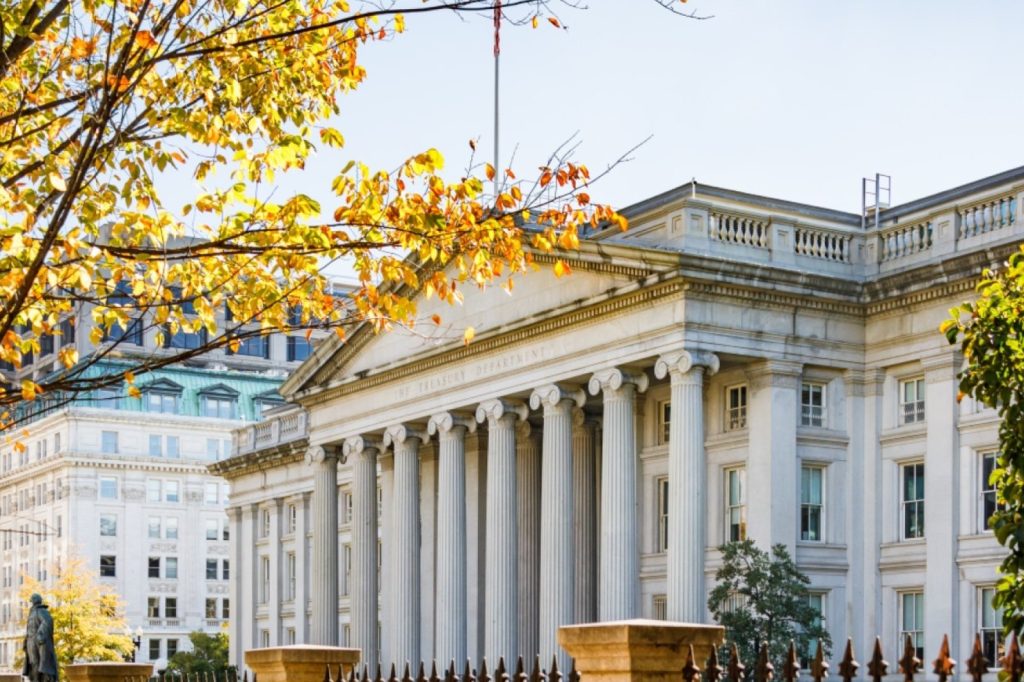
The U.S. Treasury sanctioned 35 entities and individuals on April 28 that it says run Iran’s shadow banking system. Treasury put the money moving through these channels at the equivalent of tens of billions of dollars, all tied to sanctions evasion and Iran’s backing of terrorism. The Office of Foreign Assets Control (OFAC) announced the designations under a program it calls Economic Fury.
According to Treasury, the networks give Iran’s armed forces, the Islamic Revolutionary Guard Corps (IRGC) included, a way into the international financial system. Through it they collect payment for illicit oil sales, buy sensitive components for missiles and other weapons, and send money to proxy groups.
“Iran’s shadow banking system serves as a critical financial lifeline for its armed forces, enabling activities that disrupt global trade and fuel violence across the Middle East,” Treasury Secretary Scott Bessent said. He then turned to banks. “Financial institutions are on notice: Any institution that facilitates or engages with these networks is at risk of severe consequences.”
How the rahbar system works
Iranian banks shut out of the global system lean on private firms known as rahbars. Each one manages thousands of shell companies abroad, using accounts at foreign banks in major financial centers to push through payments for Iranian imports and exports. The rahbars work with Iranian exchange houses and a web of front companies to handle trade on behalf of the IRGC, the Armed Forces General Staff, the National Iranian Oil Company (NIOC) and other sanctioned bodies.
Treasury walked through one chain. Farab Soroush Afagh Qeshm Company is the rahbar for Shahr Bank. It works through foreign fronts, among them HMS Trading FZE, which the U.S. had already sanctioned. One of those fronts, the UK-based Shuqun LTD, moved over $70 million in payments for Iranian crude and oil distillates for NIOC through 2024. Shuqun belongs to Filipino national Janelyn Eusebio Emperador, who also owns two other UK front companies, Sanovo LTD and Qianza LTD. All of them were designated.
Other targets
OFAC also went after rahbar companies tied to Bank Sina, which is controlled by the Supreme Leader’s Office, and to Bank Sepah. Treasury called Sepah a key financier of Iran’s ballistic missile program.
On the Bank Melli side, the rahbar Nikan Pezhvak Aria Kish Company handles billions of dollars of transactions for NIOC, the IRGC and the Central Bank of Iran. One of its fronts, Fratello Carbone Trading Limited, has sent more than $20 million for NIOC. Two more fronts, Nix Energy Limited and Tai Lung Trading Limited, have been used by exchange houses including the sanctioned Sadaf Exchange to move millions of dollars.
The designations rest on Executive Order 13902, aimed at Iran’s financial sector, and Executive Order 13224, a counterterrorism authority. They follow an OFAC action on January 15, 2026 against the rahbar networks of Bank Melli and Shahr Bank. Since February 2025, Treasury says, OFAC has sanctioned approximately 1,000 Iran-related persons, vessels and aircraft under the maximum pressure campaign set out in National Security Presidential Memorandum 2.
A warning on Hormuz tolls
With the designations, OFAC issued guidance on “toll” payments to the Iranian government or the IRGC for passage through the Strait of Hormuz. Such payments carry sanctions risk for U.S. and non-U.S. persons, financial institutions included. Further detail is in FAQ 1249.




