
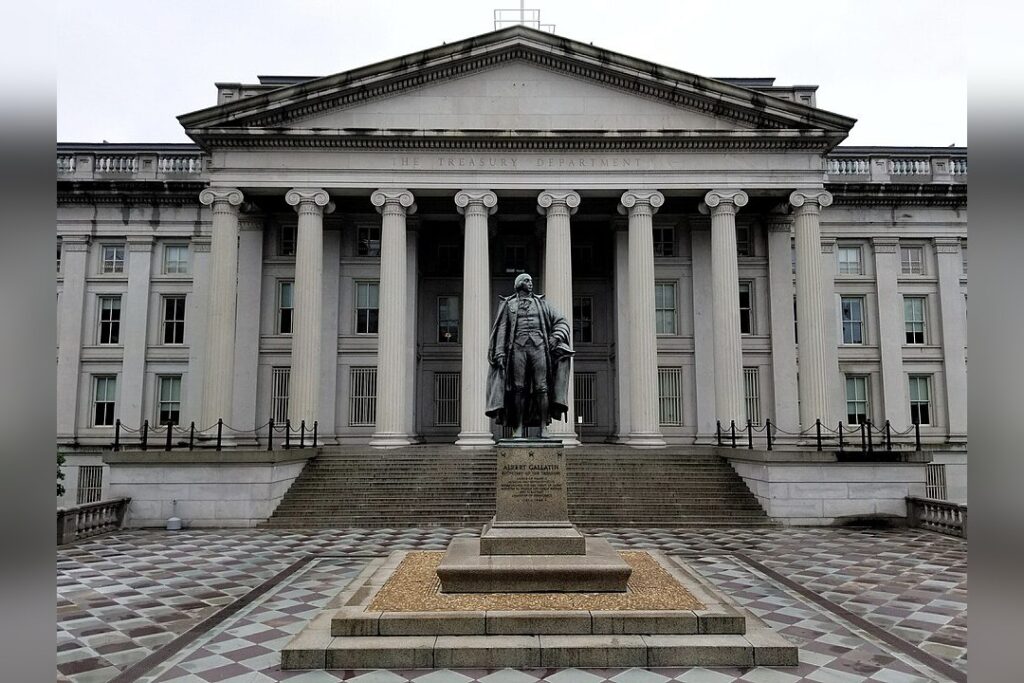
The U.S. Treasury Department announced on August 24, 2026 what it called “Operation Economic Outcast,” describing it as an unprecedented, whole-of-government economic campaign against Iran and the businesses that help it. Officials from Treasury, State and the Department of War are pressing counterparts abroad to shut down Iran-related commercial and financial activity within set deadlines, Treasury has said. Countries that fail to act, it warned, will face unilateral U.S. action.
Five sectors, five licenses
The Office of Foreign Assets Control (OFAC) issued five new sectoral sanctions determinations under Executive Order 13902. They cover Iran’s digital-asset, technology, gold, aviation and shipping sectors. The order dates to January 10, 2020 and originally went after construction, mining, manufacturing and textiles. Earlier determinations added the financial and petroleum and petrochemical sectors.
U.S. persons are already barred from most dealings with Iran, so the practical bite falls on third-country companies and banks, such as those doing business with Iranian airlines or digital-asset exchanges. Law firm Orrick, in its analysis, said the determinations do not fundamentally widen OFAC’s powers. They do let it designate anyone, anywhere, who operates in one of the listed sectors, without proving a separate link to sanctioned activity. Orrick read them mainly as an enforcement signal that these sectors are near-term priorities.
OFAC also suspended five general licenses, effective September 8, 2026. They covered educational activities, personal remittances, conference attendance, sports activities and certain academic exchanges and services.
The Banque Misr UAE rule
On August 28 the Financial Crimes Enforcement Network (FinCEN) proposed a rule under Section 311 of the USA PATRIOT Act to cut Banque Misr UAE off from the U.S. and global financial system. FinCEN found the bank’s five UAE branches to be of primary money laundering concern. Treasury said the step would “cut off a key financial lifeline and sanctions evasion vehicle for the Iranian regime.”
Treasury’s figures are specific. It says the bank processed roughly $1.8 billion for 103 companies that may belong to Iranian shadow banking networks between January 2024 and June 2026. It alleges the customers include apparent front companies used by Iran’s Ministry of Defense and the IRGC to dodge sanctions and launder money for Supreme Leader Mojtaba Khamenei. Public comment on the proposal closes October 1, 2026.
FinCEN has used Section 311 before against institutions tied to North Korean and other illicit-finance networks. Many of those closed before the measures were finalized.
Reaction abroad
Bessent said at a G20 meeting that the European Union had officially signaled support for the campaign. China took the opposite line. State-owned China Global Television Network reported that Beijing called the actions “illegal unilateral sanctions.”
Orrick noted that China buys the vast majority of Iran’s exported oil and that OFAC already has wide authority to hit non-U.S. parties. Whether the campaign works, the firm wrote, may depend on whether the administration is willing to go after larger Chinese entities, including banks, rather than smaller ones.
Sources
- Operation Economic Outcast: Treasury Escalates Maximum-Pressure Campaign on Iran
- Treasury Escalates Iranian Sanctions, Targets Illicit ‘Shadow Fleet’ as Regime Engages in ‘Economic Self‑Immolation’




