
Ethiopia, November 21, 2022 — cybernewschronicle.com — For nearly two years, Ethiopia’s Tigray region has been consumed by a war that has killed hundreds of thousands. The precise toll remains unknown, but the numbers that have emerged are staggering. A conflict that began as a political falling-out between the federal government and the Tigray People’s Liberation Front has spiraled into a humanitarian catastrophe, marked by mass violence, starvation, and a collapsed health system.
The war started in November 2020. Prime Minister Abiy Ahmed ordered a military offensive against Tigrayan forces, accusing them of attacking a federal army base.
What was supposed to be a swift operation turned into a grinding, multi-front war. Fighting spread beyond Tigray into the neighboring regions of Amhara and Afar. The conflict drew in Eritrean troops and militias from Amhara.
By the time a shaky truce was reached in November 2022, the human cost was already immense. The Uppsala Conflict Data Program recorded over 100,000 battle-related deaths in 2022 alone.
Most of those killed were soldiers, but civilians made up a significant share. Those numbers only tell part of the story. A peer-reviewed study from the University of London calculated more than 102,000 excess deaths in Tigray from November 2020 to mid-2022.
“Excess deaths” is a term demographers use to capture the gap between how many people would have died under normal conditions and how many actually did. The study broke down the causes: 72% of those deaths came from direct violence. The other 28% were attributed to a lack of healthcare and famine.
That 28% figure is crucial. It means tens of thousands of people died not from bullets or bombs, but because hospitals ran out of medicine, because doctors fled or were killed, because food supplies were cut off.
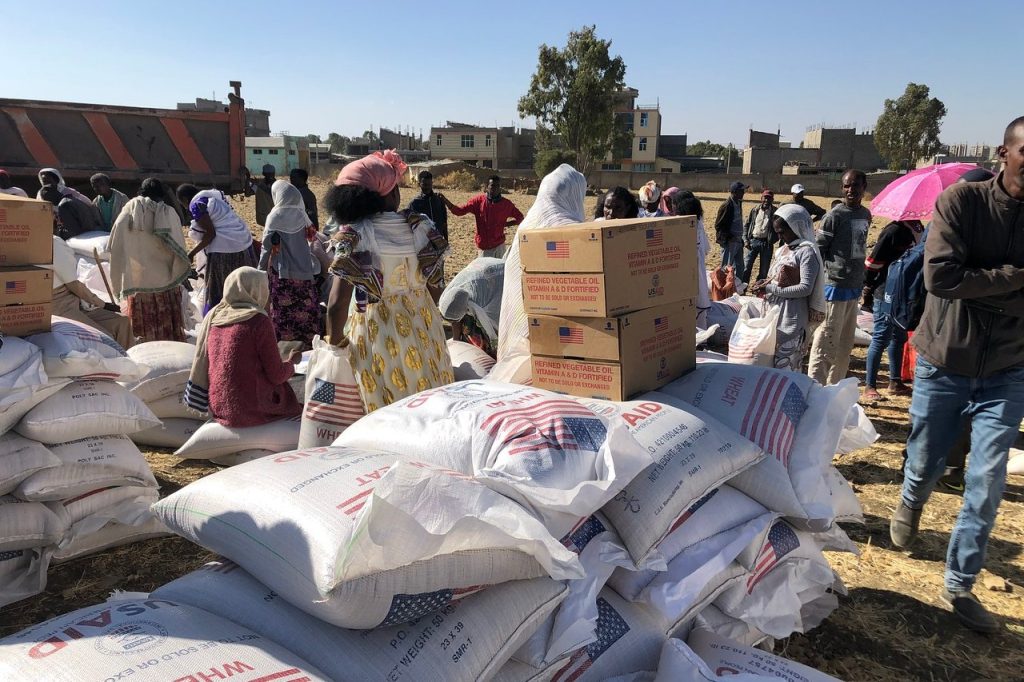
The Ethiopian government imposed a blockade on Tigray for much of the war. Humanitarian aid was severely restricted. Fuel, cash, and medical supplies were blocked from entering the region.
The result was a slow, grinding catastrophe layered on top of the immediate violence. Researchers at Ghent University in Belgium tried to account for the full scale of the disaster.
Their estimates suggest that between 162,000 and 378,000 people may have died from the combined effects of wartime violence, famine, and limited medical access. That is a wide range, reflecting the difficulty of gathering data in a conflict zone where phone lines are down, roads are blocked, and many bodies are never counted. The lower estimate alone is more than the population of a small city.
The higher estimate approaches the scale of the Syrian civil war’s documented death toll. Olusegun Obasanjo, the African Union mediator, has suggested the figure could be around 600,000. That number is not a precise count but an indication of the sheer scope of the disaster.
Obasanjo has been deeply involved in the peace process, and his estimate reflects the information available to those trying to broker an end to the fighting. The New York Times has characterized the conflict in terms that leave little room for ambiguity about its severity.
The war formally ended with a peace deal signed in Pretoria in November 2022. But the damage is not easily undone. The region’s infrastructure is wrecked.
Its economy is shattered. Millions of people remain displaced.
The famine conditions that killed thousands have eased in some areas, but food insecurity remains acute. The health system, already fragile before the war, will take years to rebuild. The psychological toll on survivors is incalculable.
For now, the numbers are the closest thing to a record of what happened. They are incomplete. They are contested.
But they are all that exists. The war in Tigray is not a distant memory.
It is a present reality for the millions who lived through it, and for the hundreds of thousands who did not.




