
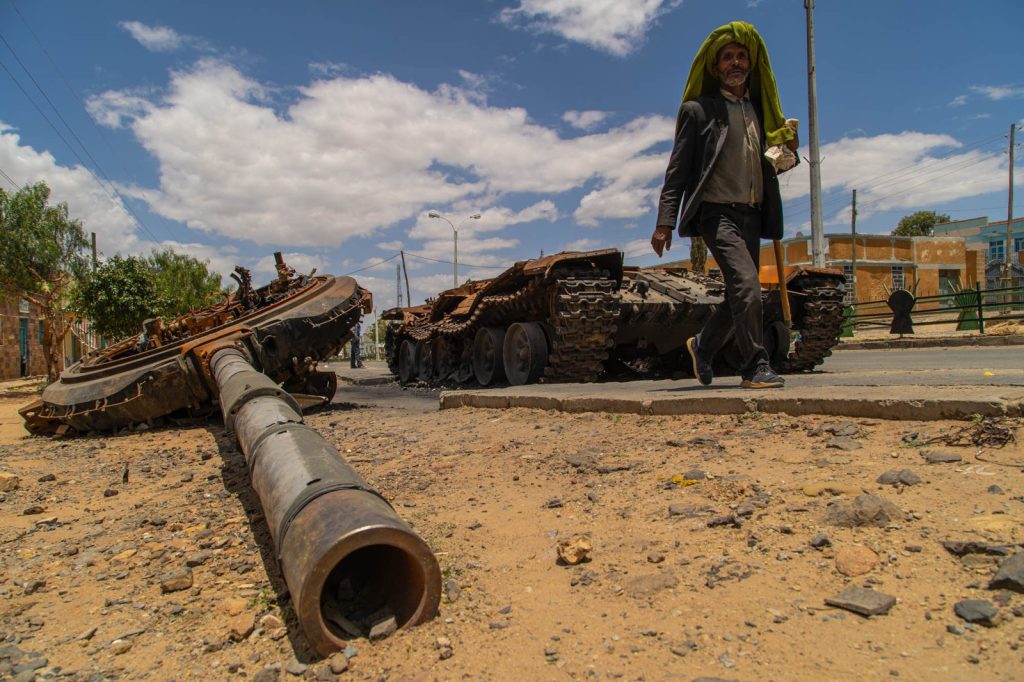
A civil war that engulfed Ethiopia’s Tigray Region for exactly two years officially ended on November 3, 2022. The conflict, which began on November 3, 2020, originated when fighters from the Tigray People’s Liberation Front (TPLF) launched an assault on the Northern Command headquarters of the Ethiopian National Defense Force (ENDF) and additional military installations within the region.
The roots of the war stretched back years, as tensions escalated between the TPLF—once a powerful force in Ethiopian national politics—and the federal government in Addis Ababa, as well as with Eritrea. The initial TPLF attack on the ENDF’s Northern Command triggered a two-pronged military response: Ethiopian forces advanced from the south, while the Eritrean Defence Forces (EDF) struck from the north. Prime Minister Abiy Ahmed characterized the federal government’s actions as a “law enforcement operation” intended to restore order in Tigray. Federal troops captured the regional capital, Mekelle, on November 28, 2020.
However, the TPLF refused to surrender, labeling the combined Ethiopian and Eritrean forces as “invaders.” Despite the government’s early claims of victory, the fighting continued. A major reversal occurred on June 28, 2021, when the Tigray Defense Forces (TDF) retook Mekelle.
By July 2021, the TDF had reclaimed control over much of the Tigray Region, and the conflict settled into a military stalemate. The war inflicted severe damage across the region. Widespread human suffering, mass displacement of civilians, and extensive destruction of critical infrastructure were reported throughout the two-year period.
International bodies repeatedly urged a peaceful resolution, but a lasting agreement remained out of reach until the conflict’s conclusion on November 3, 2022.
Broader Regional and International Impact
The Tigray war carried substantial consequences beyond Ethiopia’s borders. Eritrea’s direct involvement drew the conflict into a wider regional dynamic, raising alarms about the stability of the Horn of Africa.
The international community faced criticism for its handling of the crisis, with observers arguing that stronger action could have mitigated human suffering and advanced peace efforts earlier. The November 3, 2022, ceasefire offers a prospect for renewed stability in the area. However, significant challenges remain in rebuilding communities and fostering reconciliation between the warring parties.
The legacy of the conflict is expected to persist for years. The global community is expected to monitor closely how the Ethiopian government and the TPLF navigate the recovery process.
While the path toward lasting peace and security is acknowledged to be difficult, the formal end of hostilities represents a critical milestone for the people of Tigray and the broader region.




