
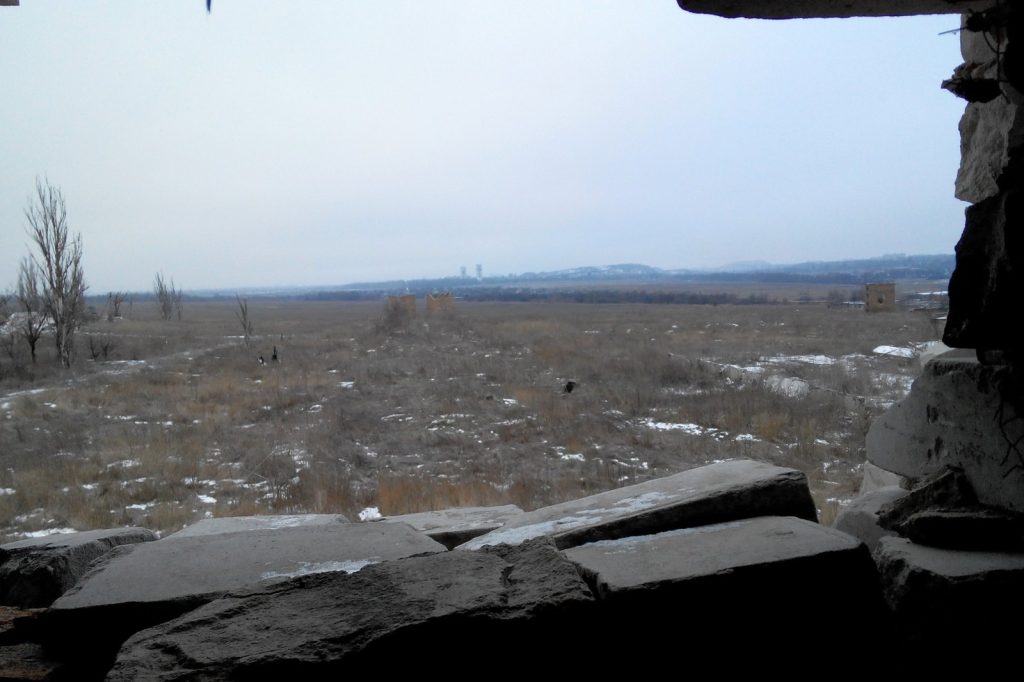
The motor would not start. A Ukrainian electrician radioed that the drone sat dead on its catapult, and then he and a technician tried again. This time it took off. It was an HX-2, an AI-equipped combat drone from the German company Helsing, being flown from a shelter in the Donbas coal region, where the Russian army is advancing.
DW followed the crew. Ahead of the flight, a pilot and a navigator had switched on laptops and monitors and strung up a few lights for atmosphere. Nearby, a detector mounted on a tree tracked Russian drones passing overhead, and the soldiers kept looking up at it. The plan was a flight of several dozen kilometers into the Russian-occupied part of the Donetsk region. The crew had picked the day for its wind speed, precipitation and cloud cover.
Then the weather turned. The sky clouded over again and the pilot struggled with navigation, so the test was aborted. Senior sergeant Oleksandr Karpyuk said the drone sometimes has trouble connecting to the ground station. On the crew’s next outing, when the DW reporter was gone, they struck a truck, and the military showed video from a reconnaissance drone. They credited better weather.
Who pays and what was promised
Helsing, a billion-dollar startup from Bavaria, is supplying thousands of these kits to the Ukrainian military, paid for by the German government. Germany’s armed forces recently gave the company a multimillion-euro contract too. The first drone it delivered was the simpler HF-1, built with a Ukrainian manufacturer, in an order of 4,000. In early 2025 Helsing announced an additional 6,000 of the newer HX-2.
The hardware has had a rocky reputation. Early this year, Western media including German outlets cited Ukrainian soldiers who reported technical problems during 2025 test deployments. Die Welt wrote that many drones were not flight-ready or crashed soon after takeoff, and that the hit rate was low. Helsing pushed back. A spokesperson told DW in late January that Ukrainian troops were testing the HX-2 alongside company staff at the front and that early results were “encouraging.”
The company was more cautious in a later answer to DW. The HX-2 has so far “not flown in sufficient numbers at the front to allow a fundamental assessment of performance under wartime conditions,” it said, adding that the drones are being adapted to front-line conditions, especially the constantly changing electronic warfare used by the other side. Helsing did not answer DW’s end-of-April question about the HX-2 hit rate.
The view from the crew
The pilot and commander, who goes by the call sign Black, described the job in blunt terms. “Our task is to destroy their logistics routes,” he said. His crew flew the HF-1 first. The HX-2, he said, is fast and agile: “It gives us a major advantage in the air, for the enemy it is harder to shoot down.”
Targeting runs on artificial intelligence. Normally his crew flies toward whatever target reconnaissance drone pilots show them, Black said, but the HX-2 can spot targets on its own. It cannot tell whether a target has already been destroyed. Once the pilot confirms the choice, the drone flies on autonomously. Like most drones, he said, it is vulnerable to electronic warfare.
The soldiers told DW they have found several shortcomings that they do not want made public. Black said manufacturer representatives would visit soon and that the unit keeps a support chat with the company.
Karpyuk said the HF-1 also performed poorly at first, but the maker took feedback and improved it, and it has since hit more than 50% of targets in the Pokrovsk area. He would keep working with the HX-2, he said, because the Russians have nothing comparable. He pointed to the Russian Lancet kamikaze drone, which has its motor and control wings at the rear. “Only Helsing has equipped its drones with four forward-facing motors,” Karpyuk said. “Why? Because it gives them maneuverability and speed.”




