
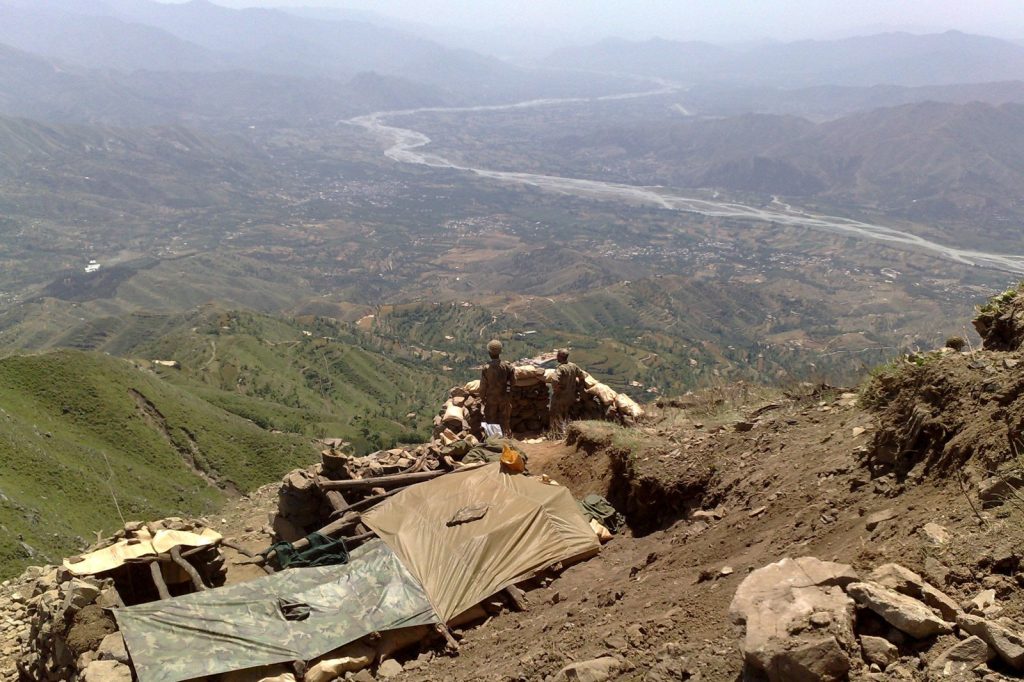
Gunfire was still being heard along the border in Khost province on Sunday night, local sources told Afghanistan International, after Taliban forces attacked a Pakistani post in Tani district. The clash began around 8 p.m.
Taliban-affiliated media said fighters had hit the post and killed several Pakistani soldiers. Abdul Haq Fida, spokesperson for the Taliban’s 203rd Corps in south-eastern Afghanistan, said the post was destroyed and that the body of a Pakistani soldier was now in Taliban hands. The corps released a video of the body and claimed at least four Pakistani troops had died so far.
The Taliban gave no figures for their own losses. Pakistani authorities had not commented on the incident or any casualties.
A war since late February
The fight in Tani is a small piece of a much larger confrontation. Relations between Kabul and Islamabad have turned dangerous since late February. Pakistan has bombed targets in Kabul, Kandahar, Paktia, Paktika and Nangarhar provinces, and the Taliban have answered with ground assaults and drone attacks.
The United Nations said 143 people were killed when a Pakistani airstrike hit a drug treatment centre in Kabul. The Taliban say the number was as high as 400. The UN Assistance Mission in Afghanistan, UNAMA, has counted between 75 and 212 Afghan civilian deaths since the fighting began, with hundreds more wounded. Tens of thousands of people have been displaced on both sides of the Durand Line, and trade routes between the two countries are shut. The Taliban have turned their commerce toward Central Asia and India.
Pakistan’s foreign minister, Ishaq Dar, says the operations are part of a counterterrorism strategy. Retired Brigadier Mahmood Shah told the outlet that the driving force is the Tehreek-e-Taliban Pakistan, or TTP, whose attacks on military bases and police in Pakistan’s tribal areas rose after the Taliban returned to power. Islamabad first tried to negotiate, he said, and chose airstrikes when that failed.
Why the leadership has been spared
One puzzle runs through the coverage: Pakistan has not struck the top Taliban leaders. Retired General Inam-ul-Haq described what he called “calibrated” pressure. In his telling, Islamabad is going after weapons depots, mid-level commanders and border posts while avoiding a “red line” that could tip the conflict into a full crisis. He said killing senior figures could leave a power vacuum, spread the fighting and make Khyber Pakhtunkhwa and Balochistan harder to hold. Foreign militant groups under Taliban influence could also spread into China, Central Asia and Pakistan itself.
Azim Rahimi, a former Kabul University professor who studies military affairs, agreed that hitting the leadership remains an option. “Pakistan will only use this option when there is a ‘need’ and a ‘political and security calculation’,” he said. “At this time, Pakistan does not genuinely seek the fall of the Taliban regime, but is instead applying limited pressure.”
Local sources say many Taliban fighters posted along the Durand Line come from Kandahar and are aligned with Mullah Hibatullah Akhundzada, with little role for the Haqqani network. TTP leaders have not been targeted either, or at least no evidence of such strikes has been shared, and sources in the tribal areas say some TTP figures went back to their home areas in Pakistan while the Afghan strikes were under way.
The political analyst Roshan Karwar went further, calling the crisis a “manufactured war” that has helped the Taliban build public support. Other analysts offer a simpler reading: Pakistan has not settled on a strategy and is still testing how much pressure works.




