
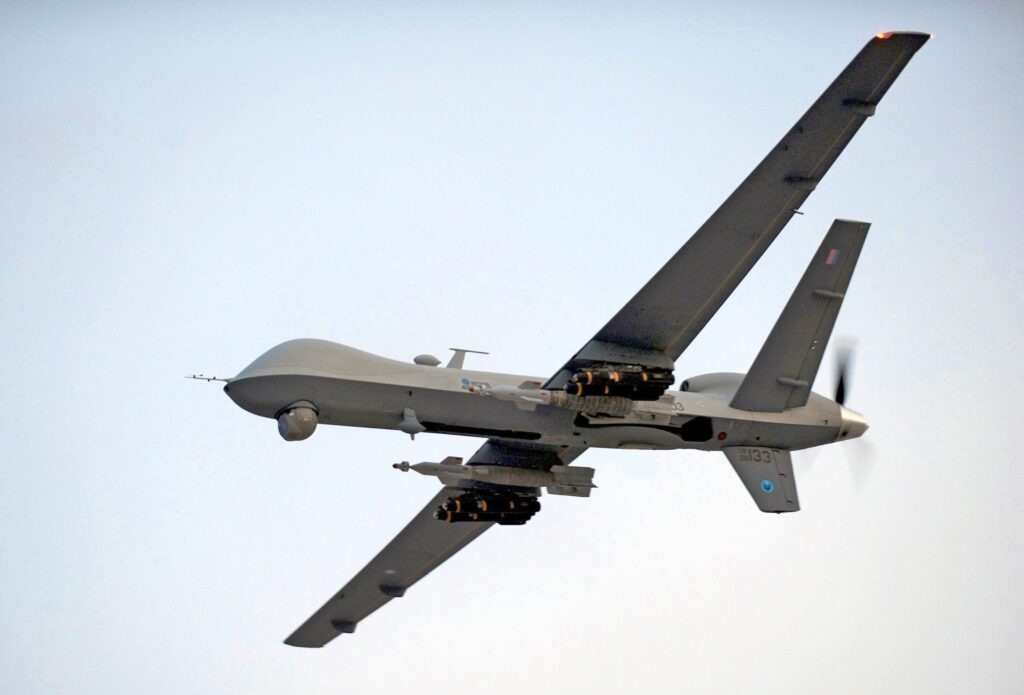
In 2025, 85 percent of Russian targets at the front were reportedly neutralized by drones, and roughly 70 to 80 percent of all Russian dead and wounded are estimated to have come from drone strikes. Yet the war in Ukraine has not been won by them. That is the central finding of a GIS Reports analysis, which argues that drones dominate tactics but not outcomes.
From maneuver to kill zones
Moscow began its invasion on February 24, 2022 with a classical offensive built on speed and surprise. By the end of 2022, after Ukraine drove the heavy, manned Russian forces out of the north and parts of the south, the war had turned static. Minefields and trenches made maneuver nearly impossible.
Drones did not break the deadlock in 2023. First-person-view (FPV) models arrived, but the lines stayed frozen, and for Ukraine the machines mainly made up for a shortage of soldiers and ammunition.
By the end of 2024 that had changed. Ukraine began counter-electronic warfare operations with fiber-optic drones that cannot be jammed, along with AI-enabled drones that find and strike targets on their own. Russia followed, setting up the Rubicon Center for Advanced Unmanned Technologies in August 2024. In February 2025 Ukraine launched the Drone Line Initiative, which pulled together its five most effective drone assault units.
The front now consists of kill zones 10 to 20 kilometers wide. Anything visible and moving can be destroyed. Small infiltrations by a few soldiers still happen, but they are too limited to turn tactical wins into operational or strategic gains.
Long-range strikes
Both sides also hit targets deep in each other’s territory. Russia combined drones with ballistic and cruise missiles against the defense-industrial base, energy infrastructure and civilian targets. At the beginning of 2026 it was fitting Shahed drones with cluster munitions and mines. The analysis says public morale has not broken and the defense industry has proved resilient.
NATO learns the lesson
Hedgehog 2025, an exercise in Estonia, involved 16,000 troops from 12 NATO countries. The opposing force was about 10 Ukrainians using their Delta system, which gave them a full picture of the battlefield. When British and Estonian units started to maneuver, Ukrainian drone specialists, some with real combat experience, destroyed them at once. The troops had hidden themselves poorly and ignored the main lesson from Ukraine: anything visible will be destroyed.
The analysis sees an upside for defenders. Drones, together with border fortifications and minefields, can force Russia into a static war. Estonia, Latvia and Lithuania are jointly building the Baltic Defense Line along their borders with Russia and Belarus.
Europe builds with Ukraine
In 2025, drones were seen over critical infrastructure, airports included, in 10 countries. An airspace violation in Poland in September 2025 led to NATO’s Operation Eastern Sentry. In February 2026 the European Commission put out a drone action plan, and member states were asked to test their 5G networks for early drone warnings. More than 350,000 5G base stations could act as one large radar system.
Ukraine’s industry has grown fast. Companies in the sector went from 41 in 2022 to 132 in 2023 and 183 in 2024. An estimated 4.5 million drones were produced in Ukraine in 2025, more than 2 million of them FPV drones. Exports have cautiously begun.
Joint ventures followed. Quantum Frontline Industries, formed in December 2025, links Germany’s Quantum Systems with Ukraine’s Frontline Robotics. In February 2026, four Ukrainian companies signed an 800 million-euro venture with manufacturers in Denmark and Lithuania. Russia’s Ministry of Defence responded in April 2026 with a published list of European drone makers and facilities it considers legitimate targets.




