
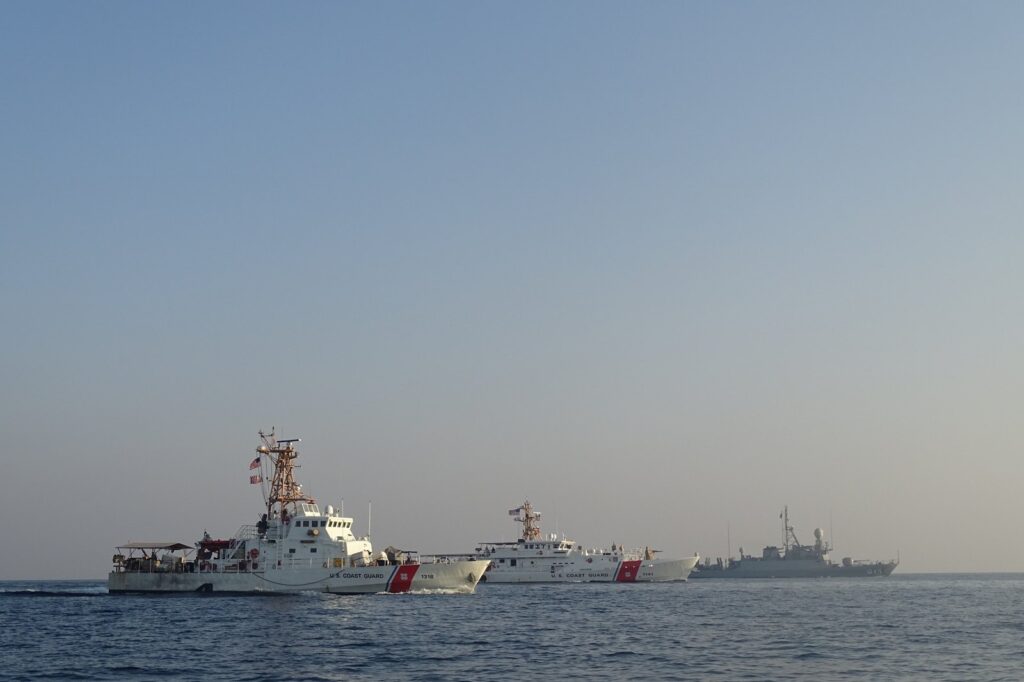
Record Number of Ship Attacks Reported in Hormuz
Twelve vessels were attacked between 5 and 11 October – the largest number of weekly strikes reported to the UK’s Maritime Trade Operations (UKMTO) agency since the US-Israeli war with Iran began. Six of the vessels were struck last Sunday, according to the UKMTO – a one-day high. Attacks have continued this week with the container ship GFS Pride sinking after a strike by an unknown projectile in the strait on Tuesday. Twenty-one crew were safely evacuated. Iran’s Islamic Revolutionary Guard Corps (IRGC) published footage of what appeared to be the same ship sinking. It said the vessel was carrying ‘2,500 containers of contraband’ and had taken an ‘unauthorised route’. Two crew missing after one of Sunday’s attacks… Eleven Indian seafarers were rescued but two are still missing, the Forward Seamen’s Union of India said. The sinking of Singapore-flagged GFS PRIDE marks a dangerous escalation after weeks of near-daily attacks on commercial shipping. Iran claims a naval mine; but a drone strike is more likely,” said former US Navy officer Charlie Brown, also a senior adviser for United Against Nuclear Iran.
How Iran Uses Drones and Proxies to Evade Patrols
Experts say Tehran has been attacking ships in an effort to assert greater control over the waterway as the US military has increased the number of tankers it is shepherding through the south of the strait to evade Iranian strikes. Iran is also carrying out more attacks on vessels further away from the Strait of Hormuz, according to experts. The aftermath of one of Sunday’s six reported attacks was captured in verified footage showing the Nicaragua-flagged tanker Petro Dolphin on fire, as filmed by the crew on a smaller boat nearby. The vessel was struck by a drone close to the Sohar Anchorage, Oman, more than 250km (150 miles) from the strait, according to the maritime intelligence firm Vanguard. Iranian state media Press TV reported that the ship had “hit a sea mine on an unauthorized route” – which experts cast doubt on, saying a drone attack was more likely. Videos verified by CNN show black smoke rising from the ship as it takes on water, while later footage and satellite images show cargo scattered in the water and a small oil slick.
Impact on Global Oil Flows and Shipping Costs
Only 4.147 million barrels of oil successfully transited the Strait of Hormuz on Monday – less than a quarter of pre-war levels, according to maritime data tracking service Kpler. The seven-day average of oil flow through Hormuz has dropped sharply since early October, Kpler’s data shows. About 12.6 million barrels per day went through the strait on 13 October, below the 15 million reported at the end of September, data from trade intelligence firm Kpler shows. This compares with a pre-war baseline of some 17 million barrels per day. Middle East oil exports have slowed as the number of ship strikes has risen. The recent increase in attacks comes as US Navy data indicates the number of vessels given assistance to navigate the Strait of Hormuz during the first 10 days of October was up 85% compared with Attacks have ramped up significantly since the end of September, once again reducing the amount of oil transiting out of the Middle East and raising oil prices around the world.
Limitations of Current US-Led Maritime Security Efforts
The US military’s Central Command… posted on social media that despite the attacks ‘commercial traffic continues to flow through the Strait of Hormuz with co-ordinated protection from US forces and regional partners’. The US military continues to enforce a blockade on Iranian ports to maintain economic pressure on Iran. To some extent, it’s worked: Iran’s eco However, the record number of attacks suggests that coordinated protection has not prevented strikes, particularly when they occur beyond the immediate strait or involve asymmetric tactics like drone strikes. Iran threatens to ‘expel’ US from region as Tehran links Hormuz reopening to troop exit. Iranian Army spokesman Mohammad Akraminia issued the warning on Friday, October 16, as President Donald Trump continued to portray Tehran’s military as severely weakened and ruled out using nuclear weapons in the conflict. Akraminia outlined Iran’s position in a post on X, arguing that a US withdrawal would allow shipping through the Strait of Hormuz to resume and enable regional countries to take collective responsibility for security.
Regional Responses and Risks of Escalation
“If America leaves the region, the Strait of Hormuz will reopen and collective security will be established with the participation of the region’s countries, and the global economy will improve,” he wrote. He followed that proposal with a threat directed at Washington: “If it doesn’t leave, we’ll expel it.” Akraminia also challenged the American assessment of Iran’s military strength. In remarks carried by Mehr News Agency, he said the country’s air defence capabilities had improved compared with their condition before and during the war, rejecting claims by Trump that US military action had severely weakened Iranian forces. Trump rules out nuclear weapons, weighs further strikes. Trump said he would not use nuclear weapons against Iran, even as reports emerged that US military planners had prepared options for renewed strikes on Iranian targets. In an interview with Newsmax on Thursday, Trump discussed the GBU-43/B Massive Ordnance Air Blast bomb, widely known as the “Mother of All Bombs”, stressing that the weapon was conventional rather than nuclear. “The mother of all bombs is not nuclear,” Trump said, describing it as an exceptionally large bomb. Trump what he’s thinking about dropping on Iran: “This is an extremely large bomb. It’s like a tiny nuclear bomb.” “I wouldn’t use nuclear. We don’t have to,” he added. Reports citing US officials said potential strike plans could involve Iranian nuclear sites and energy infrastructure, with operations considered for a period either before or after the November 3 midterm elections. Earlier, Trump had also argued that US military strikes had stripped Tehran of much of its ability to wage war. “They don’t have a Navy, they don’t have an air force, their army is decimated, their leaders are gone,” Trump told the crowd during a campaign rally in Montana on Wednesday, adding that Iran was no longer “the bully of the Middle East”.
What Comes Next for Commercial Shipping and Diplomacy
Many ask what response will the US Navy mount to Iran’s escalating attacks on global shipping,” he added. “But the real question is what response will other nations take? How long will the world tolerate this threat to shipping, seafarers and freedom of navigation?” The sinking of Singapore-flagged GFS PRIDE marks a dangerous escalation after weeks of near-daily attacks on commercial shipping. As the number of strikes has risen, the recovery in oil shipments through the strait seen last month has slowed, industry data suggests. BBC Verify collated incident reports published by the UKMTO on its website and created a timeline based on the first date cited in each report. This is approximate because some incidents use the date of the attack and some the date on which it was reported. So far this week, there have been four reported attacks. The previous week saw 10 ships reporting attacks. The number of ships that have reported being attacked in and around the Strait of Hormuz has hit a record high, BBC Verify analysis of data from a UK maritime agency shows.
Sources
- Two cargo ships sunk in Strait of Hormuz as Iran ramps up attacks in run-up to midterms | CNN
- Iran threatens to 'expel' US from region as Tehran links Hormuz reopening to troop exit
- Ship attack reports near Hormuz reach record high as oil exports slow
Photo: Culinary Specialist 2nd Class Bailey Redy, U.S. Navy (Public domain)




